A path into the reading
Wudang Mountain Fitness, Access and Safety
Physical demands, accessibility limits, weather risks and when to change the plan
Start here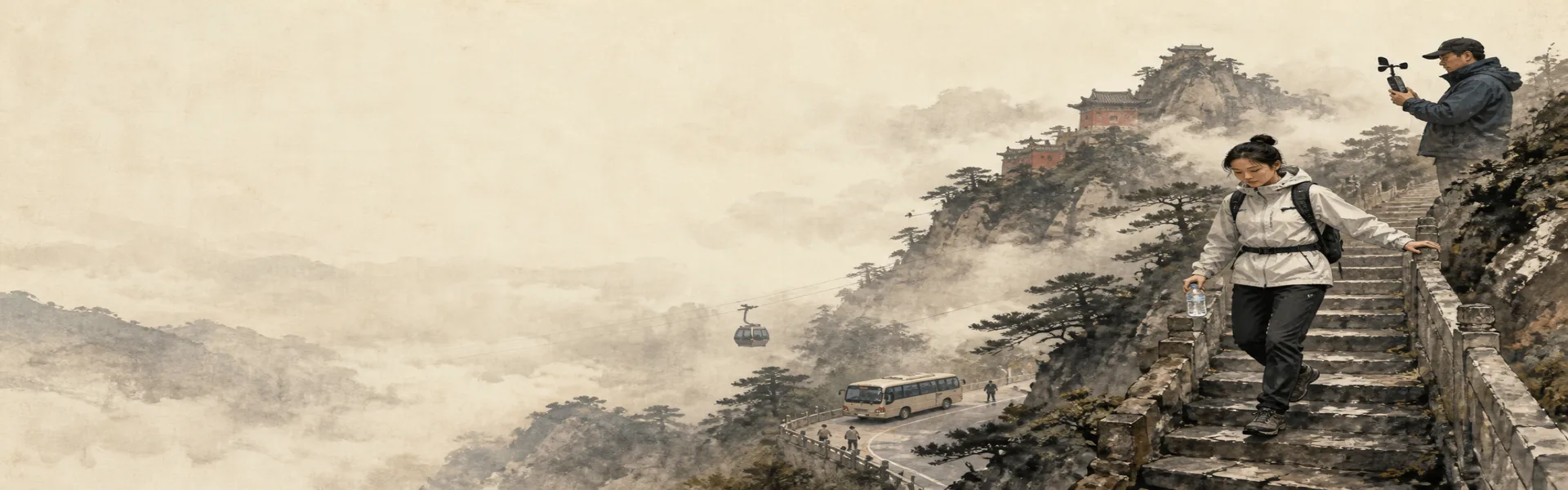
01 Find your bearings
How Physically Demanding Is Wudang Mountain?
A section-by-section guide to steps, gradients, route choices and who may struggle
Explore this sectionGo further
Deeper reading
The full guide
What should I know before reading further?
This sub-group is about how physically hard Wudang really is, what can be done if climbing is difficult or impossible, and what actually goes wrong here. It is written plainly because vagueness on this subject is unkind: people arrive having read that a cable car exists, discover a thousand stone steps, and have a miserable and occasionally unsafe day.
Read more The complete guide
This sub-group is about how physically hard Wudang really is, what can be done if climbing is difficult or impossible, and what actually goes wrong here. It is written plainly because vagueness on this subject is unkind: people arrive having read that a cable car exists, discover a thousand stone steps, and have a miserable and occasionally unsafe day.
Why this needs saying plainly
Most travel material about this mountain describes the scenery and the temples and treats the effort as a detail. The effort is not a detail. For a large proportion of visitors it is the defining feature of the day, and for some it is the reason a visit fails.
The core of a visit is climbing stone steps, repeatedly, over several hours, frequently in heat and humidity, on surfaces worn smooth and often wet. Mechanical transport covers part of the height and removes some of the climbing, but not the parts that matter most. Saying so in advance lets you plan a visit that suits you. Not saying it produces disappointment at best and injury at worst.
Two different questions, often confused
Separate two things that are constantly run together, because the answers are different.
The first question is whether you are fit enough to do the standard visit, meaning the ascending route including the summit. That is a question about repeated stair climbing over hours and on consecutive days, and about knees on the descent. It has nothing to do with athletic ability in the sporting sense; steady capacity with rests matters far more than speed or strength.
The second question is whether the site is accessible to someone with limited mobility, which is not the same question at all. Parts of Wudang are genuinely inaccessible and cannot be made otherwise without destroying the thing being visited. But other parts are much more manageable than people assume, and a well-chosen partial visit can be excellent rather than a consolation.
Confusing the two leads to two bad outcomes: unfit visitors attempting the summit because they are not disabled, and visitors with limited mobility staying away because they assume the whole site is stairs.
Altitude is not the issue
Worth stating clearly, because it comes up constantly. The summit is roughly sixteen hundred metres, which is not high enough to cause altitude sickness in ordinary circumstances. Nobody needs to acclimatise for Wudang.
What altitude does do is change the weather. The summit is markedly colder and windier than the town below, is inside cloud for a large part of the year, and can carry ice in winter. Those are real issues. Thin air is not.
The genuine physiological challenges here are ordinary ones: sustained exertion, heat and humidity in the warm season, dehydration, and cumulative fatigue over consecutive days. Plan for those rather than for anything exotic.
The real hazards
The things that actually cause problems on this mountain are unglamorous, which is why they are underestimated.
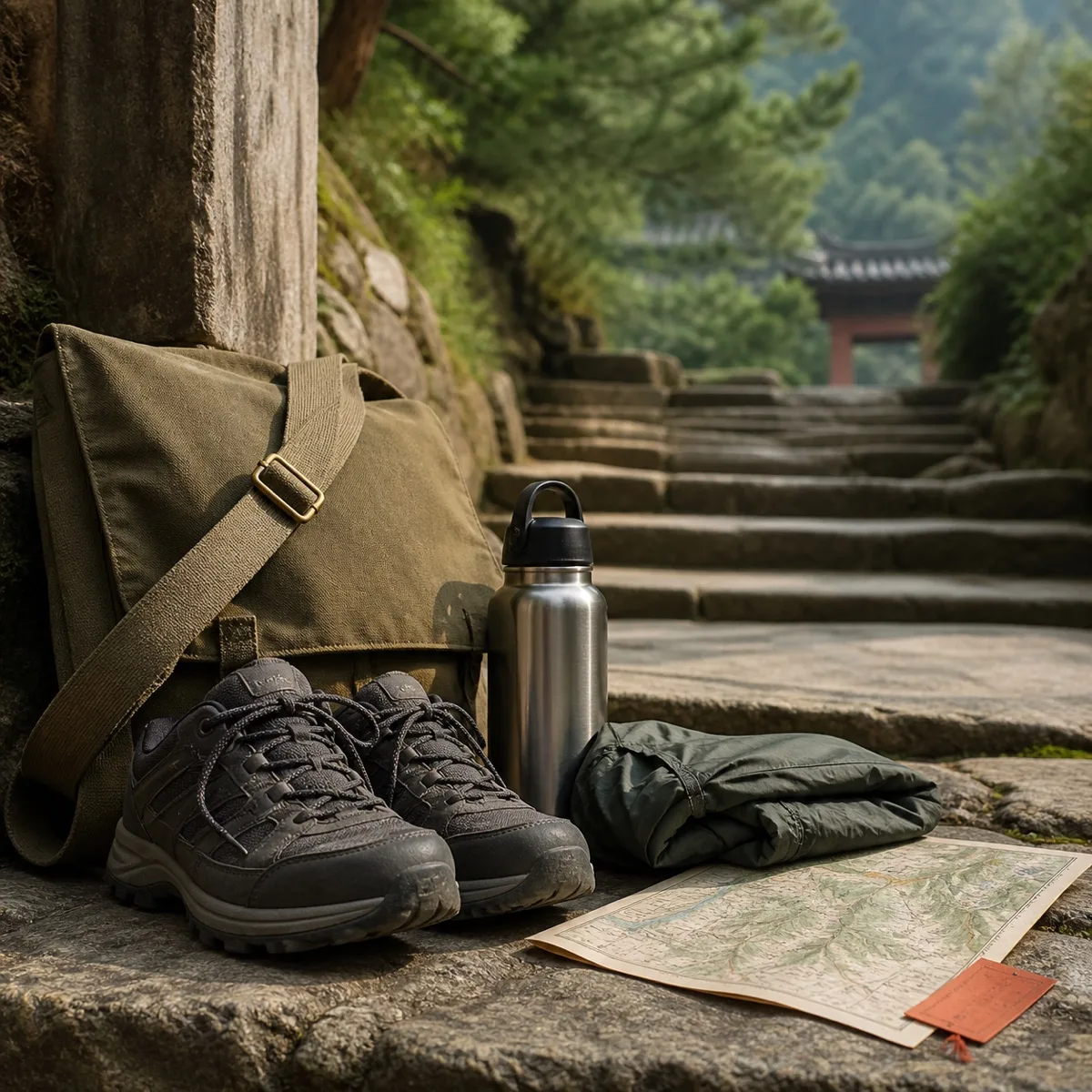
Slipping is first. Centuries of use have polished the stone, mist and rain keep it damp, and a stairway with a drop beside it is an unforgiving place to lose your footing. Footwear with genuine grip is a safety item, not a refinement.
Second is weather. Conditions at the summit can be substantially worse than at the base, they change quickly, and visibility can close in within minutes. Cold and wind at altitude affect people who set out in warm sunshine at the bottom.
Third is exposure. Some sections, particularly on the southern cliff and the summit approach, run close to long drops. They are railed and safe if treated properly, but they are not places to be distracted, hurried, crowded or looking at a phone.
Fourth is fatigue and its consequences. Most incidents on mountains of this kind happen to tired people descending, not to fresh people climbing. Fifth is heat and dehydration in summer. Sixth, and easily forgotten, is that help is slower to arrive here than in a city, which is the subject of the next section.
Descending is the underestimated part
Almost everyone plans for the climb and nobody plans for the descent, which is where knees, ankles and concentration fail.
Going down stone steps loads the knees far more than going up, uses muscles most people have not trained, and is where tiredness translates most directly into a slip. It is also mentally the point at which visitors relax and stop paying attention, having achieved what they came for.
Practical responses are straightforward. Keep something in reserve rather than spending everything on the ascent. Take the descent slowly and deliberately. Use handrails where they exist. Consider descending by a different and gentler route if one is available, or using mechanical transport downward even if you climbed up. Trekking poles help those who are used to them. And do not schedule the descent so late that you are doing it in poor light.
Access with limited mobility
An honest assessment, in two halves.
What is not realistically accessible: the summit, which requires steep stone stairways with no alternative; the southern cliff complex, whose internal circulation is narrow and stepped; and the historic stairways generally. No amount of assistance changes this, and a site of this kind cannot be re-engineered without destroying what it is.
What is more manageable than people expect: the great ruined palace near the foot of the range sits on essentially level ground and is one of the most interesting places on the mountain intellectually, so it is a genuine destination rather than a compromise. The palace associated with Zhang Sanfeng is also low and level. Parts of some mid-mountain complexes are reachable by vehicle with only short walks, though internal courtyards involve steps. The town at the foot is normal urban ground.
The practical advice is to plan a specific partial itinerary in advance rather than arriving hopefully, to ask locally about current provision because facilities change, and to consider bringing a companion, since assistance is not reliably available on site. A visit built around the level sites, with time to look properly, is a good visit. It is worth adding that many people with limited mobility find these quieter sites more rewarding than the crowded summit that others queue for.
The margin is thinner than in a city
This is a mountain with a large visitor operation on it, not a wilderness, and it is not dangerous in any dramatic sense. But the margin for error is narrower than in an urban environment and it is worth understanding why.
Distances are vertical, so reaching someone or moving them takes far longer than the map suggests. Some locations can only be reached on foot up stairs. Weather can prevent movement. Mobile coverage cannot be assumed everywhere, particularly in valleys and away from the main route. Medical facilities are in the town at the foot, not on the mountain. And crowds at the busiest points make rapid movement difficult in either direction.
None of this argues against going. It argues for modest, boring precautions: tell someone your plan, carry water and a phone, do not go far off the main routes alone, start early enough to finish in daylight, and turn back if conditions or your own condition deteriorate.
The judgement that matters most
If there is one thing to take from this sub-group, it is that the decision to stop is the one that requires judgement, and it is the one people get wrong.
Visitors have travelled a long way, paid for admission and transport, and often have only one day. All of that pushes towards continuing when continuing is a poor idea: when the weather has closed in, when a stairway is iced, when someone in the party is struggling, or when you are already tired and the descent still has to be done. The sunk cost is real but irrelevant to the decision in front of you.
Turning back is not a failed visit. The mid-mountain palace and the cliff complex are the best things here on any honest assessment, and both are lower and easier than the summit. Anyone who reaches those, understands what they are looking at, and comes down safely has had a better day than someone who reached the summit in cloud and was too exhausted to notice anything on the way down. If you have any doubt about a condition that exertion might affect, take advice from your own doctor before travelling rather than deciding on a stairway.
The two pages
One page covers the physical demands in detail, with realistic descriptions of what each part of the visit involves and how to build a plan around a given level of fitness. The other covers safety and access: hazards, weather, what to carry, options for visitors with limited mobility, and what to do if something goes wrong.
Sources and limits. This page describes the physical character of the site and general precautions; it is not medical advice and cannot account for individual circumstances. Anyone with a relevant health condition should consult a qualified practitioner before undertaking sustained exertion. Access provision, railings, safety works, transport and available assistance all change without notice, and conditions vary enormously with weather and season. Confirm current arrangements locally, and treat this as orientation only.
Key points
The effort is not a detail: repeated stair climbing over hours is the defining feature of a standard visit.
Fitness for the standard visit and accessibility with limited mobility are different questions with different answers.
At roughly sixteen hundred metres, altitude sickness is not a concern; altitude matters because of cold, wind and cloud.
The real hazards are polished wet stone, changeable weather, exposure, fatigue, summer heat and slow assistance.
Descent is the underestimated part, harder on knees than ascent and where tiredness causes slips.
The summit, the cliff complex and historic stairways are not realistically accessible; the level sites near the foot genuinely are.
The margin for error is thinner than in a city because distances are vertical, help is slow and coverage is patchy.
Knowing when to stop is the judgement that matters, and turning back after the mid-mountain sites is a good day, not a failure.
Recommended next page
Where next?
Wudang Mountain Weather and SafetyCommon risks, rapidly changing conditions and the point at which to turn backA few alternatives