How Physically Demanding Is Wudang Mountain?
游览武当山需要多少体力
Visitors ask how hard Wudang is and are usually given an unhelpful answer, either reassurance or exaggeration. The honest answer is that it is not technically difficult and it is physically substantial, that the two are different questions, and that the difficulty is almost entirely a matter of steps. This page describes what the climb actually consists of, who tends to struggle, and how to judge your own case.
What the climb actually consists of
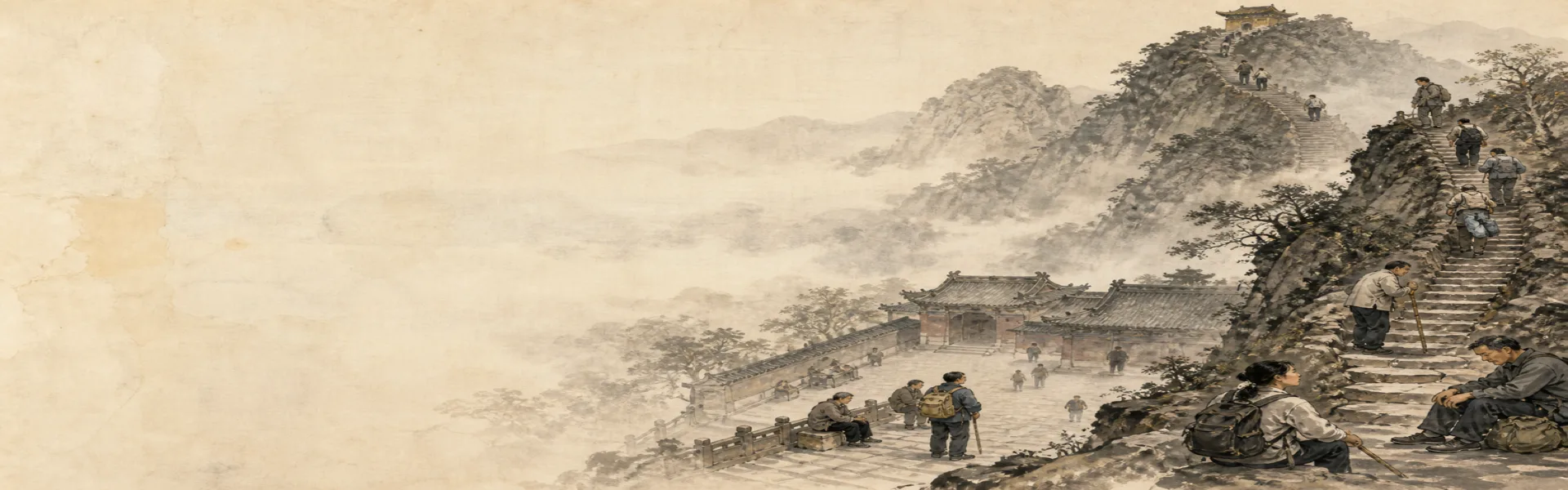
There is no scrambling, no exposure requiring hands, no route-finding and no equipment. Everything is on constructed stone paths and stairways, and the way is obvious throughout. In that sense it is not mountaineering and should not be described as such.
What it is instead is stairs, in quantity. Long flights, repeatedly, often steep, sometimes with drops beside them, on stone worn smooth by centuries of feet. The total number of steps in a full ascent is large by any ordinary standard, and even a visit that uses shuttles and the cable car involves a substantial number.
The character of the effort is worth naming, because it is different from hillwalking. Continuous stepping loads the quadriceps and the knees far more than a graded path does, it offers no rhythm to settle into, and it gives your legs no variety. People who walk long distances comfortably at home are frequently surprised by how specifically tiring stairs are.
The route is also stacked rather than spread. Because level ground is scarce, the complexes sit on terraces at different heights, so even moving around within a single site involves climbing. There is very little truly flat walking above the foot of the mountain.
Section by section
The difficulty is not evenly distributed, and knowing where it concentrates lets you plan around it.
The sites near the foot are the easiest. Yuxu Palace in particular is largely level and very large, and a visit confined to this zone involves ordinary walking rather than climbing.
The lower and middle complexes involve moderate climbing: flights of steps between terraces, and approaches that rise, but in manageable sections with places to stop. Most reasonably mobile visitors manage these without difficulty.
The middle to upper transition is where the effort steps up. The connecting sections are long, and this is where people who have overestimated themselves begin to realise it. It is also, not coincidentally, the part most often replaced by mechanised transport.
The cliff site involves stairs and narrow ways with drops beside them. The difficulty is moderate; the exposure is the notable feature, and it affects people with a fear of heights considerably more than it affects their legs.
The final approach to the summit is the hardest part and is on foot regardless of what you took to get near it. Steep, sustained, and at the end of a long day, which is a combination that makes it feel harder than its length suggests. Visitors who assume the cable car delivers them to the summit are consistently surprised here.
And then the descent, which is discussed below because it deserves separate treatment.
Difficulty and hazard are two different questions
Conflating these is the most common error in how this mountain is described.
Difficulty is how tired you will be. It is high in the sense of volume, and it is entirely predictable: more steps means more tired, and you can manage it by doing less.
Hazard is the chance of something going wrong, and it comes from three specific things rather than from the climb as a whole. Worn smooth stone, which is slippery when wet or foggy and is wet or foggy often. Drops beside the path at the cliff and in places on the upper sections. And fatigue, which is what turns a manageable surface into a fall.
The two peak at different times, which is the practical point. Difficulty peaks on the way up. Hazard peaks on the way down, when the surface is the same but your legs are tired, your attention has gone, and the light may be fading. Nearly every incident here happens on a descent.
The corollary is that managing difficulty and managing hazard require different actions. Difficulty is managed by doing less. Hazard is managed by footwear, by keeping your eyes on your feet rather than your phone, and by leaving enough time that you are not hurrying.
Altitude is not the issue
This needs stating plainly because visitors worry about it and the worry is misplaced.
The summit here is a little over one and a half thousand metres. Altitude sickness is not a realistic concern at that height for ordinary visitors, and the symptoms people report and attribute to altitude, headache, heaviness, breathlessness, are almost always dehydration, exertion or having skipped breakfast.
What altitude does affect is weather. It is cooler than the valley, sometimes markedly, wind is stronger, cloud sits on the upper mountain frequently, and conditions can change quickly. The gap between exertion on the climb and standing still in a stone hall at the top is where people get cold.
So the practical response to altitude is a warm layer and a waterproof one, not acclimatisation. Anyone who has been told they need to prepare for altitude at Wudang has been misinformed.
Note that this is a statement about typical visitors and not medical advice. If you have a cardiac or respiratory condition, the relevant question is about sustained exertion rather than about altitude, and it belongs with your own doctor.
Judging your own case
A few honest tests are more useful than any grading of the route.
The best predictor is stairs, not distance. If you can climb ten or fifteen flights of building stairs at a steady pace without needing a long recovery, you will manage the main route with rests. If that sounds difficult, plan a version of the visit that stops lower, and there is a good version.
Knees are the specific limiting factor here, more than fitness. Continuous descent on stone loads the knees heavily, and people with existing knee trouble frequently find the way down worse than the way up. If that is you, plan to descend by mechanised transport even if you climbed.
Weight carried matters disproportionately. Every item is carried up every flight, and visitors consistently regret their third layer of preparation. Leave luggage below.
Be honest about the day rather than the hour. Most people can climb a long flight of steps; the question is whether you can do it repeatedly for several hours and then descend safely. Judge the whole day.
And take the weather into account, since the same route in rain or fog is materially harder and slower than in dry conditions.
Access with limited mobility
This deserves a plain answer rather than an encouraging one.
The level sites near the foot genuinely are accessible, and Yuxu in particular is flat, extensive and among the most interesting places on the mountain. A visit confined to the foot is a real visit, not a consolation prize, and it includes the complex that explains most about how this institution actually worked.
The summit and the cliff cannot be made accessible without destroying what is visited. This is a statement of fact rather than an apology. The difficulty of arrival is part of what these places mean; the ascent was built as an ordeal with a meaning, and removing the ordeal would remove the thing.
Mechanised transport reduces the climbing considerably but does not eliminate steps, and the remaining sections include long flights. Current arrangements change, so ask on site rather than relying on anything published, including this page.
Plan the descent rather than the ascent. Getting up is a matter of determination; getting down is a matter of knees and tired legs, and it is where a plan that worked in the morning fails in the afternoon.
The margin is thinner than in a city
One structural point is worth understanding because it changes how you should treat small problems.
You are on a mountain, on stone stairs, some distance from a road, with managed transport that has a last service. If something goes wrong, whether a twisted ankle, a dizzy spell or simply running out of energy, the options available are fewer and slower than they would be in a town. There is no taxi where you are standing.
This does not make the mountain dangerous. It means that the sensible response to a minor problem is more conservative here than it would be at home. A slightly hurt ankle at the top of a long descent is a genuine difficulty rather than an inconvenience.
Practically: keep something in reserve rather than spending your last energy on the summit. Know roughly where you are on the route. Keep a charged phone. And do not be the last person on a section of stairs at dusk.
Build in a margin at the end of the day that feels excessive. An hour is not too much. Queues, a slower descent than planned, and a hall you did not want to leave all consume it.
Turning back is the skill
If there is one thing worth taking from this page, it is this.
Knowing when to stop is the judgement that matters on this mountain, and it is the judgement visitors are worst at, because stopping feels like failure and the summit feels like the point.
It is not the point. The summit is the destination and the substance is elsewhere: the working complex in the middle, the courtyards, the sculpture, the way the buildings sit on the ground. A visitor who stopped at the cliff and descended in good order has seen more, more attentively, than one who reached the summit exhausted and came down in fading light.
Set a turning-around time in the morning and honour it. This is standard practice on any mountain and it works here for the same reason: the decision made calmly at nine is better than the decision made tired at four.
And treat a stopped visit as a complete one. Wudang rewards standing still more than covering ground, so a shorter route walked attentively is not a diminished version of the visit. It is frequently the better one.
Sources and limits: this page gives general descriptions of terrain and effort, not measurements, and individuals vary widely. Route conditions, closures, transport arrangements and accessibility provisions change and must be checked locally. Nothing here is medical advice: statements about altitude concern typical visitors, and any question about your own fitness, knees, heart, breathing or medication belongs with your own doctor.
Key points
- There is no scrambling, exposure requiring hands, route-finding or equipment. The difficulty is stairs, in quantity.
- Continuous stepping is more specifically tiring than distance walking, and there is very little flat ground above the foot.
- Effort concentrates in the middle-to-upper transition and the final approach to the summit, which is on foot regardless.
- Difficulty and hazard are different. Difficulty peaks going up; hazard peaks coming down, and nearly every incident happens on a descent.
- Hazard comes from worn smooth wet stone, drops beside the path, and fatigue. Footwear, attention and time manage it.
- Altitude sickness is not a realistic concern here. Altitude matters for cold, wind and cloud, so bring layers rather than acclimatising.
- The best predictor is building stairs, not distance, and knees are the specific limiting factor.
- The level sites at the foot are genuinely accessible; the summit and cliff cannot be made so without destroying them.
- Your margin is thinner than in a city, so keep energy in reserve, keep a charged phone, and build in an hour at the end of the day.
- Knowing when to stop is the skill. Set a turning-around time and treat a shorter, attentive visit as complete.