Wudang Mountain Weather and Safety
武当山天气与出行安全
Wudang is not a dangerous place, and this page is not intended to make it sound like one. What it does is name the specific things that actually go wrong here, all of which are ordinary and predictable, and set out how to avoid them. Almost everything on this page reduces to footwear, attention and leaving enough time.
Wet stone and ice
This is the single largest hazard on the mountain and the cause of most incidents involving visitors.
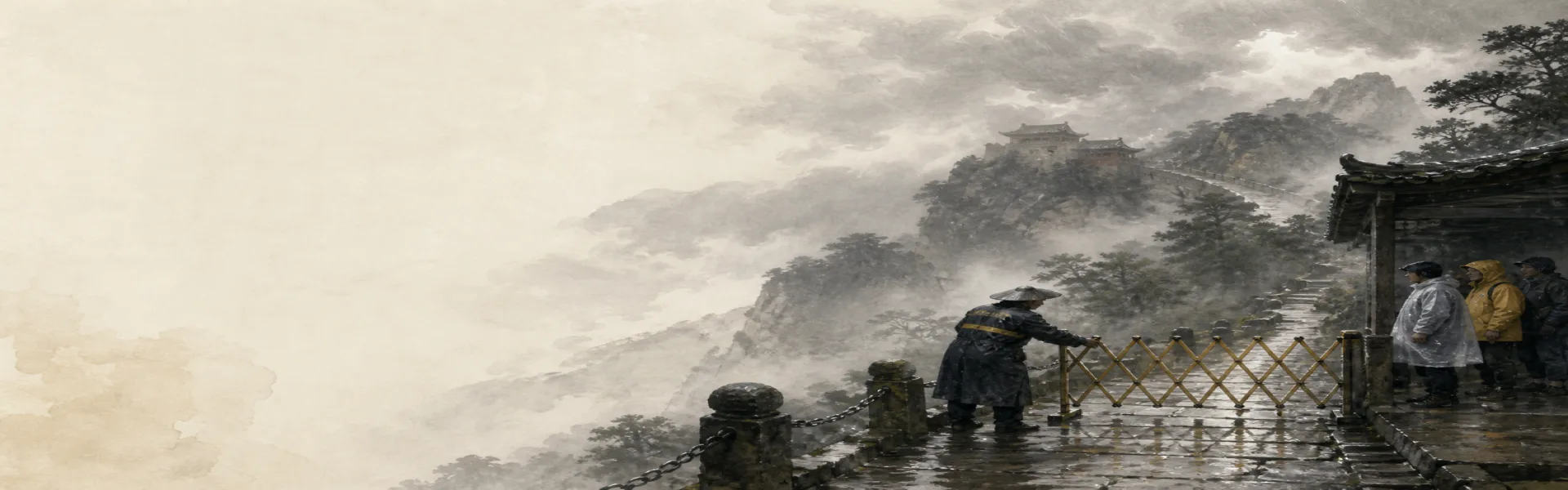
The stairways are stone, and a great deal of it has been worn smooth by several centuries of feet. Smooth stone is slippery when wet, and it is wet often: rain is frequent, cloud sits on the mountain and condenses on every surface, and steps in shade stay damp long after the sun has come out.
The single most effective protection is footwear with genuine grip. Not support, not cushioning, not lightness: grip. Smooth-soled shoes on smooth wet stone is the combination that produces falls, and no amount of care fully compensates for the wrong shoes.
Descent is where it happens. Going down, your weight is forward, your foot strikes at an angle, your legs are tired and your attention has usually wandered. Nearly every fall on this mountain is a fall on a descent, which is why the descent deserves more of your caution than the climb.
In winter, ice adds a different problem, because it is often invisible on stone and forms in shaded sections that look merely damp. Sections of the route may be closed for this reason, and where they are, the closure is not excessive caution. If you visit in deep winter, check conditions locally before committing to a summit attempt.
Practically: use handrails where they exist, take stairs at a pace that allows you to place each foot deliberately, and put your phone away while descending. Looking at a screen on worn wet steps is the most common self-inflicted risk here.
Fog
Fog is the defining weather feature of Wudang and it creates hazard indirectly rather than directly.
It makes every surface wet, which returns you to the problem above. It obscures drops, which matters at the cliff and in places on the upper sections, where the edge you would ordinarily see is simply not there. And it slows everything down, which is how a comfortable schedule becomes a rush at the end of the day.
It also disorients. Familiar landmarks disappear, distances become impossible to judge, and it is genuinely easy to lose your sense of where you are on the route even though the way itself is obvious.
The response is to slow down and shorten your plan rather than to press on. Fog arrives quickly and can persist for days, and it does not correlate reliably with rain, so a dry forecast is no assurance.
Do not use fog as a reason to leave the constructed path in search of a view. The paths exist because the terrain either side of them is not walkable, and in poor visibility that is not evident.
Thunderstorms
Thunderstorms occur, chiefly in the warmer months and often in the afternoon, and they are the one weather event here that warrants genuine caution rather than mere care.
The reason is position. On this mountain the exposed places are ridges, stairways on open slopes, the cliff, and the summit, and all of them are bad places to be in a storm. The summit in particular is a small elevated structure on the highest point of the range.
It is worth knowing that the summit was historically famous for a lightning phenomenon, and that lightning protection installed in the modern period reportedly brought that to an end. The relevant point for you is not the loss of a wonder but the reason it was famous: this is a place that is struck.
The practical response is to descend or shelter rather than continue. Get off ridges and open stairways, get inside a substantial building if one is available, and wait. Do not shelter under an isolated tree, and do not stand at the edge of anything.
Because afternoon storms are the pattern in the warm months, this is another argument for the summit being a morning objective. A visitor who reaches the top early has usually descended before the weather builds.
Heat and cold
Both are more likely to cause trouble here than any dramatic hazard, because both are gradual.
In summer, the valley is hot and humid and the climb is strenuous, which makes dehydration and heat exhaustion the realistic risks. Drink more than you think you need, carry a refillable bottle rather than a day's supply, use the shade where the route offers it, and slow down rather than pushing through. The headache and heaviness that visitors attribute to altitude are almost always this.
In cold weather, the specific problem is the transition between exertion and stillness. You climb, you sweat, then you stand in an unheated stone hall in wind and cloud and cool very fast. This is where people get genuinely cold, and it is entirely preventable with a warm layer carried for the purpose and put on before you feel cold rather than after.
Wind on the upper mountain makes cold considerably worse than the temperature suggests, and it is stronger at the summit than anywhere else.
Rain compounds both. A waterproof layer is worth more than any other single item you can carry here, because being wet in wind removes your ability to warm up at all.
Crowds as a safety matter
This is rarely discussed and is a real consideration on stairs.
At busy times the stairways carry heavy two-way traffic in confined spaces, sometimes with drops beside them. The specific risks are being jostled while on a step, having your view of your own feet blocked, and being pushed into a faster pace than you would choose.
Bottlenecks concentrate at the same places crowding does: transport stops, cable car stations, gateways and narrow sections at popular sites. These are the places to be deliberate rather than to hurry.
Practically: stand aside to let a group pass rather than trying to walk against it, keep to one side and hold a handrail on busy flights, and do not stop suddenly on a stairway. If a section is genuinely congested, waiting a few minutes usually clears it.
The general remedy is the same one that improves the visit for every other reason: go early, and go a few minutes' walk away from the transport stops. Both reduce crowding dramatically.
Before you go up
A short list of preparations, all of which take minutes and prevent most difficulties.
Establish the time of the last internal service down, at the entrance, on the day. This is the most consequential operational fact of your day and the one visitors most often discover too late. Missing it means walking down in fading light on worn stone with tired legs.
Check whether the cable car is operating and whether any section is closed. Both change with weather and maintenance.
Charge your phone and bring a means of charging it. It is your map, your translation, your camera and your way of contacting anybody.
Carry water, something that would function as a meal, a warm layer, a waterproof layer, sun protection and any medication you need. Leave everything else below.
Tell somebody your plan if you are walking alone, particularly out of season when sections of the route may be very quiet.
And check that your insurance covers what you are doing, including medical evacuation, since the nearest capable hospital is not on the mountain. Read the exclusions rather than the summary.
If something goes wrong
The general principle is that your options here are fewer and slower than in a town, so respond earlier than you would at home.
If you are hurt, stop immediately rather than continuing to a more convenient place. Continuing on a hurt ankle or knee is how a minor injury becomes an evacuation, and there is no taxi where you are standing.
Get off the stairway. Move to a landing, a terrace, a courtyard or any level place out of the flow of people, and then assess.
Find staff. Scenic area staff manage the site and are the appropriate people for an incident: they know where you are, what transport is available and how to get help. Temple staff and clergy will also help. Do not spend a long time trying to solve it yourself first.
Know where you are, at least roughly, in terms of the nearest named site. This is the single most useful piece of information you can give anybody.
If you are separated from a companion, agree in advance what you will do. Fog and crowds both separate people, and a plan settled at the entrance is worth a great deal more than an improvised search.
For anything beyond minor, seek medical attention rather than judging it yourself. Nothing on this site is medical advice, and a decision that seems reasonable while tired on a mountain frequently looks different afterwards.
Turning back
This is the last section because it is the most important, and it is the judgement visitors are worst at.
Set a turning-around time in the morning and honour it regardless of how close you feel to the top. This is standard practice on any mountain and it works here for the same reason: a decision made calmly at nine is better than one made tired at four.
Turn back if the weather has changed, if a section looks worse than you expected, if you are more tired than the halfway point should have made you, or if you are hurrying. Hurrying is the reliable signal that the plan has already failed.
Remember that the summit is the destination and not the substance. The working complex in the middle of the mountain, the courtyards, the sculpture and the way the buildings sit on the ground are what this place is. A visitor who stopped at the cliff and descended in good order has had a better day than one who reached the top exhausted and came down in the dark.
Knowing when to stop is the skill this mountain actually asks for. Everything else on this page is a detail by comparison.
Sources and limits: this page describes general hazards and precautions, not current conditions. Route closures, weather, ice, cable car operation and the time of the last service change and must be checked locally on the day. Notices and instructions on site always take precedence. Nothing here is medical advice; injuries, existing conditions and fitness to undertake a long day of steps are matters for your own doctor, and insurance terms must be confirmed with the insurer.
Key points
- Worn smooth wet stone is the largest hazard, and footwear with real grip is the single most effective protection.
- Nearly every fall happens on a descent, so the way down deserves more caution than the way up.
- Put your phone away while descending. Looking at a screen on wet steps is the commonest self-inflicted risk here.
- Fog wets surfaces, hides drops, disorients and slows you down. Shorten the plan rather than pressing on, and never leave the path.
- Thunderstorms warrant genuine caution: get off ridges, open stairways, the cliff and the summit, which is a place that is struck.
- Afternoon storms in warm months are another reason the summit is a morning objective.
- Heat causes dehydration; cold catches you in the transition from climbing to standing still. Carry water, a warm layer and a waterproof layer.
- Crowds are a stairway hazard. Stand aside, hold handrails, do not stop suddenly, and go early and away from transport stops.
- Before going up: confirm the last service down, check closures, charge your phone, and check that insurance covers medical evacuation.
- If hurt, stop at once, get off the stairway, find staff, and know roughly where you are. Set a turning-around time and honour it.