Getting Around Wudang Mountain
如何在武当山景区内出行
Movement inside the protected area is a managed system rather than a matter of your own arrangements, and understanding its structure is the difference between a day that works and a day spent waiting. This page describes how the pieces fit together. It contains no times, fares or frequencies, because those change and a stale figure is worse than none. Confirm current arrangements at the entrance on the day.
Why your own vehicle stops at the gate
The first thing to understand is that you do not drive up this mountain, and neither does anybody else.
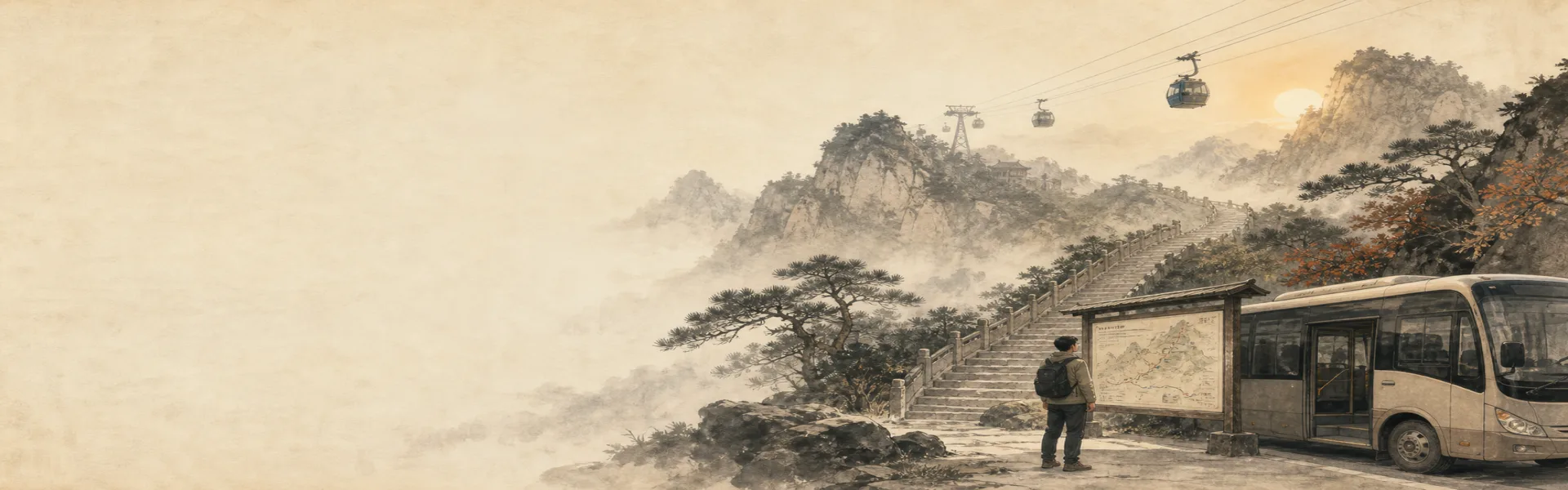
Private vehicles stop at the entrance to the protected area. Beyond that point, movement is by the managed internal transport system, on foot, or by cable car where one operates. This is standard practice at Chinese scenic and heritage areas and it applies regardless of whether you arrived by car, taxi or coach.
The reasons are straightforward and worth knowing because they explain the rest of the system. The roads are mountainous and narrow, the site is heavily visited, the buildings are protected, and unmanaged traffic would be both dangerous and destructive. Concentrating movement into a controlled fleet is the only way a site of this shape absorbs the number of people who come.
The practical consequence is that the flexibility of having your own vehicle disappears at the gate. You are on the system's schedule from there on, and planning around that schedule rather than against it is the single most useful thing you can do.
The shuttle buses
Internal shuttles are the backbone of the system and how most visitors move between the main sites.
They run on fixed routes between the entrance and the principal stopping points, with the major complexes served as nodes along the line. The service is frequent in season and less so out of it, and it is busiest in the middle of the day, which is another reason to start early.
Two structural points matter more than any timetable. First, the shuttles follow the mountain's road, which means the sequence in which you can visit places is largely fixed by where the road goes. You are not free to plan an arbitrary route. Second, the stops are the crowd nodes. Crowding at Wudang is concentrated at the points where transport delivers people, so the experience improves dramatically a few minutes' walk away from any stop.
Practically, treat each stop as a decision point. Get off, walk in, take as long as you want, come back to the same point. Trying to be clever about combining stops in one direction usually produces a worse day than following the line in order.
Luggage on shuttles is a common friction. They are not designed for large cases, they are crowded, and you will be getting on and off repeatedly. This is the practical argument for leaving anything substantial at your accommodation.
The cable car
A cable car operates on part of the route and changes the arithmetic of a visit considerably.
What it does is remove a long section of climbing near the top. What it does not do is remove all steps: the sections at either end still involve stairs, and the final approach to the summit is on foot regardless. Visitors who assume the cable car delivers them to the summit door are consistently surprised.
It is also weather-dependent. Cloud, wind and ice can suspend operation, and this happens often enough that it should be in your plan rather than a surprise. If the cable car is your route up and it stops running while you are above it, you are walking down.
Queues concentrate at the cable car more than anywhere else on the mountain, and they are worst in the middle of the day and in peak season. The queue at the bottom in the morning and the queue at the top in the afternoon are the two pinch points of the whole day for most visitors.
Whether to use it is a real choice. Taking it saves energy and time and skips the section that carries much of the explanation of how the buildings relate to the terrain. Walking that section is more rewarding and costs you a large fraction of your day. Most people should take it up and consider walking part of the way down, since descent is where the views are anyway.
Walking
Walking is not merely the fallback; on this mountain it is where a good deal of the point is.
The stone paths and stairways between complexes are the part of the site where the relationship between architecture and terrain becomes legible. Builders here fitted structures to the ground rather than levelling the ground for the structures, and that decision is visible on the connecting routes in a way it is not from a bus window.
Be realistic about the surface. You will be on stone steps, many worn smooth by several centuries of use and frequently wet. Grip matters more than anything else in your footwear, and the descent is where accidents happen rather than the climb.
Be realistic about the quantity. Even a visit that uses shuttles and the cable car involves a substantial number of steps, and a visit that walks the connecting sections involves a great many. Long flights are the norm rather than the exception.
The sensible compromise for most visitors is mechanised where it saves the most, on foot where it reveals the most. That usually means riding the long transit sections and walking within and immediately around each complex, plus one connecting stretch chosen deliberately.
The last service down
This is the single most important operational fact on the page and the one visitors most often discover too late.
Internal transport has a last service, and it is earlier than most people assume. Missing it does not mean waiting; it means walking down, in fading light, on worn stone, on legs that have already done a full day. Every year visitors do this.
So plan the day backwards from the last service rather than forwards from the entrance. Establish when it is on the day you are there, at the entrance, from staff, rather than relying on anything published in advance including this site. Then work out where you need to be and when, and build in a margin, because you will be slower at the end of the day than you think.
The margin should be larger than feels necessary. Queues at the cable car in the afternoon, a slower descent than planned, and a hall you did not want to leave all consume it. An hour of margin is not excessive.
The corollary is that the summit is a morning objective, not an afternoon one. Attempting it late is how people end up racing a clock down a mountain, which is both unpleasant and the least safe thing a visitor here does.
Luggage and what to carry
What you carry affects the day more than visitors expect, because you are carrying it up steps.
Leave anything substantial at your accommodation. If you are staying on the mountain, take a small bag up and leave the rest below. If you are visiting for the day, use whatever left-luggage arrangement exists rather than carrying a case around a mountain.
Carry water and a way to refill it, small cash notes, sun protection, a light waterproof layer, something to eat, a charged phone and a means of charging it, and any medication you need. That is the whole list, and it is short deliberately.
Leave heavy camera equipment behind unless photography is the actual purpose of the trip. The gains are small and the cost over several hours of stairs is not.
Weight compounds. Every additional item is carried up every flight, and visitors consistently regret the third layer of preparation rather than the second.
Building a day that works
Putting the pieces together, a well-shaped day has a recognisable structure.
Start at the entrance early, before the middle-of-the-day congestion builds. Establish the last service time before you go in. Move up the mountain in sequence rather than by convenience, since the road largely dictates this anyway and the ascending order is also the meaningful one.
At each node, get off and walk in. Spend your time inside complexes rather than in transit, and take the few minutes' walk away from any stop that separates you from the crowd.
Put the summit early if you want it, and make the decision about it in the morning rather than in the afternoon. Give the largest single share of your day to the complex that most rewards standing still rather than to the one furthest up.
Then descend with margin, deliberately, rather than being pushed down by a timetable. A day that ends unhurried at the entrance with light to spare is a better day than one that ends with a summit photograph and a run for the last bus.
Sources and limits: this page describes the structure of internal transport and deliberately contains no times, fares, frequencies or last-service details, because these vary by season and change without notice. Current arrangements, cable car operation, closures and the time of the last service must be confirmed at the entrance on the day. Notices and instructions on site always take precedence. Anything concerning your own fitness for a long day of steps is a matter for your own doctor.
Key points
- Private vehicles stop at the entrance. Beyond it you move by managed shuttle, cable car or on foot.
- The shuttles follow the mountain's road, so the sequence of your visit is largely fixed. Plan with the line rather than against it.
- Crowding concentrates at transport stops, so a few minutes' walk from any stop transforms the experience.
- The cable car removes a long climb but not all steps, and the summit approach is on foot regardless.
- The cable car is weather-dependent and suspends often enough that it belongs in your plan, not as a surprise.
- Consider taking it up and walking part of the way down, since descent is where the views are.
- Walking the connecting sections is where the relationship between architecture and terrain becomes legible.
- Plan the day backwards from the last service down, confirm its time at the entrance, and build in an hour of margin.
- The summit is a morning objective. Attempting it late is how visitors end up racing a clock on worn stone.
- Leave luggage below, carry a short list, and remember that every item is carried up every flight.