How to Reach Wudang Mountain
如何前往武当山
Wudang sits in northwestern Hubei, inland and away from the major coastal hubs, which means reaching it is a two-stage problem: getting to the region, then getting from the regional transport point to the mountain. This page describes the structure of the options rather than the schedules. No times, fares or journey durations appear here, because they change and a stale figure is trusted more than it deserves. Check current services close to the time.
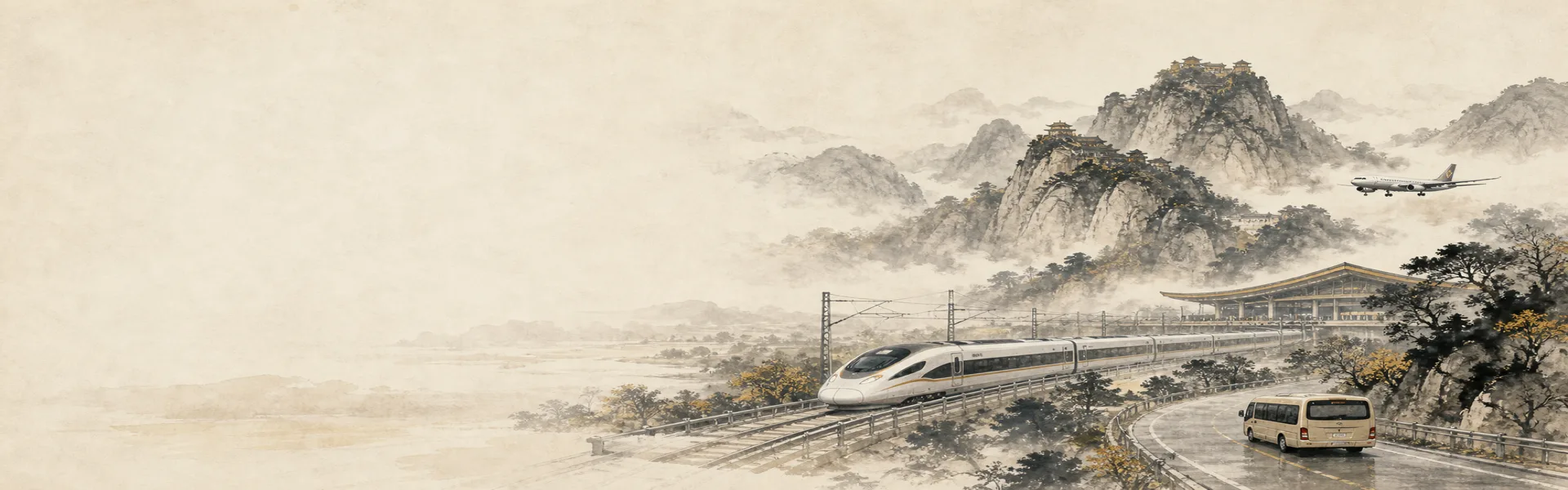
By high-speed rail
High-speed rail is the option that has changed access to Wudang most in recent years, and for most visitors it is now the sensible default.
The network reaches the area, and there is a station serving the mountain directly, which removes the long road transfer that used to define the journey. Trains connect the region to the major national hubs, and connections through the larger interchange cities are generally straightforward.
The structural advantages are worth stating because they are not obvious to visitors accustomed to flying. High-speed rail in China is punctual, frequent, comfortable and lands you in the middle of things rather than at an airport on the periphery. For a journey of this length it is usually competitive with flying once airport transfers at both ends are counted, and it is far less vulnerable to weather.
Booking is the part that catches foreign visitors. Tickets are sold through the national system, they are released on a fixed schedule in advance rather than continuously, popular services sell out, and buying requires identity documents. For a foreign passport the process is workable but is not the same as buying a local ticket, so allow more time than you would expect and do it before you travel rather than on arrival.
One practical note: confirm which station your service uses. The region has more than one railway station and they are not interchangeable, and arriving at the wrong one is a genuinely time-consuming mistake.
By conventional rail
Conventional trains still serve the region and remain useful in specific situations.
They reach places the high-speed network does not, they run overnight, and they are cheaper. An overnight sleeper converts travel time into sleeping time and can be the most efficient way to arrive if your origin is a long way off and your schedule is tight.
The trade-offs are real. Journeys are considerably longer, comfort is lower, and punctuality is less reliable. Sleeper berths on popular routes sell out well in advance and the better classes go first.
This option suits travellers who are already using conventional rail elsewhere in China, or who are arriving from a direction the high-speed network serves poorly. For most people coming from a major hub, high-speed rail is simply better.
By air
There is an airport serving the area, and flying is worth considering if you are coming from a long way inside China or have limited time.
The advantages are speed over long domestic distances and a straightforward booking process for foreign visitors, since air ticketing is more familiar and less document-dependent than the rail system.
The disadvantages are the usual ones and they matter more here than they might elsewhere. Routes are fewer and less frequent than to a major city, connections often require a hub, and you still have a transfer from the airport at the far end. Weather causes disruption, and cloud in this region is common.
The practical comparison is not flight time against train time but door to door against door to door. Once you count getting to an airport, checking in, and transferring at the other end, high-speed rail wins for a great many journeys that look faster by air on paper.
By road
Long-distance buses serve the region, and driving is possible for residents or those with the appropriate licence arrangements.
Buses are useful for connections from smaller places in the region that rail does not serve well, and they are inexpensive. They are slower, less comfortable, and their timetables are harder for a foreign visitor to research in advance.
Driving yourself is the option most often overestimated. A foreign driving licence is generally not sufficient in China, and the arrangements required take time to organise. Beyond that, the roads in the area are mountainous and busy in season.
The point that surprises people most is this: your own vehicle does not take you up the mountain anyway. Private vehicles stop at the entrance, and internal transport within the protected area is managed. So the flexibility that makes driving attractive elsewhere buys you less here than you would expect.
The last leg
Whichever way you reach the region, there is a final stage from the transport point to the town at the foot of the mountain, and then a separate stage from the town into the protected area.
These are different problems and conflating them causes most arrival difficulties. Getting to the town is ordinary local transport: taxis, local buses, or a transfer arranged by your accommodation. Getting into the mountain area is a managed system with its own entrance, ticketing and internal shuttles, described on its own page.
Arranging the transfer through your accommodation is worth the small premium if you are arriving late, arriving without Chinese, or arriving with luggage. It converts an uncertain problem into a solved one at the point in the journey when you are least equipped to deal with uncertainty.
Have the name and address of where you are staying written in Chinese characters, on paper as well as on your phone. This solves a problem that arises far more often than visitors expect and costs nothing to prepare.
Arrive the night before
This is the single most useful piece of advice on the page, and it applies regardless of how you travel.
Arrive in the area the evening before you intend to go up the mountain. Then your first day on the mountain starts early, which is the single largest improvement available to a visitor: quiet halls, better light, the day's first service possibly under way, and no coach groups.
A same-day arrival, by contrast, puts you at the entrance in the middle of the day, at the worst hour, having already spent your energy travelling. It also removes all margin. A delayed train, a missed connection or weather turns a tight plan into a lost day.
The corollary applies at the other end. Do not plan to descend the mountain and catch a long-distance service the same afternoon unless you enjoy watching a clock. Descent takes longer than people expect, it is the harder half on tired legs, and the internal transport has a last service that is earlier than you would assume.
If your schedule allows only one buffer night, put it at the start rather than the end. Arriving rested is worth more than leaving unhurried.
A note for foreign visitors
A few structural points apply specifically to foreign travellers and are better known in advance.
Entry to China requires permission appropriate to your nationality and purpose, arrangements change, and short and long stays differ in kind. Confirm current requirements with the Chinese embassy or consulate responsible for your country, and do it early. Nothing on this site is a statement of current rules.
Payment is the practical difficulty most consistently underestimated. Everyday transactions in China run overwhelmingly through domestic mobile payment applications, foreign card integration varies and works better in cities than in small towns, and cash is increasingly awkward for small purchases. Resolve how you will pay before you need to, and carry some cash in small notes regardless, because donation boxes and small stalls take nothing else.
Registration of where you are staying is an ordinary legal requirement in China rather than something aimed at foreigners. Hotels handle it automatically. If you are staying somewhere informal, ask.
Language falls away as a problem more than expected on the transport network, where systems are visual and increasingly bilingual, and more than expected in the town, where it is not. A translation application, a charged phone and your address in characters cover almost everything.
Finally, connectivity. Some services you may rely on at home are not accessible in China, and mapping and translation tools you intend to use should be tested before you depend on them for finding a hotel at night.
Sources and limits: this page describes the structure of transport options and deliberately contains no schedules, fares, journey times or station details, because these change and stale figures mislead. Current services, ticketing rules, entry requirements and driving arrangements must be confirmed with the relevant operators and with the Chinese embassy or consulate responsible for your country. Nothing here is legal advice.
Key points
- Reaching Wudang is two problems: getting to the region, then getting from the transport point to the mountain.
- High-speed rail is now the sensible default for most visitors, and a station serves the mountain directly.
- Rail booking catches foreign visitors: tickets release on a schedule, sell out, and require identity documents. Buy before you travel.
- Confirm which station your service uses; the region has more than one and they are not interchangeable.
- Conventional overnight trains suit long approaches and tight schedules; flying suits long domestic distances but loses time in transfers.
- Driving buys less than expected, because private vehicles stop at the entrance and internal transport is managed anyway.
- Arrange the final transfer through your accommodation if arriving late, without Chinese, or with luggage.
- Carry your accommodation's name and address in Chinese characters, on paper as well as on your phone.
- Arrive the night before. It buys you an early start, which is the largest single improvement available, plus margin against delay.
- Confirm entry requirements with the embassy early, resolve payment before you need it, and carry small cash notes.