How to Identify Deities in Wudang Temple Halls
如何辨认武当宫观殿内神像
Being able to name the figure on an altar changes a visit more than any other single piece of preparation. Without it you are walking past a series of similar rooms; with it you are reading a hierarchy that the whole mountain is arranged to express. This page gives a method rather than a catalogue, because a handful of visual markers covers the great majority of what you will see.
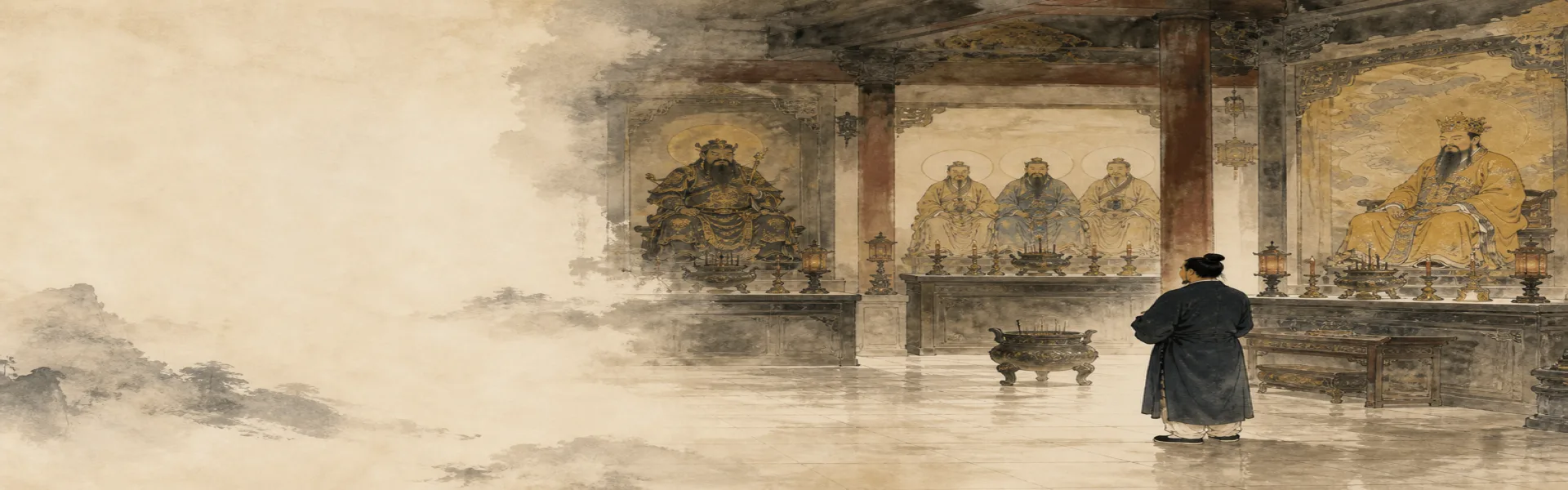
A quick method
Four questions, asked in order, will identify almost anything you meet.
First, where is it? The central figure of a hall sits at the back, on the axis, facing the door. Anything at the sides is subsidiary, and anything near the entrance is usually a guardian rather than an object of devotion. Position tells you rank before you have looked at the face.
Second, what is it wearing and holding? Dark robes and a sword point to Zhenwu. Formal robes with a tablet or a sceptre and an imperial cap point to the Jade Emperor. Three seated figures dressed alike point to the Three Pure Ones. A red-faced armed figure at the door is a guardian.
Third, what is at its feet or beside it? This is the most reliable single test, because the attributes are consistent. A tortoise and a snake mean Zhenwu, with near certainty.
Fourth, what do the words say? The board above the altar and the couplets on the columns almost always name the figure or the hall, and reading even one character often settles it. This is the step visitors skip, and it is the one that works when the sculpture is ambiguous.
Applied in that order, the method resolves most halls in a few seconds, which leaves you free to look at the thing properly.
Zhenwu, the figure the mountain is about
Zhenwu accounts for the majority of what you will see, so learning him first does most of the work.
The markers are consistent and easy. He wears dark robes, often black or very deep blue. He carries a sword, held or set beside him. He is frequently barefoot, with hair loose or partly unbound rather than formally dressed. A tortoise and a snake, sometimes intertwined, appear at his feet or nearby. He is usually seated, and usually large.
The bare feet and loose hair are worth pausing on, because they are unusual and deliberate. A god of this rank would normally be shown in full formal dress. The unbound hair and bare feet mark him as an ascetic who achieved his position through cultivation on this mountain, not as an official who was appointed to it. The image is making an argument.
His history is worth knowing because it explains the inconsistencies. He began as Xuanwu, the Dark Warrior, an abstract emblem of the north rather than a person: a direction, a season, a colour, and the tortoise and snake as its animal sign. Over centuries the emblem acquired a biography, a face and a cult. The name changed to Zhenwu in the eleventh century to avoid a Song imperial naming taboo, which is why both names appear in older inscriptions.
Two corrections are worth carrying. He is not the highest god, and the sword is not a fencing reference. It is a ritual instrument, the implement of a figure whose portfolio includes subduing malign forces, and it has no connection to martial arts instruction despite the association most visitors bring with them.
The Three Pure Ones
Where you see three seated figures of equal size, dressed alike, arranged symmetrically at the back of an important hall, these are the San Qing, the Three Pure Ones, and they are the highest deities of the Taoist pantheon.
They are usually distinguished by what they hold rather than by face or dress, and the attributes vary between temples, so identifying them individually is not necessary and is often not possible from the visitor's floor. What matters is recognising the group.
The reason it matters is hierarchy. If a complex contains both a Three Pure Ones hall and a Zhenwu hall, the Three Pure Ones outrank him, and their hall's position and scale will usually show it. Noticing this is what stops Wudang looking like the centre of Taoism rather than the mountain of one very important god.
They are also the clearest case of a figure you will see and not meet, in the sense that the cult here is not primarily addressed to them. Their presence is structural: a complete Taoist establishment includes them because the pantheon has an apex, whether or not local devotion is directed there.
The Jade Emperor
Yu Huang, the Jade Emperor, is shown as an emperor, and that is the identification: full formal imperial dress, a flat-topped imperial cap, a tablet or sceptre held in both hands, seated in state, often flanked by attendants holding regalia.
He ranks above Zhenwu and below the Three Pure Ones, occupying the position of a ruler in a bureaucracy rather than an abstract principle at its origin. The distinction is meaningful: the Three Pure Ones are cosmic, the Jade Emperor governs.
This is the point at which the whole pantheon becomes legible, and it is worth stating plainly, because it explains almost everything about how these halls are arranged. The Taoist pantheon is organised like an imperial administration. There is an apex that does not administer, a ruler who does, and officers with defined portfolios who handle particular matters. Zhenwu is an officer, a very senior one, and his portfolio includes the north, warfare and the suppression of malign forces.
Once you see the scheme, the layout of a complex reads as an organisational chart, and a visitor who grasps that gets more out of Wudang than one who has memorised names.
Wang Lingguan, the one at the door
The fierce armed figure near an entrance, commonly red-faced, sometimes with three eyes, holding a whip or a mace, is Wang Lingguan, the most frequently encountered Taoist guardian.
His position is functional rather than honorific. Guardians stand at thresholds because a threshold is where protection is needed, and their frightening appearance is the point. They are not being worshipped in the way the figure at the back of the hall is; they are working.
Guardians in pairs flanking a gate follow the same logic. If you meet two large aggressive figures facing each other across an entrance, you are at a boundary, and the important hall is further in.
This is useful navigationally as well as devotionally. Guardians mark transitions, so encountering one tells you that you are crossing from a less important zone into a more important one, which is the same information the axis gives you by other means.
Others you will meet
A handful of further figures recur and are worth recognising.
Taishang Laojun is Laozi in deified form, shown as a serene elderly figure, often white-bearded, sometimes with a fan or a scroll, seated calmly. He is a major deity rather than a philosopher in this context, and the hall is not about the book.
The Eight Immortals, Ba Xian, appear constantly in decoration: carved panels, painted beams, ceramic ornament. They are identified by their attributes, a fan, a flute, a gourd, a sword, a basket of flowers, and they are a group of eight, which is itself the clue. They are figures of story here rather than the object of major cult, so meeting them on a beam is normal and meeting them on a principal altar is not.
Attendant and civil-official figures stand at the sides of major altars in formal dress, holding tablets or documents. They are not individually important to a visitor and their function is to show that the central figure has a staff, which is exactly the bureaucratic point.
Local and minor deities occupy smaller halls and side shrines, and are often not identifiable without reading the board. That is a reasonable place to stop; not everything on a mountain of this size has a name a visitor needs.
Reading the words as well as the images
The written material on and around an altar is the most reliable identification available and the part visitors most consistently ignore.
The board above an altar, the bian (匾), usually gives the hall's name, which usually names the figure. Couplets on the flanking columns often describe the figure's qualities or the site's history. Stelae in courtyards record who built or repaired the building and when, and frequently with whose money, which is a more informative thing than it sounds.
Where photography is permitted, photograph the boards and the stelae. It preserves the characters, which is what lets you match a place or a figure across a map, a ticket and a book that all render the name differently, and it lets you work out afterwards what you were looking at. That is frequently when the interest arrives.
Look up before leaving a hall. Painted beams, ceiling panels and the underside of the roof structure carry a great deal of a building's own account of itself, and they are the part visitors reliably miss because eye level holds the sculpture.
Finally, judge age by material while you are looking. Bronze, dressed stone and weathered joinery are generally old. Bright paint, crisp carving and machine-cut stone are generally recent. Most halls contain both, because most have been repaired repeatedly, and the mixture is the normal condition of a working building rather than a defect in it.
Sources and limits: identifications here are based on standard iconography and are reliable for the figures described, but attributes vary between temples and periods, and some sculpture has been replaced or repainted in ways that alter detail. Individual minor figures often cannot be identified without the inscribed name. Nothing here sets out doctrine; it describes how to recognise what is in front of you.
Key points
- Ask four questions in order: where is it, what is it wearing and holding, what is at its feet, and what do the words say.
- Position gives rank. The central figure is at the back on the axis; sides are subsidiary and entrances hold guardians.
- Zhenwu is dark robes, a sword, bare feet, loose hair, and a tortoise and snake. He accounts for most of what you will see.
- The bare feet and unbound hair mark him as an ascetic who earned his position, which is the image making an argument.
- He began as Xuanwu, an abstract northern emblem, and was renamed in the eleventh century for a Song naming taboo.
- Three identical seated figures are the Three Pure Ones, the apex of the pantheon, who outrank Zhenwu.
- The Jade Emperor is identified by full imperial dress and a tablet. The pantheon is organised like an imperial administration.
- Zhenwu is a very senior officer with a portfolio, not the supreme deity, and his sword is ritual rather than martial.
- A fierce red-faced armed figure at a door is Wang Lingguan; guardians mark thresholds, so the important hall is further in.
- Read the board, the couplets and the stelae, photograph them where permitted, and look up before you leave.