A Glossary of Wudang Mountain Names and Terms
武当山名词与地名速查
This is a glossary for the signage: the words and characters you will actually encounter on boards, tickets, maps and gates. It is organised by kind rather than alphabetically, because that is how you meet them, and it gives characters alongside the romanisation because recognising a shape on a sign is more useful than remembering a spelling. Read it once for recognition. You are not meant to memorise it.
The mountain's own names
The mountain has more than one name and you will meet several of them. Wudang Shan (武当山) is the ordinary modern name and the one on maps and tickets. Taihe Shan (太和山), the Mountain of Supreme Harmony, is an older and more formal name that survives in the name of the summit complex, Taihe Gong (太和宫).
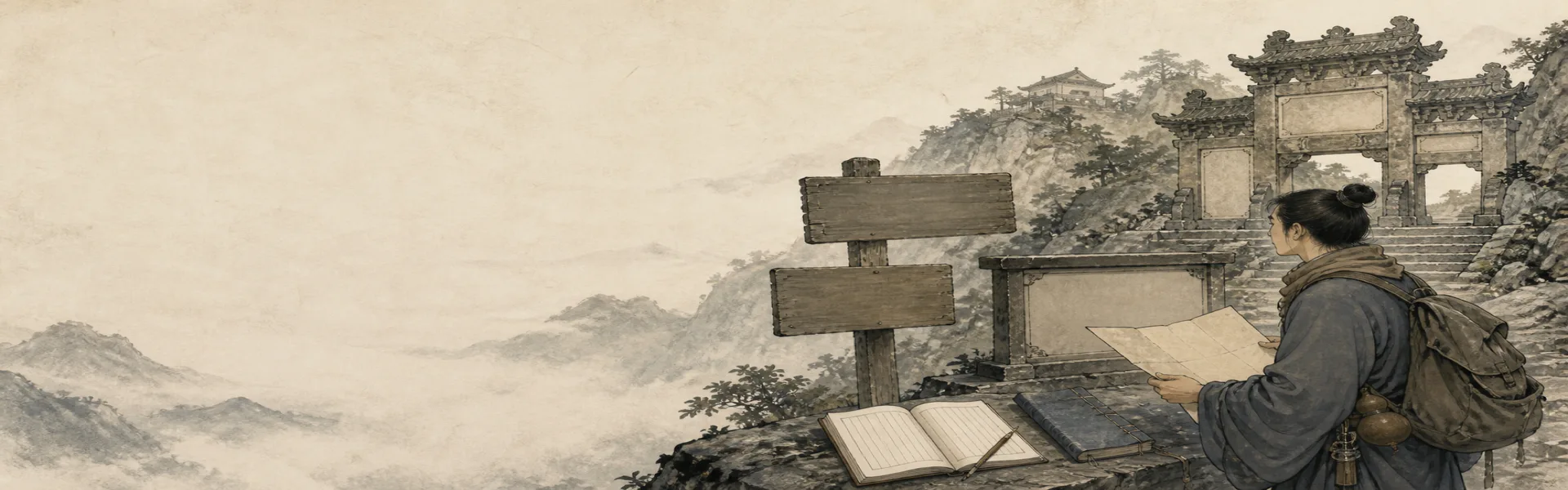
Two imperial titles appear on inscriptions. Da Yue (大岳), Great Peak, is the rank the Ming court gave the mountain, deliberately placing it above the Five Marchmounts. Xuan Yue (玄岳), the Dark or Mysterious Peak, appears in the four characters Zhishi Xuanyue (治世玄岳) carved on the great stone gateway that marks the historical entrance to the sacred area. Reading that gateway is a good introduction to the whole site, because it is the state announcing what it has decided this mountain is.
The characters Wu (武) and Dang (当) are frequently explained on site through a pious etymology, that none but Zhenwu is fit to occupy this mountain. It is a back-formation. A Wudang county existed under the Han, long before the association with the god was established, so the name almost certainly came first and the explanation afterwards.
Words for kinds of building
These are the most useful characters to recognise, because they tell you what scale of thing you are approaching. Gong (宫), palace, is the largest category and indicates a major complex, usually one with imperial patronage. Guan (观) is the ordinary word for a Taoist temple or abbey and covers most religious establishments. Dian (殿) is a hall, the individual building inside a complex, and is the word you will see most often on boards above doors. An (庵) and ci (祠) denote smaller establishments and shrines.
For the parts of a site: men (门) is a gate and shanmen (山门) the main gate of a temple; paifang (牌坊) is a free-standing ceremonial archway; ting (亭) is a pavilion; tai (台) a terrace or platform; bei (碑) a stele, the inscribed stone slabs that are among the most valuable objects on the mountain; and ta (塔) a tower or pagoda.
Landscape terms appear in site names constantly. Yan (岩) is a cliff, which is why Nanyan (南岩) is the southern cliff. Dong (洞) is a cave or grotto. Jing (井) is a well, as in Mozhen Jing (磨针井). Chi (池) is a pool, po (坡) a slope, as in Taizi Po (太子坡), and ding (顶) a summit, as in Jinding (金顶).
One caution about translation. English divides temple, palace, monastery, abbey, hall and shrine differently from Chinese, so an English name may imply a scale or function the Chinese does not. The characters are the reliable part.
The main sites, in the order you meet them
Names are given here in ascending order, because the sequence is meaningful and remembering the order is easier than remembering a list.
Xuanyue Men (玄岳门) is the great stone gateway at the historical entrance. Yuzhen Gong (遇真宫), the Palace of Meeting the Perfected, commemorates a meeting between the Yongle emperor's envoys and Zhang Sanfeng that never took place. Yuxu Gong (玉虚宫), the Palace of Jade Emptiness, is the enormous administrative complex at the foot, largest of all despite being lowest.
Mozhen Jing (磨针井), the Needle-Grinding Well, marks the story of Zhenwu nearly abandoning his cultivation. Taizi Po (太子坡), the Prince's Slope, also called Fuzhen Guan (复真观), recalls his princely origins. Zixiao Gong (紫霄宫), the Purple Heaven Palace, is the largest surviving working complex on the mountain and the site of long cultivation.
Nanyan Gong (南岩宫) is the cliff palace, where the Longtou Xiang (龙头香), the Dragon-Head Incense Beam, projects over a long drop. Wulong Gong (五龙宫), the Five Dragons Palace, is the oldest foundation and lies away from the main line. At the top, Taihe Gong (太和宫) holds the Jin Dian (金殿), the bronze hall, on the Jinding (金顶), the Golden Summit.
People and roles
Daoshi (道士) is a Taoist priest or nun, and daozhang (道长) is the respectful term of address you would actually use, for either sex. If you learn one word before visiting, learn this one.
Quanzhen (全真), Complete Perfection, is the monastic branch of organised Taoism and the tradition at Wudang: celibate, communal, resident. Zhengyi (正一), Orthodox Unity, is the other main branch, non-monastic, with married priests in ordinary households, strongest in the south. Both are fully Taoist; the distinction matters because it determines what kind of institution you are in. Chujia (出家) means to leave the household, that is, to become a monastic.
Zhuchi (住持) is an abbot or head of a temple. Zhang Sanfeng (张三丰) is the ascetic traditionally credited with originating internal boxing, an attribution that appears centuries too late to be documentation. Yongle (永乐) is the reign name of the emperor whose vast building programme from 1412 created most of what you see.
Deities you will see named
Zhenwu (真武), the Perfected Warrior, is the god of this mountain and the figure you will meet in hall after hall. Xuanwu (玄武), the Dark Warrior, is his earlier name, changed in the eleventh century to avoid a Song naming taboo. Gui she (龟蛇), tortoise and snake, are his emblem and the surest way to identify him.
San Qing (三清), the Three Pure Ones, are the highest deities of the Taoist pantheon. Yu Huang (玉皇), the Jade Emperor, ranks above Zhenwu also. Taishang Laojun (太上老君) is Laozi in deified form. Where these appear, they occupy the more important position, and noticing that is what prevents the common misreading in which Wudang looks like the summit of the pantheon rather than the mountain of a powerful officer.
Wang Lingguan (王灵官) is the fierce guardian you will meet near entrances, usually red-faced and armed. Ba Xian (八仙), the Eight Immortals, appear constantly in decoration and are figures of story rather than objects of major cult here.
Practice and ritual
Gongke (功课) is the daily service, held morning and evening, and the reason early visits are rewarding. Keyi (科仪) is liturgy or ritual procedure generally, and jiao (醮) a major offering rite.
Shangxiang (上香) is offering incense, and the gongde xiang (功德箱) is the merit box, the donation box that is the standard way to give money. Qian (签) are divination lots, drawn and matched to a written verse. Sushi (素食) is vegetarian food, which is what monastic communities eat.
For practice: dazuo (打坐) is seated meditation, zhanzhuang (站桩) standing post practice, and qigong (气功) the general term for breath and movement work. Taijiquan (太极拳) is the art most students come for; neijia (内家) and waijia (外家), internal and external family, name the two supposed approaches; tuishou (推手) is push hands; and jian (剑) is the straight sword, the emblematic Wudang weapon.
Ideas you will see referenced
Dao (道) is the way, and de (德) its expression in conduct or virtue, the two words that give the Dao De Jing (道德经) its title. Qi (气) is the term you will see everywhere, sometimes written chi in older romanisation, covering breath, vapour and vital energy depending on context.
Yin yang (阴阳) names the paired complementary aspects of any situation, and wuxing (五行), the five phases, the fivefold scheme of correspondences. Wuwei (无为), non-action or effortless action, is the political and personal ideal of the early texts.
Dantian (丹田), the cinnabar field, is the centre in the lower abdomen referred to constantly in practice. Neidan (内丹), internal alchemy, is the body of contemplative practice that gave Quanzhen its characteristic method.
Administrative language
These are the words that appear on tickets, barriers and management signage rather than on temples, and they are the ones you will need for getting around. Jingqu (景区) is a scenic area, the administrative category the mountain falls under. Shoupiao chu (售票处) is the ticket office, and suodao (索道) the cableway.
Wenwu (文物) means cultural relic or protected heritage object, and you will see it on notices explaining why something is fenced off. Daojiao xiehui (道教协会) is the Taoist association, the body that runs the temples as distinct from the secular administration that runs the mountain.
Three instruction signs are worth recognising on sight: jinzhi paizhao (禁止拍照), photography prohibited; qing wu chumo (请勿触摸), please do not touch; and zhuyi anquan (注意安全), take care, which appears wherever there is a drop. Any of these outranks anything written on this site.
Sources and limits: romanisation here is pinyin, and older spellings persist in books and on some signage. Translations of building categories are approximate, because English and Chinese divide these terms differently. Site names vary between maps, tickets and boards, and several places carry more than one legitimate name. Notices and instructions at any specific site always take precedence over this page.
Key points
- Read this once for recognition, not memorisation. Recognising a character on a sign beats remembering a spelling.
- The mountain is Wudang Shan, formally Taihe Shan, and titled Da Yue and Xuan Yue in imperial inscriptions.
- The pious etymology of the name Wudang is a back-formation; a Wudang county existed under the Han.
- Gong is a palace-scale complex, guan a temple, dian an individual hall. These three characters tell you the scale of what you are entering.
- Landscape words recur in site names: yan cliff, dong cave, jing well, po slope, ding summit.
- Daozhang is the term of address for any ordained Taoist. Wudang's clergy are Quanzhen, the monastic branch.
- Zhenwu, earlier Xuanwu, is identified by the tortoise and snake. The Three Pure Ones and the Jade Emperor rank above him.
- Gongke is the daily morning and evening service, and the gongde xiang is the donation box.
- English divides temple, palace and hall differently from Chinese, so the characters are the reliable part.
- Learn three signs on sight: photography prohibited, do not touch, and take care.