Weapons and Other Subjects at Wudang Martial Arts Schools
武当武馆的兵器与其他课程
Beyond the hand forms and the internal work, school curricula carry a long tail of additional subjects. Some are substantial parts of the martial tradition, some are pleasant additions, and some exist mainly because they look good in a prospectus. Sorting them is useful, because your time is limited and the tail is where it tends to leak away.
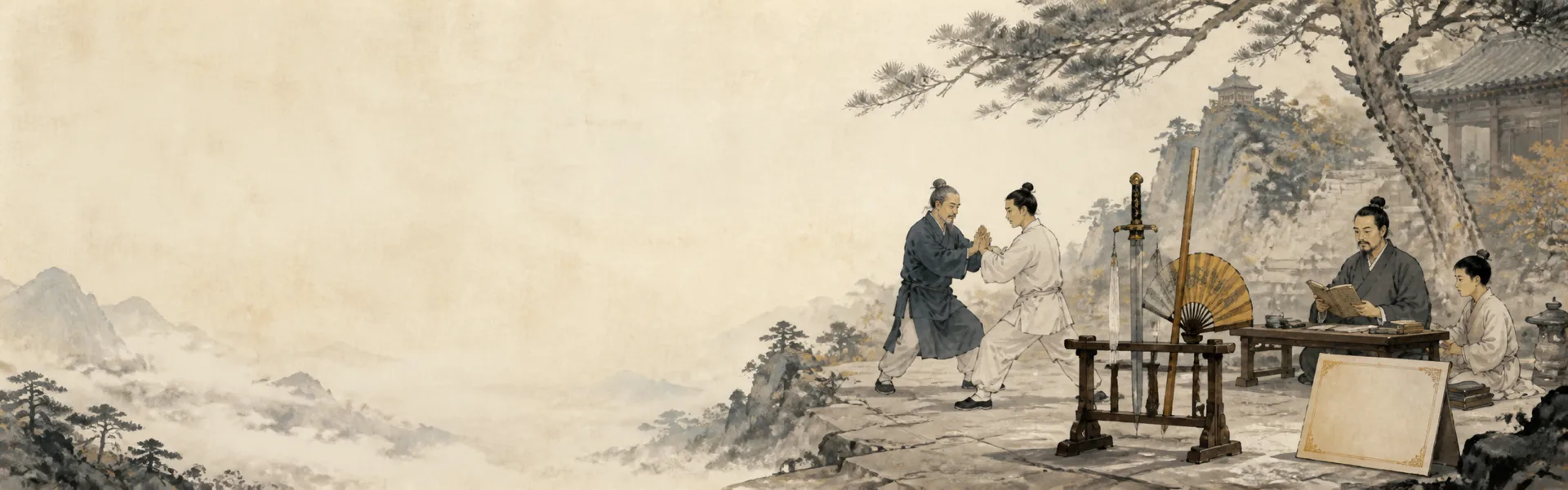
Weapons
Weapons are a genuine part of the curriculum rather than an add-on, and their place in the sequence is deliberate. They are normally taught after a hand form is reasonably stable, for a straightforward reason: a weapon extends and magnifies whatever your body is already doing. Bad structure that is tolerable empty-handed becomes obvious with three feet of steel attached to it, and a student who starts with a sword usually learns to move the sword with the arm, which is the habit the training is meant to prevent.
The straight sword is the emblematic Wudang weapon and where most students begin. It is light, double-edged, and used with a mixture of deflection and precise thrusting rather than heavy chopping. What it trains is the connection between the feet and the tip: to point the sword accurately you have to move the whole body accurately, and errors that hide in a hand form become visible immediately.
The broadsword is heavier, single-edged and more direct, and it trains a different quality: committed, powerful, whole-body cutting. Schools also teach the staff, the spear, and a range of less common implements. Fans, whisks and other light objects appear in some curricula, usually as vehicles for the same principles in a more decorative package.
Two honest caveats. First, weapons forms are demanding on the shoulder and wrist, and this is where students who train hard tend to acquire small persistent injuries. Second, weapons training here is a physical and formal discipline, not preparation to use a weapon, and any school that frames it otherwise is either posturing or serious in a way you should avoid.
Push hands
Push hands deserves its own treatment because students consistently misunderstand what it is. It is a cooperative exercise in which two people maintain contact through the arms and work with each other's balance and force. Its purpose is to develop sensitivity to pressure, to teach you to keep your own structure while under load, and to train the timing of yielding rather than resisting.
Done well, it is among the most valuable things on offer here, because it is the only common practice that tests whether your form has produced anything usable. A form can be performed beautifully by someone whose structure collapses the moment it is touched. Push hands finds that out immediately.
Done badly, it becomes a contest of strength in which the bigger person wins and both people learn nothing except how to shove. This is extremely common, including among students who have practised for years. The tell is simple: if both people are straining, it has stopped being push hands.
The important thing to be clear about is that it is not sparring. There is no striking, no attempt to hit, and the roles are cooperative. It builds a real component of martial skill and it does not build the others. Students who conclude from success at push hands that they could handle a fight have drawn a conclusion the exercise does not support.
Health practices and massage
Many schools offer some form of health instruction alongside training: simple self-massage, work on the joints, stretching routines aimed at particular problems, sometimes basic partner massage.
Taken as self-care, this is reasonable and often genuinely useful. A student training several hours a day acquires stiff hips, tight calves and sore knees, and learning to look after them is sensible. Taken as anything else, it needs care. A short course does not qualify you to treat other people, and treating other people is exactly what some students go home and do.
Chinese medicine proper is a licensed profession in China with a long formal training route through recognised institutions. A module taken alongside martial arts is not a step on that route and does not connect to it. If a school implies that its course leads toward practice, that is a reason for concern about the school generally, not only about that course.
Language, calligraphy and culture classes
Cultural offerings are usually real, usually pleasant and usually shallow, and there is nothing wrong with that as long as it is understood.
Chinese language classes are the exception worth taking seriously, because they compound. Even a few hundred words of body-part, direction and correction vocabulary changes how much of your training you actually receive. If a school offers language instruction and you are staying more than a few weeks, it is probably the highest-return item on the list.
Calligraphy, tea preparation and similar classes are introductions. You will produce some characters, learn how tea is properly made, and enjoy an afternoon. You will not acquire a skill. This is fine; it is worth knowing so that you do not choose a school on the strength of it.
Philosophy classes for foreign students are an introduction to ideas rather than a textual study. They do not involve reading classical Chinese, they vary enormously in quality depending on who teaches them and whether translation is good, and they should not be confused with religious instruction. At their best they are a genuinely interesting orientation to the ideas behind the practice. At their worst they are a loose talk assembled from popular books.
What is not on offer
Three things are asked about constantly and are not available, and saying so plainly saves people money and disappointment.
Religious ordination. Becoming a Taoist priest is not a course, cannot be purchased, and is not something a martial arts school can arrange. It requires a long relationship with a particular temple and teacher, functional Chinese, and sustained presence, and it is not offered to visitors on a timetable. A school suggesting otherwise is misrepresenting either itself or the institution.
Secret transmission. If it were secret, it would not be advertised. Offers of hidden material, usually contingent on further payment or on a longer commitment, describe a sales structure rather than a curriculum.
Qualification to teach. No stay of a few weeks or months produces a teaching credential, whatever paper accompanies it. Some students do go home and teach, and some of them teach adequately, but that is a decision they have made and not an authority anyone conferred.
Certificates, and what they actually are
Most schools will issue a certificate at the end of a stay, and it is worth being precise about what such a document says.
A school certificate records that you attended a particular private business for a period and studied particular material. It is a statement by that business about its own customer. It is not a licence, not a recognised qualification, and carries no authority outside the school that issued it. Chinese martial arts do have formal grading and examination systems administered through sports bodies, with their own procedures and standards; a school-issued certificate is not part of them and should not be presented as if it were.
This does not make certificates dishonest. As a record of what you studied, and as a souvenir of a period that mattered to you, a certificate is perfectly legitimate. The problem arises only when it becomes a reason for choosing a school, or when it is later used to imply something it does not say.
A practical suggestion: ask what the certificate will state before you decide it matters. If it names the forms studied and the dates, it is a useful record. If it uses grand language about levels or mastery, treat that as marketing and value it accordingly.
How to allocate limited time
The tail of extra subjects is where short stays quietly fail, so it is worth having a rule.
For a stay under a month, take the language class if there is one and decline nearly everything else. Your bottleneck is repetition on one form and its basics, and every additional subject reduces it. For a longer stay, add one supporting subject at a time and only once the core material has stopped feeling new.
The test to apply is whether a subject supports the thing you came for or replaces it. Push hands supports a Taijiquan form. Sword supports it once the form is stable. A second unrelated art replaces it. Culture classes are neutral and cost you an afternoon, which is a fair price if you enjoy them and a poor one if you took them because they were included.
Sources and limits: this describes patterns common to schools at Wudang, not the curriculum of any particular school, which you should confirm directly. Statements about professional qualification reflect the general structure of licensed practice in China rather than any specific regulation, and should be checked if it matters to you. Nothing here is medical advice, and no course described here confers a professional or teaching qualification.
Key points
- Weapons come after a stable hand form, because a weapon magnifies whatever your body already does.
- The straight sword trains the connection from feet to point; it is a formal discipline, not preparation to use a weapon.
- Push hands is cooperative and genuinely valuable, but it is not sparring; if both people are straining, it has stopped working.
- Health and massage instruction is useful self-care and qualifies you to treat nobody.
- Chinese medicine is a licensed profession with its own long training route, which these modules are not part of.
- Language classes are the highest-return extra; calligraphy, tea and philosophy are enjoyable introductions.
- Ordination, secret transmission and teaching authority are not on offer, whatever is implied.
- A certificate is a private business's record of its customer, not a licence or a recognised grade.
- On a short stay, take language and decline the rest; extra subjects compete with the repetition you came for.