Qigong, Meditation and Internal Practice at Wudang Schools
武当武馆的气功、打坐与内功训练
Qigong, meditation and internal practice appear on every Wudang school's curriculum, and they are the part of the offering that students find hardest to evaluate. Martial training is legible: you can see whether someone moves well. Internal practice is not legible from outside, its traditional explanation uses a vocabulary that does not translate into physiology, and the field around it contains both careful teaching and extravagant nonsense. This page tries to describe what is actually taught, what the traditional model does and does not explain, and where to be sceptical.
What is normally taught
Behind a wide variety of names, what schools teach under this heading falls into four recognisable kinds of practice.
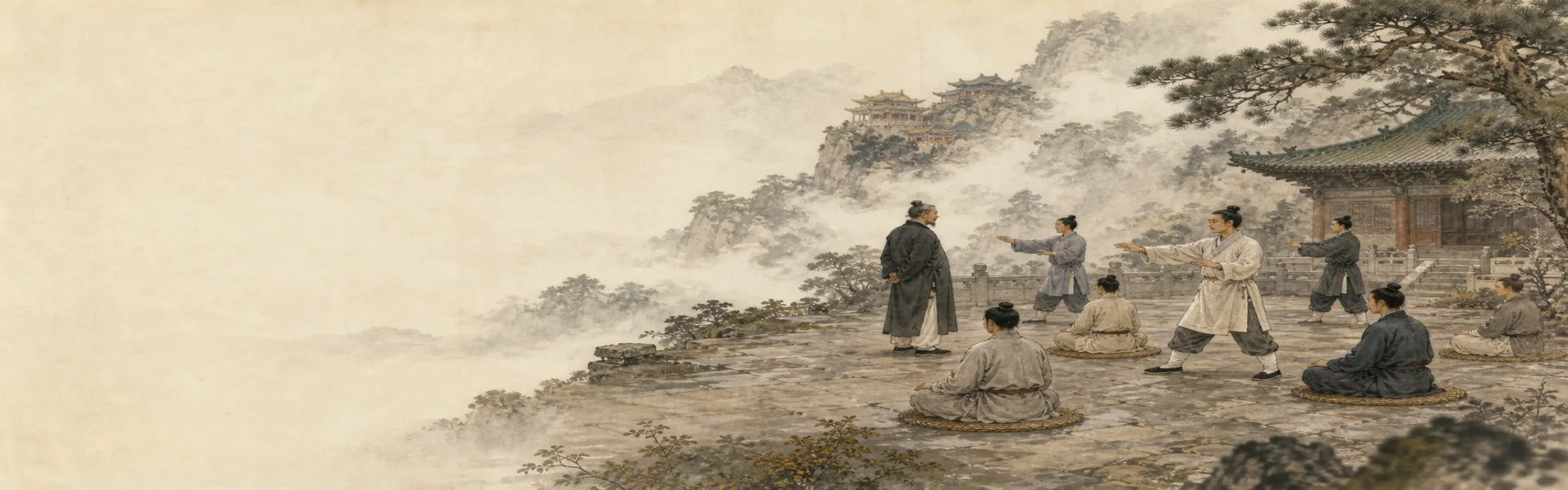
Standing practice is the foundation. You adopt a position, usually with knees slightly bent and arms held in a defined shape, and stay in it. Sessions may begin at a few minutes and extend considerably. Almost every internal curriculum at Wudang rests on this, and it is also the practice students most want to skip.
Moving sets are the visible face of Qigong: sequences of slow, repeated movements coordinated with breathing, usually short enough to memorise in days. Several well-known historical sets circulate widely, and most schools teach one or two of them alongside sets particular to the school.
Breathing work is taught as a component of the above and sometimes separately: lengthening the breath, breathing low into the abdomen rather than high into the chest, and coordinating breath with movement.
Seated practice covers quiet sitting, attention on the breath or on a point in the lower abdomen, and in some schools more structured visualisation. This is often the smallest part of a foreign student's timetable, partly because it is difficult to teach across a language barrier and partly because sitting still is a hard sell.
Standing practice, and why it dominates
Standing is given so much weight that it is worth explaining what it is for, since to a newcomer it appears to be doing nothing at all.
Held for long enough, a stance produces fatigue in the large superficial muscles that normally do the work of holding you up. As they tire, the body is forced to find a way to remain upright that uses less effort, which in practice means stacking the skeleton more efficiently and letting deeper stabilising muscles take over. That reorganisation is the point. It cannot be arrived at by being told about it, because the shortcut of muscular effort is always available until fatigue removes it.
A second function is attention. Standing still with nothing to do is an unusually clear environment for noticing what your body is actually doing. Students routinely discover, weeks in, that one shoulder has been raised for years or that their weight sits toward one heel. Those discoveries are not available while moving.
The discomfort is normal; sharp pain is not. Trembling legs, heat, sweating and a strong desire to stop are ordinary. Pain in a joint, particularly the knee, means the position is wrong, and the correct response is to raise the stance and ask the teacher, not to endure it. Enduring joint pain is the most common way students injure themselves here.
Breathing, and what it plausibly does
Breathing practice is where the gap between traditional language and ordinary explanation is widest, so it is worth stating what can be said plainly.
Slow, low, unforced breathing changes measurable things. It lowers the rate of respiration, tends to reduce arousal, and produces the settled state that practitioners describe. This is not controversial and does not require any special mechanism: deliberate slow breathing is one of the few voluntary levers on the involuntary nervous system, which is why it appears in contemplative traditions everywhere.
What cannot be established in the same way are claims that particular breathing patterns direct a substance through defined channels, cure named diseases, or produce specific abilities. The practice may still be valuable. The explanation offered for it belongs to a different system of description.
Forcing the breath is the main error. Holding it long, straining to breathe deeply, or trying to push sensation around the body causes dizziness, chest tightness and headache. Traditional instruction is generally emphatic on this point: the breath should become long by itself as tension leaves, and not be lengthened by effort. A teacher who encourages forced retention with beginners is worth being cautious about.
The traditional model and what it explains
Internal practice is taught within a model that speaks of qi, of channels through which it moves, of centres in the lower abdomen and elsewhere, and of transformation between coarser and finer forms of vitality. Students often want to know whether this is true, which is the wrong question to start with. A better one is what the model is doing.
It works well as a description of experience. Practitioners report warmth, heaviness, tingling, a sense of fullness low in the abdomen, and sensations that seem to travel. These reports are consistent across centuries and cultures, and the traditional vocabulary is a precise and economical way of talking about them. Told to relax the chest and sink attention low, most people can eventually do it, and the traditional phrasing communicates the instruction better than a physiological one would.
It also works as an instructional grammar. The model tells a teacher what order to teach in, what to correct first, and what to warn against. Whatever its ontology, it encodes several centuries of accumulated observation about how people learn these practices and how they go wrong.
Where it does not work is as physiology. The channels do not correspond to anatomical structures, and qi is not a substance that has been isolated or measured. Treating the model as a competing account of anatomy sets up an argument it cannot win and that it was never making.
Holding both at once
The practical position, and the one most experienced teachers occupy whether or not they say so, is to use the traditional language inside the practice and ordinary language outside it.
Inside the practice, the vocabulary works. Sink the qi to the lower abdomen is an instruction that produces a result. Attempting to replace it with an anatomical paraphrase makes it longer and less effective.
Outside the practice, when the question is what the effects are and how confident we can be, ordinary language is appropriate. Regular slow movement, held postures and attention training improve balance, leg strength, body awareness and, for many people, sleep and mood. That is a modest, well-supported and genuinely worthwhile list. It does not require the stronger claims, and students who need the stronger claims in order to value the practice tend to become disillusioned later.
What to be sceptical about
Several specific claims recur, and each deserves resistance.
Claims of external power: that a teacher can affect you without contact, move you across a room, or transmit force through the air. This is the clearest available test of whether a school is being honest with you, because the claim is testable and has never survived a test conducted under controlled conditions.
Claims of cure: that a set treats a named disease, replaces medication, or removes the need for a diagnosis. Such claims are unsupported and can be dangerous, because they may delay proper treatment. Anything to do with an actual medical condition belongs with your own doctor, and a teacher who advises otherwise has stepped outside their competence.
Claims of secrecy and level: that a higher transmission is available for further payment, or that a special initiation unlocks a stage. The commercial structure of this claim is more informative than its content.
Claims of speed: that weeks produce results normally described as taking years. Internal practice is unusually slow. It is one of the few things about it that everybody agrees on.
Deviation, and pushing too hard
Traditional literature describes a category of problems arising from excessive or badly guided practice, and modern accounts recognise something similar. It is worth taking seriously without dramatising it.
Reported difficulties include persistent agitation, difficulty sleeping, headaches, chest tightness, intrusive or unusually intense mental states, and in rare cases episodes severe enough to require medical attention. The pattern in most reports is the same: a great deal of practice, done alone or with poor supervision, driven by intensity, often combined with strenuous breath retention or forceful attempts to move sensation around the body.
The protections are unglamorous. Practise moderate amounts under supervision. Increase slowly. Do not force the breath. Stop a session that produces sharp pain, severe dizziness or distress, and tell your teacher what happened rather than pushing through. Long intensive retreats are not a good idea for beginners, and a school that offers one to a newcomer is not thinking about them carefully.
Anyone with a history of a serious psychiatric condition, or who is on medication that affects mood or perception, should discuss intensive meditative practice with their own doctor before starting. This is ordinary caution and not a comment on the practice.
What to expect over a few weeks
In a short stay, realistic outcomes are: one or two moving sets learned well enough to keep practising alone, a stance you can hold for a reasonable period, breathing that has become slower without being forced, and a clearer sense of your own posture and tension. Many people also report sleeping better and feeling calmer, and there is no reason to be sceptical about that.
What will not happen in a few weeks is anything a school might describe as an internal achievement. If your teacher is honest, they will tell you that. If they tell you otherwise, that is information about the school rather than about you.
Sources and limits: descriptions of what is taught reflect general practice at Wudang schools rather than any particular curriculum. The traditional model is described as a model, and this page does not assert that its terms name physical substances or structures. Claims about effects are limited to what is ordinarily observable. Nothing here is medical advice, no practice described here treats any condition, and questions about your own health, medication or psychiatric history belong with your own doctor.
Key points
Four kinds of practice cover almost everything taught: standing, moving sets, breathing work and seated practice.
Standing dominates because fatigue forces a structural reorganisation that cannot be reached by instruction alone.
Discomfort in standing is normal; joint pain means the position is wrong and should be corrected, not endured.
Slow unforced breathing has real, ordinary effects; forcing or holding the breath is the main beginner's error.
The traditional model works well as a description of experience and as teaching grammar, and poorly as physiology.
Use traditional language inside the practice and ordinary language outside it.
Be sceptical of external power, cure claims, paid higher transmissions and promises of speed.
Problems from overdoing it are real and follow a pattern: too much, unsupervised, forced. Moderation and supervision are the protection.
Anyone with a serious psychiatric history should speak to their own doctor before intensive practice.