A path into the reading
What Wudang Mountain Martial Arts Schools Actually Teach
Curriculum structure, core training, certificates and the limits of authenticity claims
Start here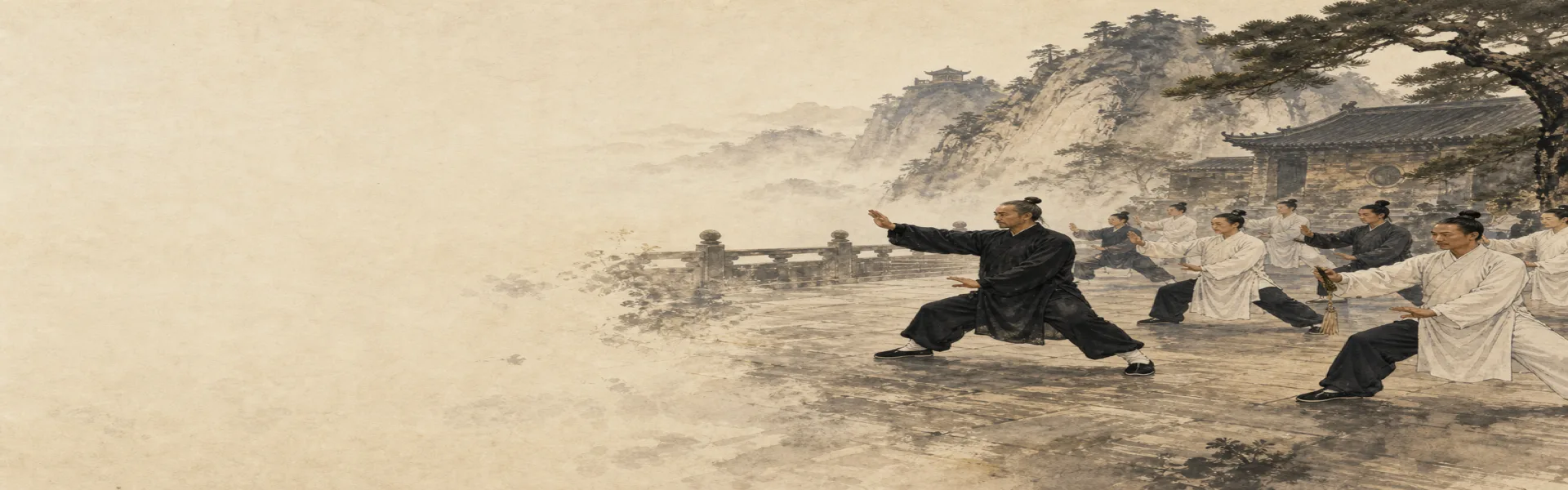

01 Find your bearings
Wudang Martial Arts: What the Label Means
An old name, a broken transmission, and a modern curriculum
Explore this sectionGo further
Deeper reading
- Wudang Martial Arts: What the Label MeansAn old name, a broken transmission, and a modern curriculum
- Qigong, Meditation and Internal Practice at Wudang SchoolsWhat students are normally taught, what the traditional model means and where healthy scepticism is necessary
- Weapons and Other Subjects at Wudang Martial Arts SchoolsSword, staff, push hands, health practices and the subjects schools may advertise but not truly provide
The full guide
What should I know before reading further?
School signs and websites list an impressive range of subjects: Taijiquan, Baguazhang, Xingyiquan, Wudang sword, Qigong, meditation, Taoist philosophy, calligraphy, tea, medicine. The list is not dishonest, but it describes an inventory rather than a course. What you will actually do with your days is much narrower, and knowing that in advance is the difference between a productive stay and a scattered one.
Read more The complete guide
School signs and websites list an impressive range of subjects: Taijiquan, Baguazhang, Xingyiquan, Wudang sword, Qigong, meditation, Taoist philosophy, calligraphy, tea, medicine. The list is not dishonest, but it describes an inventory rather than a course. What you will actually do with your days is much narrower, and knowing that in advance is the difference between a productive stay and a scattered one.
The expectation, and the reality
Most people arrive expecting to be taught something rare. What they are taught is a modern curriculum: standardised forms with recognised names, taught in a fixed order, in a group, with corrections repeated until the shape holds. This is not a lesser thing than they hoped for. It is simply a different thing, and the mismatch is worth dissolving on the first day rather than the fortieth.
The second expectation worth adjusting concerns pace. A form that takes four minutes to perform takes weeks to learn and years to perform well. In the first fortnight you will spend more time on stance work and basic exercises than on anything you would recognise as martial arts, and the proportion of your day spent standing still, uncomfortably, is higher than any promotional video suggests.
The third concerns breadth. A student who studies four arts for a month each has, at the end of four months, four badly executed forms and no foundation. A student who studies one has one form and legs that work. Schools rarely refuse a request for variety, because the customer is paying. The restraint has to come from you.
What is actually taught
Behind the long list, almost every curriculum reduces to four kinds of work.
Basics come first and never stop. These are stance training, leg conditioning, stretching, waist and hip work, footwork drills, and simple repeated movements practised in lines. This is the least glamorous part of the day and the part that determines whether everything else has any quality. A school that lets a new student skip it in order to keep them entertained is being commercially sensible and pedagogically dishonest.
Forms are the organising unit of everything else. A form is a fixed sequence of movements, learned in sections, and it functions as a syllabus, a memory device and a standard of assessment all at once. Most of your visible progress will be measured in forms: how many you know, how well you perform them, how much correction they still need.
Internal work covers standing practice, breathing exercises, simple seated meditation, and the sets usually labelled Qigong. In a martial curriculum this is often given a modest slot in the early morning or late afternoon. In a health-focused curriculum it is the centre.
Application work, where it exists, covers push hands, partner drills, and occasionally light sparring. This is the most variable element between schools, and the element most often listed and least often taught.
How a curriculum is actually structured
Schools present curricula as levels, but the underlying logic is simpler than the numbering suggests, and understanding it lets you judge where you are without relying on what you are told.
The first stage is the body. Before any form can be meaningful, the student needs a low stable stance, hips that turn independently of shoulders, and the ability to move slowly without wobbling. This is trained through repetition rather than explanation and typically occupies most of the first month.
The second stage is one short form, learned properly. Short is the operative word: an abbreviated set of a few dozen movements is enough to contain nearly every principle in the art, and it is short enough to be corrected in detail. A student who leaves with one short form performed well has more than a student who leaves with three performed approximately.
The third stage is refinement, and it looks like nothing is happening. The form does not change; the student's execution of it does. Weight distribution, timing, the coordination of turning and stepping, where the eyes go. Students who measure progress by new material find this stage intolerable and often leave during it, which is unfortunate, because it is the stage where the training starts to be worth something.
The fourth stage adds a weapon or a longer form, and the cycle repeats. Very few short-stay students reach it, and there is nothing wrong with that.
What is not on offer
Several things appear on lists and are best understood as garnish.
Taoist philosophy, taught as a class to foreign students, is normally an introduction rather than a study. It may be genuinely interesting. It is not textual training, it will not involve reading classical Chinese, and it should not be confused with religious instruction. Calligraphy, tea and similar cultural offerings are the same: pleasant, real, shallow.
Medicine is a special case and deserves care. A school may teach simple self-care, basic massage, or general theory. It is not qualifying you in anything. Chinese medicine is a licensed profession in China with a long formal training route, and a course taken alongside martial arts training is not a step on it. Treat any implication otherwise as a reason for concern about the school as a whole.
Religious ordination is not on offer at all, and this bears repeating because it is asked constantly. It is not a course, not purchasable, and not something a martial arts school can arrange, whatever the relationship its teacher has with a temple.
Finally, secret transmission is not on offer, because it is not a thing that is sold to newcomers in any tradition. If it were secret, you would not have found it in an advertisement.
The question of authenticity
Students ask whether what they are being taught is the real Wudang art. The question deserves a straight answer, which has two parts.
As history, the honest position is that transmission of these arts at Wudang was disrupted badly in the twentieth century, and that much of what is now taught was assembled or reassembled in the decades after, drawing on surviving local practice, on teachers trained elsewhere, and on the standardised forms developed in modern China. Claims of unbroken lineage from named figures centuries ago are claims, not documentation, and the gap is not small.
As practice, the material is nonetheless coherent, demanding and internally consistent, and it is taught by people who have spent decades doing it. Whether a form was fixed in its current shape in 1600 or 1980 makes very little difference to what it does to your body, and no difference at all to whether you are being taught with care.
So the useful question is not whether the lineage is ancient but whether the teaching is good. That is answerable by watching a class, which is a far better use of an afternoon than reading a school's account of its own ancestry.
Certificates and what they mean
Many schools issue certificates at the end of a stay, and some students choose a school partly on that basis. It is worth being clear about what such a document is.
A school-issued certificate records that you attended that school for a period and studied certain material. It is a statement by a private business about its own customer. It is not a licence, not a teaching qualification, and not recognised by any authority. There are separate examination and grading systems in Chinese martial arts administered by sports bodies, and those are a different matter with their own procedures; a school certificate is not one of them.
None of this makes certificates worthless. They are a reasonable souvenir and a legitimate record. But if a certificate is a significant part of why you are paying, you are buying paper, and it is worth asking yourself what you intend to do with it.
Language, and what you can realistically gain
Teaching in these arts is heavily physical and light on words, which cuts both ways for a student without Chinese. The core of instruction is demonstration and correction by touch or gesture, and that survives translation almost intact. What does not survive is the running commentary, the aside about why a movement is wrong, and the ordinary conversation in which a great deal of a teacher's knowledge is transmitted informally.
What you can realistically gain in a short stay is one form learned to a reasonable standard, a set of basic exercises you can continue alone, a noticeable change in leg strength and balance, and a clear sense of whether you want to continue. That is a solid return for a few weeks and it is a great deal more than most people achieve in a year of weekly classes at home.
What you cannot realistically gain is martial competence, deep understanding of the internal aspects, or authority to teach. Anyone offering those on a short timetable is selling something other than instruction.
How progress actually feels
It is worth knowing the shape of the curve, because it is not what people expect and misreading it makes students quit at the wrong moment.
The first week feels like rapid progress, because everything is new and the volume of material is high. The second and third weeks feel like decline, because you now know enough to see how badly you are doing it, and because your legs hurt. This is the normal pattern and it is not evidence that the school is wrong or that you are unsuited.
Real progress after that arrives in steps rather than smoothly. A movement that has been wrong for three weeks becomes right in a single afternoon, usually while you are thinking about something else. Students who train through the flat stretches get these; students who change schools looking for a better teacher restart the curve instead.
The three pages
The pages that follow this one take the curriculum in three parts. One deals with the martial arts specifically: where the Wudang label comes from, what internal and external actually mean, and what a martial curriculum contains. One deals with Qigong, meditation and internal practice, including what the traditional model explains and what deserves scepticism. One deals with everything else, from weapons and push hands to culture classes and certificates.
Sources and limits: this describes patterns common across schools at Wudang as consistently reported by students and teachers, not the curriculum of any particular school, which you should confirm directly and in writing. Statements about lineage and history reflect what documentary evidence supports; where it does not, that is said plainly. Nothing here is medical advice, and no course described here confers any professional qualification.
Key points
- Long subject lists are inventories, not courses. Your actual days will be narrow.
- Almost every curriculum reduces to basics, forms, internal work and application work.
- One short form learned properly is worth more than three learned approximately.
- The refinement stage looks like nothing is happening and is where the value is.
- Philosophy, calligraphy, tea and medicine classes are introductions, not training, and qualify you in nothing.
- Ordination and secret transmission are not on offer, whatever a website implies.
- Lineage claims are claims; the useful question is whether the teaching is good, which you can see by watching a class.
- School certificates are records issued by a private business, not licences or teaching qualifications.
- Expect a good week, two discouraging ones, and then progress in steps rather than smoothly.
Recommended next page
Where next?
Qigong, Meditation and Internal Practice at Wudang SchoolsWhat students are normally taught, what the traditional model means and where healthy scepticism is necessaryA few alternatives