What to Wear and Bring to a Wudang Temple
参访武当宫观:穿着、时间与随身物品
This page covers the small number of practical decisions that genuinely improve a temple visit. There are not many, and none of them is a rule. What makes them worth a page is that all of them have to be made before you arrive, and that getting the timing right in particular changes the visit more than anything else within your control.
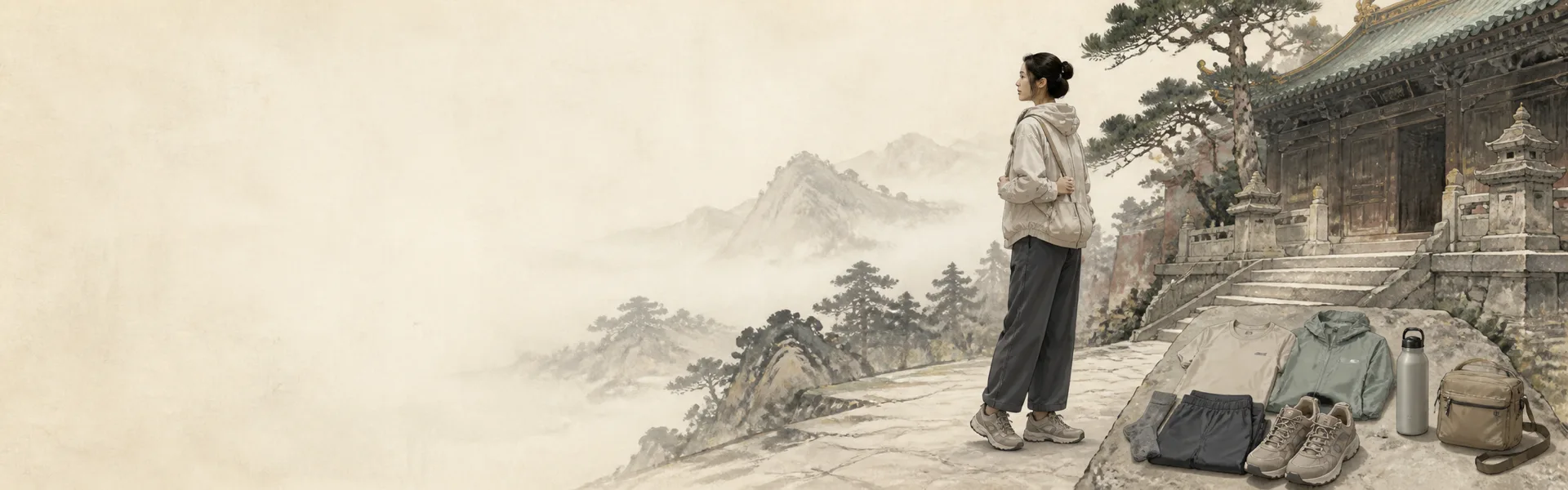
There is no dress code, and that matters
No Wudang temple imposes a dress code, and nobody will stop you at a gate to assess what you are wearing. It is worth saying this plainly, because visitors sometimes arrive expecting an inspection and dress as though for one.
The absence of a rule is precisely why a little thought helps. Where a dress code exists, the institution has made the decision for you and you can stop thinking about it. Where none exists, the judgement is yours, which also means the responsibility for misjudging is yours. Nobody will tell you that shorts and a vest were a poor choice in a hall where somebody is kneeling; you will simply be the person who made that choice.
The standard to aim for is not devout, it is unremarkable. If nothing about your clothing draws attention in either direction, it is correct. That is a low bar and it is genuinely all that is being asked.
One further consideration outweighs appearance: whatever you wear has to survive several hours of steps. A temple visit at Wudang is almost always also a hike, and clothing chosen only for propriety tends to fail on the stairs.
What to wear
Cover shoulders and knees. This is the single guideline that covers most of the ground, it applies to everyone regardless of gender, and it is easily met with ordinary clothing.
Layers are more useful here than any single garment. The mountain is substantially cooler than the valley, weather changes quickly, and you will alternate between exertion on steps and standing still in stone halls, which is a combination that makes a single correct temperature impossible. A light layer you can put on and take off solves more problems than anything else in your bag.
Choose clothing you can move in. You will be climbing, sitting on stone, and occasionally crouching to look at something. Stiff or restrictive clothes make a long day worse.
Rain matters more than most visitors expect. Cloud sits on this mountain frequently, and the difference between an enjoyable damp day and a miserable one is usually a light waterproof layer. An umbrella is less useful than a jacket on steps and in wind.
For cold months, add a warm layer for standing still. You will underestimate how cold a stone hall is when you have stopped moving, particularly if you have been sweating on the way up.
Shoes
Shoes are the item most worth getting right, and the reason is the surface rather than any custom.
You will be walking on stone steps for hours, many of them worn smooth by several centuries of feet, and many of them wet or damp. Smooth soles on smooth wet stone is the most common cause of visitor accidents here, and the descent is where it happens rather than the climb. Grip matters more than support, and support matters more than lightness.
Choose shoes you can take off and put on easily without sitting down. Some places may ask you to remove shoes at particular thresholds, and while this is not universal at Wudang, it is far easier to comply gracefully in shoes that slip off than in laced boots.
Avoid new shoes. A full day of stone steps in unfamiliar footwear produces blisters reliably, and there is no good way to recover from that halfway up.
Socks are worth a thought purely because of the possibility of removing shoes. Ones you would not mind being seen in are a small courtesy that costs nothing.
What not to wear
This is a short list, and none of it is prohibited. It is simply what tends to look wrong or work badly.
Very short shorts, cropped tops, beachwear and anything obviously intended for a hot resort. It is not that anyone objects; it is that it reads as treating the place as a backdrop, which is the one thing worth avoiding.
Clothing with slogans or imagery that would be awkward in front of an altar. Almost nobody will read it, but you will be conscious of it, which is reason enough.
Hats inside halls. Take them off. This is one of the few near-universal conventions and it costs nothing.
Strong fragrance. Halls are full of incense and enclosed, and competing smells are unpleasant in a way that is easy to avoid.
Anything you would be unwilling to get dusty, wet or creased. You will be sitting on stone at some point.
Timing within the day
This is the most valuable advice on the page. Go early. If you make one change to your plan, make it this.
Early morning gives you quiet halls, better light, cooler air for climbing, the possibility of encountering the day's first service, and an absence of coach groups. The same building at seven in the morning and at eleven is not comparable, and the difference is not marginal. Visitors who describe Wudang as overwhelmingly crowded and visitors who describe it as peaceful are frequently describing the same place at different hours.
Late afternoon is the second-best option and has some of the same advantages, with better light for photography and thinning crowds. The disadvantage is that you are working against closing times and the last transport, which introduces a pressure that early mornings do not have.
The middle of the day is the worst time for the main sites and it is when most people are there. If your schedule forces you into it, use it for walking between places, for the outlying sites, or for lunch, and save the halls for either end of the day.
One further point about services: morning and evening rites are the fixed points of a temple's day and are the most interesting thing a visitor can happen upon. They are not scheduled for you and are not announced, so encountering one is a matter of being present early rather than of planning.
Timing across the calendar
Season changes the visit as much as time of day, and the choices involve genuine trade-offs rather than one right answer.
Spring and autumn are the most comfortable for walking and the most popular for exactly that reason. Expect good conditions and company.
Summer is hot and humid in the valley and better on the mountain, with frequent cloud and rain. It is busy, and stone steps in heavy rain are the least pleasant version of this visit.
Winter is cold and damp, the mountain is quiet, halls are at their least crowded, and the atmosphere is at its best for anyone who does not mind being cold. Snow and ice can close or make hazardous parts of the route. This is the season experienced visitors often prefer and inexperienced ones often regret.
National holiday periods concentrate domestic visitors dramatically and are worth avoiding if you have any flexibility at all. Festival days in the traditional calendar transform the temples into working pilgrimage sites, which is a genuine reason to come and a genuine reason to stay away, depending on what you want. This site lists no dates, because a wrong date is worse than none; check locally close to the time.
What to bring
The list is short, and it is short deliberately, because you will be carrying whatever is in it up a great many steps.
Water, more than you think, and a way to refill it. Cash in small notes, because small purchases and donation boxes do not accommodate cards and because foreign cards are not smoothly integrated into everyday payment. Sun protection, since exposed sections have no shade. A light waterproof layer. Something to eat, since options between sites are uneven.
A phone that is charged, plus a means of charging it, because it is your map, your translation and your camera. A written note of where you are staying, in Chinese characters if possible, which solves a problem that arises surprisingly often.
Any medication you need, and enough for a longer day than you planned. A basic blister plaster is worth its negligible weight.
Tissues and hand sanitiser, since facilities on the mountain are variable.
What not to bother with
Equally useful is knowing what you can leave behind, since weight is the enemy on steps.
Heavy camera equipment, unless photography is the actual purpose of your trip. The gains are small and the cost over several hours of stairs is not.
Formal clothing. There is no occasion for it and no expectation of it.
Gifts or offerings brought from home. Anything appropriate is available locally, and buying it there is simpler and supports the place you are visiting.
A detailed printed itinerary. Conditions, closures and your own energy will alter it, and the flexible visitor has a better day than the scheduled one.
Anything you would be upset to lose or break while climbing.
Sources and limits: this page gives practical suggestions, not rules. No dress requirement is imposed at Wudang temples, and nothing here is an official requirement. Opening times, transport, seasonal access and festival dates vary and change, are not listed here, and must be checked locally. Notices and instructions at any specific site always take precedence over this page.
Key points
- There is no dress code, which is exactly why a little forethought helps. Aim to be unremarkable rather than devout.
- Cover shoulders and knees, wear layers, and choose clothes you can climb and sit on stone in.
- Shoes are the most important item: grip on worn wet stone matters most, and the descent is where accidents happen.
- Avoid new shoes, take hats off inside halls, and skip strong fragrance.
- Go early. Early morning is the single largest improvement available to a visitor, and the difference is not marginal.
- Morning and evening services are the most interesting thing you can encounter, and encountering one is a matter of being there early.
- Spring and autumn are comfortable and busy; winter is cold, quiet and often the best atmosphere; avoid national holidays if you can.
- Bring water, small cash notes, a waterproof layer, a charged phone and your accommodation written in Chinese.
- Leave behind heavy camera gear, formal clothes, offerings from home and a rigid itinerary.
- Festival dates and opening times are not listed here on purpose; check locally close to the time.