Before You Enter a Wudang Temple
进入武当宫观之前
Most visitors arrive at a Wudang temple with one of two mistaken pictures in their heads, and correcting both takes about a page. Doing so is worth the effort, because almost every awkward moment that visitors report comes from acting on the wrong picture rather than from breaking any actual rule. This page sets out what the building in front of you is, what that means for you in practice, and the few decisions worth making before you walk in.
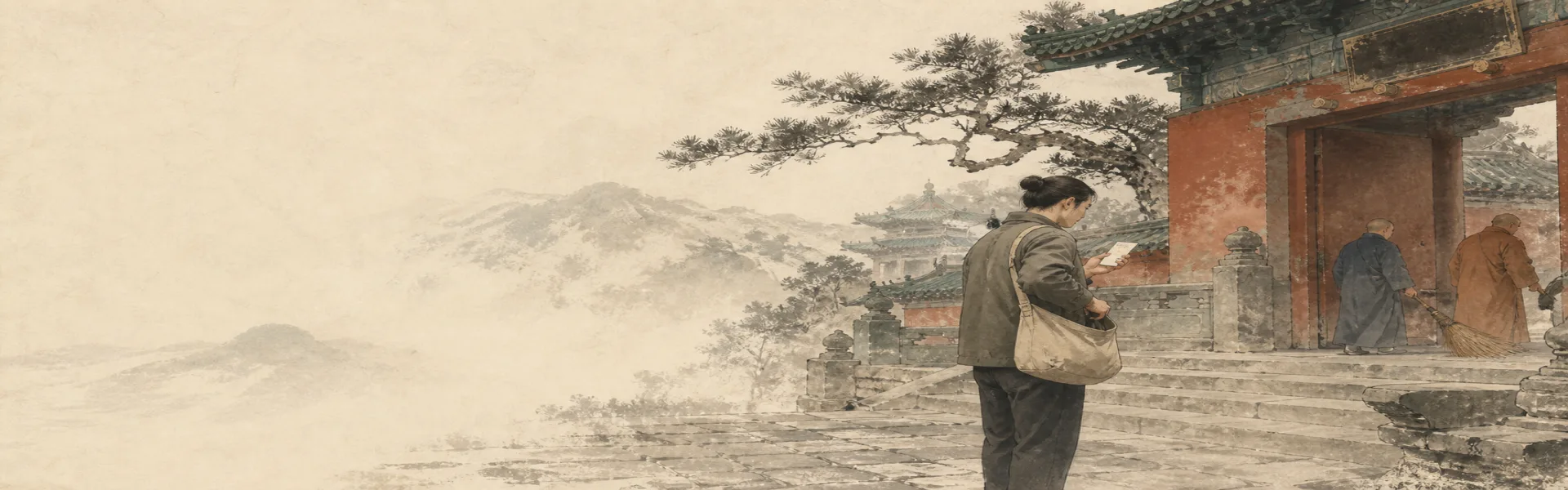
The museum idea, and why it is understandable
The first mistaken picture treats the temple as a heritage site: an old building preserved for its architecture, with contents arranged for viewing, essentially a museum with incense.
The idea is understandable, because nearly everything about the visit encourages it. You bought a ticket. There are information boards, arrows, and railings. Groups follow guides. The site appears in lists of monuments and in an inscribed heritage designation. Photographs are being taken constantly. All of this is the apparatus of a museum and it is genuinely present.
The reason it is wrong is that the halls are in use. The figures on the altars are not exhibits; they are the objects of daily ritual performed by people who live on the site. The incense is not atmosphere provided for visitors. The cushion in front of the altar is there because people kneel on it. If you walk through treating the space as a display, you will at some point stand in front of somebody who is trying to bow, and the mistake will be entirely invisible to you.
The practical consequence is small and specific: assume that anything that looks like equipment is equipment, and that anyone standing still in front of an altar is doing something rather than looking at something.
The opposite idea, and why it is also wrong
The second mistaken picture is the reverse: that the temple is a closed religious space you are being tolerated in, governed by rules you do not know, where a wrong move causes offence.
This produces visitors who tiptoe, apologise, refuse to enter halls, and generally have a worse time than necessary. It is wrong for a straightforward historical reason. Chinese temples of this kind have been public places for centuries. They were built with imperial money as state-supported institutions, they received pilgrims of every level of commitment, and they have always been visited by people who came for the view, the walk, the festival or the company. Casual visitors are not a modern intrusion; they are the normal population of such a site.
There is also no membership requirement. You do not need to believe anything, to have been introduced, or to know what you are looking at. Nobody will ask what you believe, and nobody is checking.
The practical consequence here is the opposite of the first: relax. Go in. Look at things. Standing outside a hall out of anxiety is not respect, and the people who work there would rather you came in and behaved ordinarily than hovered at the door.
What a working temple means for you in practice
Holding both corrections at once gives a simple working model: this is a public building with a job, and the job takes priority over your visit.
In practice that reduces to a handful of habits. Give way to anyone who appears to be worshipping, and do so without ceremony. Do not stand between a person and the altar they are facing. If a rite is in progress, watch from the side or the back rather than the middle, and stay for as long as you like. Keep your voice at the level you would use in a library rather than at the level you would use outdoors. Move at the pace of the place.
Some areas are not open, and this is ordinary rather than pointed. Living quarters, kitchens, offices and store rooms are private for the same reason they would be anywhere. A closed door is a closed door.
Local notices override anything written here or on any other website. If a sign says no photography, or a rope closes a section, or somebody indicates that you should not go somewhere, that instruction is current and specific and this page is neither. Follow it without needing an explanation.
Two administrations, one gate
One structural feature explains a great deal of what confuses visitors, and knowing it in advance saves puzzlement.
The mountain is managed as a scenic and heritage area by secular authorities, and the temples within it are run by a Taoist religious organisation. These are two different bodies with different responsibilities occupying the same ground. Ticketing, transport, paths, signage, safety barriers and conservation of the fabric largely belong to the first. What happens inside the halls, the rites, the clergy and the religious use of the space belong to the second.
This is why the experience can feel inconsistent: a heavily managed approach, turnstiles and loudspeakers, and then a hall in which somebody is quietly performing a rite that has nothing to do with any of it. Neither half is a facade. Both are real, and they are operated by different people.
It also explains why staff answers vary. A person in a uniform managing crowds may know nothing about the ritual calendar, and a member of the clergy may know nothing about bus times. Ask the right side of the operation and you will usually get a good answer.
The two decisions worth making in advance
Very little preparation is needed, but two choices genuinely change the visit and both have to be made before you arrive.
The first is clothing, and the relevant point is that there is no dress code and this is precisely why a small amount of thought helps. Nobody will turn you away, so the decision is entirely yours, which means it is also entirely yours to get wrong. Cover shoulders and knees, wear something you can climb several hundred steps in, and wear shoes you can walk all day in and take off if you need to. That is the whole of it.
The second is timing, and it matters more than clothing. Early morning is the single largest improvement available to a visitor. The halls are quiet, the light is better, the day's first rites may be under way, and the coach groups have not arrived. The same hall at eleven in the morning and at seven is close to two different places. If you can only make one adjustment to your plan, make it this one.
Beyond those, bring water and cash in small notes, and expect to be walking on stone in changeable weather. That is the extent of the preparation that repays effort.
If you have no religious interest at all
A good proportion of visitors, including many Chinese visitors, have no religious purpose whatever, and this is a completely normal way to come.
You are not obliged to participate in anything. You do not need to bow, light incense, make an offering, or perform any gesture. Nobody will invite you to, nobody will mind that you did not, and doing something you do not mean is not more respectful than not doing it.
There is a great deal to come for without belief. The buildings are among the most interesting surviving examples of siting architecture on difficult terrain in China. The sculpture and the fittings are worth looking at closely. The mountain itself is the point for many people. And watching a rite as an outsider is genuinely interesting, provided you watch from a position that does not obstruct anyone.
The one thing worth avoiding is treating the place as a backdrop. The difference between visiting a working building respectfully and treating it as scenery is mostly a matter of where you stand and how loud you are, and it costs nothing.
The one thing actually expected of you
If everything else on this page is forgotten, one principle covers almost every situation and can be stated in a sentence: behave as you would in someone else's place of worship, and if unsure, choose the quieter gesture.
Doing less is the operative half. Most visitor mistakes are not omissions but additions: sitting on something that turned out to be ritual furniture, arranging a photograph in front of an altar, imitating a gesture incorrectly in the middle of a rite, handling an object to see what it is. Standing still and looking is never wrong.
The second half of the principle is that when you do get something wrong, which occasionally happens to everyone, the correct response is small. Move, stop, or step back, and continue. Prolonged apology draws far more attention than the original error and is more disruptive than the thing you were apologising for.
The two pages that follow
The rest of this section is more specific. One page deals with what a working temple actually is: who lives there, what happens daily, the two administrations, and what is and is not open to visitors. Another covers dress, timing and what to bring in practical detail. Beyond those, further pages address behaviour inside the halls, incense and offerings, photography, money and donations, how to address clergy, and the mistakes visitors most commonly make.
None of it is complicated, and none of it is a test. The whole of this section could be compressed into being quiet, giving way, and following local signs. Everything else is context for those three things.
Sources and limits: this page describes general practice at working Taoist temples and the administrative arrangement typical of a managed scenic and heritage area. Individual temples differ, arrangements change, and the notices and instructions at any specific site always take precedence over anything written here. Nothing on this page describes doctrine or prescribes religious practice.
Key points
A Wudang temple is neither a museum nor a closed religious enclosure. It is a public building with a job, and the job comes first.
Assume that anything resembling ritual equipment is equipment, and that a person standing before an altar is doing something.
Casual visitors are the normal population of such sites and always have been. You need believe nothing and will not be asked.
The mountain is run by secular authorities and the temples by a Taoist organisation, which is why the experience feels inconsistent and why staff answers vary.
Two advance decisions matter: modest practical clothing, and going early. Early morning is the single biggest improvement available.
Living quarters, kitchens and offices are private for ordinary reasons. A closed door is a closed door.
Local notices always override this or any other website.
You need not bow, light incense or participate in anything, and performing a gesture you do not mean is not respect.
When unsure, pause and observe. Standing still and looking is always acceptable.
If you get something wrong, move or step back and continue. A long apology is more disruptive than the mistake.