How a Working Wudang Temple Operates
武当宫观如何日常运作
The phrase working temple is used constantly on this site and deserves unpacking, because what it actually describes is an institution with residents, a daily timetable, a legal status and a division of labour. Knowing how it is organised explains most of what you will see, including several things that otherwise look inconsistent or arbitrary.
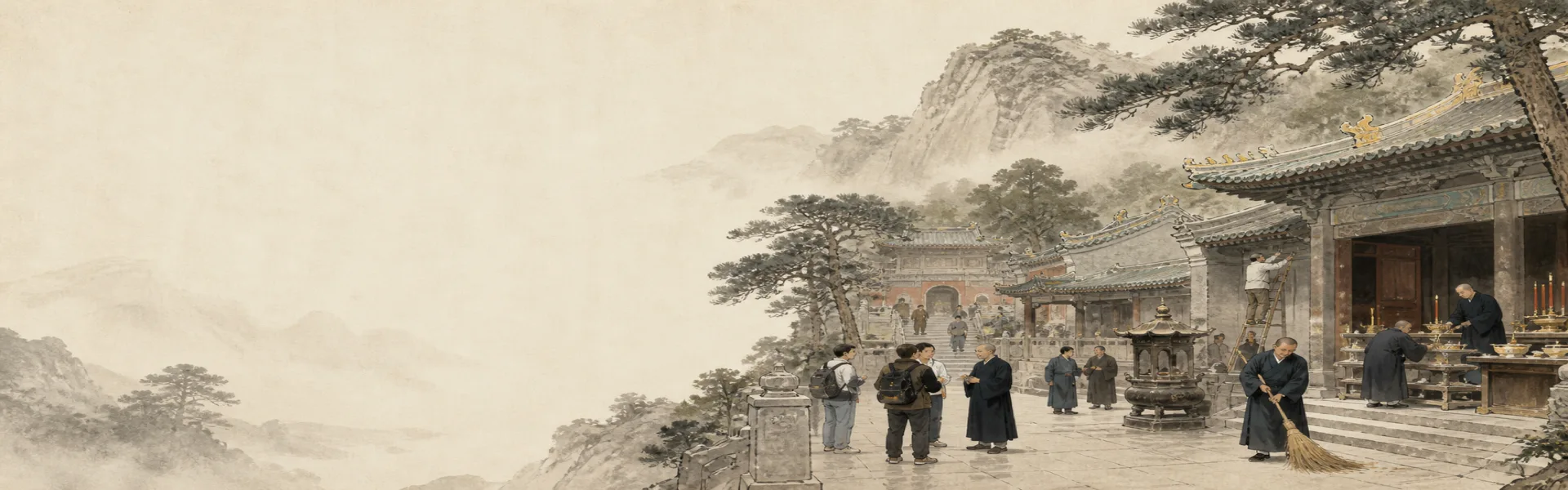
Who lives and works there
The Taoist clergy at Wudang belong to the Quanzhen tradition, which since roughly the twelfth century has been the monastic branch of organised Taoism in northern and central China. The practical distinction that matters is monastic: Quanzhen clergy are celibate, live in community, and reside at the temple rather than in a household of their own.
This is worth stating because the other major branch of organised Taoism, generally called Zhengyi and strongest in the south and in Taiwan, is not monastic. Its priests marry, live in ordinary households, and serve a community from within it, often transmitting their office within a family. Both are fully Taoist. If your prior impression of Taoist priests involves family lineages and household practice, that impression is accurate about a tradition, just not about the one on this mountain.
You will recognise clergy by dress. Robes vary by occasion and rank, hair is typically worn long and gathered, and formal robes appear for services. During the day you may equally see people in ordinary clothes doing ordinary work, and they may well be clergy too. Temples also employ lay staff, and there are volunteers, contractors and heritage workers about. Not everybody on site is a priest, and not every priest is dressed like one.
Numbers on the mountain are modest. The population of a temple can be as small as a handful, and even the larger sites hold what would count as a small community, not the hundreds sometimes imagined.
An open monastery, not a family shrine
Two structural features follow from Quanzhen organisation and both affect your visit directly.
The first is that a monastery of this kind is institutionally open. Historically, a Quanzhen public monastery was open to ordained Taoists from anywhere who arrived with the correct credentials, and it was equally open to lay visitors and pilgrims. It was never the private property of a family or a village, which is why the doors are open to strangers as a matter of ordinary practice rather than modern tourism policy.
The second is that the community is somewhat impersonal in a specific and useful sense. Because members come from elsewhere and may move between institutions, the temple is an office with occupants rather than a household. Your presence is not an intrusion into anybody's home. This is a real difference from visiting a village shrine tended by a local family, where the social situation is entirely different.
What this means practically is that you can enter, look, stay a while and leave without anyone regarding it as an event. The threshold you are worried about crossing has been crossed by strangers continuously for centuries.
What happens there daily
A temple's day is structured, and the structure is what makes it a working institution rather than a preserved one.
There are morning and evening services. These are the fixed points of the day, conducted by the resident clergy, involving chanting, instruments, and prescribed movement, and they are the reason early morning is the best time to visit. They are not performances and they are not scheduled for visitors, but they are generally not hidden either, and watching from a position that obstructs nobody is ordinary and accepted.
There is a great deal of maintenance. Halls are cleaned, altars are tended, lamps and incense are managed, offerings are replaced, and buildings on this terrain need constant attention. Much of what you see clergy doing during the day is this rather than anything obviously devotional.
There are rites performed on request. A visitor or a family may ask for a rite for a particular purpose, which is arranged with the temple and involves a contribution. This is a normal function of such an institution and has been for as long as they have existed. It is not aimed at foreign visitors and you are unlikely to be offered it.
And there is administration: the site is managed, staff are organised, heritage obligations are met, and records are kept. A temple is a legal and administrative entity as well as a religious one.
The ritual calendar
Beyond the daily pattern, the year has a shape, and it is worth knowing because it determines whether you find a quiet hall or a crowd.
Festival days concentrate activity dramatically. The most significant for Wudang are those associated with Zhenwu, the god whose mountain this is, and the general Taoist festival days observed everywhere. On these days the temples fill, additional rites are performed, incense consumption rises steeply, and the site becomes crowded with pilgrims rather than sightseers.
Whether you want this is a genuine choice rather than an obvious one. A festival shows you the place doing the thing it exists to do, with a scale and intensity that an ordinary Tuesday cannot convey. It also makes quiet observation nearly impossible, fills accommodation, and turns the main routes into slow queues.
Since dates follow the traditional lunar calendar, they move against the ordinary calendar from year to year. This site does not list them, for the same reason it lists no prices: a wrong date is worse than no date. If it matters to your plans, check locally or with the temple close to the time.
Two administrations, one site
This is the single most useful structural fact for a visitor, and it explains most apparent inconsistency.
The mountain as a whole is administered by secular authorities as a scenic and heritage area. That side is responsible for entry, transport within the area, paths and steps, signage, safety infrastructure, crowd management and the physical conservation of protected buildings. It is also the side generating the museum-like apparatus discussed elsewhere in this section.
The temples are run by a Taoist religious organisation. That side is responsible for the clergy, the services, the ritual use of the halls, the altars and their contents in use, and the religious life of the site.
The two overlap on the same ground and mostly cooperate, but they are distinct bodies with distinct priorities. Conservation and ritual use can pull against each other: a hall protected as a monument is also a hall in which people burn incense. Most of the compromises you will notice, restricted burning, designated areas, particular things behind glass, are the visible result of that negotiation.
For you the practical value is knowing whom to ask. Questions about tickets, transport, timings and access belong to site staff. Questions about a rite, a figure on an altar, or the religious meaning of something belong to clergy, if anyone is free.
Registered, and why that matters
Religious activity in China operates through officially registered institutions, and the temples at Wudang are registered religious sites within that framework.
Two consequences are worth understanding rather than judging. First, the clergy operate within a recognised structure with its own leadership, training arrangements and obligations, which is part of why ordination is a long formal process and not something arranged privately. Second, some things are consistent across sites for institutional reasons rather than religious ones.
This context also explains a discontinuity you will read about repeatedly on this site. Organised religious life here was suppressed for roughly two decades from the late 1950s, most severely during the Cultural Revolution, and clergy were dispersed. Recovery began in the late 1970s. The institution you see today is continuous with the older one in place, in buildings and in much of its practice, and discontinuous in personnel and in a great deal of transmitted knowledge. Both halves of that sentence are true, and neither should be quietly dropped.
What is and is not open to you
The boundaries are ordinary and mostly guessable, but stating them removes hesitation.
Open: the courtyards, the main halls, the paths, the views, and generally anywhere the public route goes. You may look at altars, sculpture, inscriptions and fittings. You may stand and watch a service. You may stay as long as you like.
Not open: living quarters, kitchens, offices, store rooms, and anything behind a closed door or a rope. These are private for the same reasons they would be private anywhere, and no explanation is owed.
Variable, and governed entirely by local notices: photography inside halls, incense burning in particular places, access during a rite, and occasional closures for work or ceremony. This is why the instruction that local signs override this website appears on every page in this section.
Worth asking about rather than assuming: whether a particular hall is open at a particular time, and whether a service is due. Site staff can answer the first, and either side can usually answer the second.
What is not asked of you
Finally, the reassuring part, because visitors consistently overestimate what is expected.
You are not asked to believe anything, to declare anything, or to participate in anything. You will not be questioned about your religion or your reasons for coming. There is no expected donation and no minimum, and choosing to give nothing is entirely normal.
You are not asked to perform gestures. Bowing, kneeling and offering incense are available to anyone who wishes to, and not expected of anyone who does not. Imitating a gesture you do not understand is not more respectful than standing still, and standing still is always sufficient.
What is asked is minimal and practical: be quiet, give way, keep out of the way of people doing something, and follow local instructions. That is the whole obligation, and it is the same obligation any working building would place on a visitor.
Sources and limits: the monastic character of Quanzhen Taoism, its distinction from Zhengyi practice, and the twentieth-century suppression and later recovery of religious institutions are well established. Details of individual temples, current staffing, service times and festival dates vary and change, are not listed here, and should be checked locally. Local notices and instructions always take precedence over this page, which describes general arrangements and does not set out doctrine.
Key points
- Wudang's clergy are Quanzhen: monastic, celibate, living in community at the temple.
- The other main branch, Zhengyi, is non-monastic with married priests in ordinary households, and is equally Taoist. It is simply not the tradition here.
- A Quanzhen public monastery is institutionally open to strangers, which is why entry is ordinary rather than a modern concession.
- The temple is an office with occupants rather than a family home, so your presence is not an intrusion.
- Daily life has morning and evening services, constant maintenance, rites performed on request, and administration.
- Festival days transform the site, follow the lunar calendar, and are not listed here because a wrong date is worse than none.
- Secular authorities run the mountain and a Taoist organisation runs the temples, which is why the experience feels inconsistent and whom you ask matters.
- The temples are registered religious sites, and today's institution is continuous in place and buildings but discontinuous in personnel and transmitted knowledge.
- Courtyards, halls and public routes are open; living quarters, kitchens and offices are not. Photography and incense rules are local.
- Nothing is asked of you but quiet, giving way, and following local signs. There is no expected donation and no gesture you must perform.