Taoist Clergy, Donations and Common Mistakes at Wudang Temples
武当宫观中的道长、功德与常见错误
This part of the section deals with people rather than buildings: who you are actually dealing with on the mountain, how money works and where it goes wrong, and what to do when you get something wrong yourself. These are grouped together because they share a single underlying point, which is worth stating before anything else.
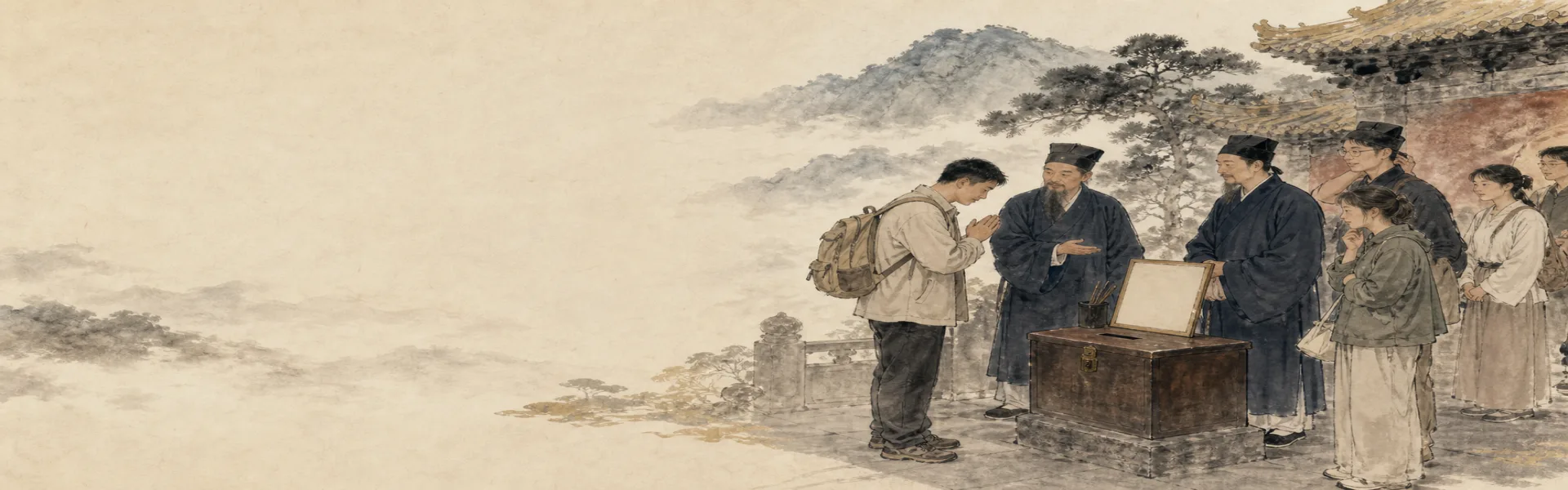
The thread running through all of it
The thread is that almost every problem in this area comes from misjudging who you are talking to, and almost every solution is to slow down.
A temple site holds clergy, employed staff, contractors, volunteers, licensed vendors, unlicensed vendors, guides of varying quality, and other visitors. They look more alike than they are, they have entirely different relationships to you, and the confusion between them accounts for the great majority of unpleasant experiences reported by visitors.
Slowing down is the general remedy because every pressure-based pattern on this mountain depends on speed. You are asked to accept something, agree to something or pay for something before you have had time to establish what it is. Nothing legitimate at a temple requires an immediate decision, so the ability to say that you will think about it and walk on resolves nearly every difficult situation before it develops.
The corollary is reassuring: the temple itself is not the source of these problems. Clergy do not approach visitors to sell things, and a registered temple's own arrangements are ordinary and low-pressure. Where you meet pressure, you have almost certainly left the institution and entered the commercial fringe around it.
Who you are actually dealing with
Sorting the categories is the most practically useful thing on this page.
Clergy are ordained Taoists resident at the temple. They are recognisable by robes and often by long gathered hair, though during the day they may equally be in ordinary clothes doing maintenance. They are working. They are not guides, they do not solicit, and they are generally happy to answer a brief question if they are not busy.
Temple staff and volunteers handle counters, sell incense and printed material, manage donation boxes and keep the halls in order. Their answers about arrangements inside the temple are reliable.
Scenic area staff are employed by the secular administration and handle tickets, transport, paths, safety and crowds. They are the right people for questions about access, timings and getting around, and often know nothing about religious matters.
Licensed vendors run stalls and shops selling incense, souvenirs, food and drink. Prices are ordinary and transactions are normal.
The fringe is the category to be alert to: people offering a blessing, a reading, an amulet, a special access, or an unspecified service, often initiating contact and often near entrances and busy nodes. They are not part of the temple and their relationship to it is nil.
The single most useful test is who started the conversation. If you approached a counter or a stall, you are almost certainly fine. If someone approached you with an offer, slow down.
Why money is where the trouble concentrates
Money is the pressure point for structural reasons rather than because anybody here is unusually dishonest.
Religious giving is genuinely open-ended. There is no price on a blessing, no fixed amount for a rite, and no published tariff for merit, which is exactly as it should be within the tradition and exactly what makes the area exploitable. When the correct amount is unknowable in principle, a stranger can suggest any figure and you have no reference point.
Visitors also arrive predisposed to give. Most people want to behave properly in an unfamiliar religious setting, are worried about causing offence, and would rather overpay than seem disrespectful. That combination is the raw material of every temple-adjacent scam anywhere in the world.
And the transaction is usually one-off and untraceable, conducted in cash, with a stranger you will not see again, on ground where you do not know the rules. There is no repeat-business incentive to keep anyone honest.
Understanding this reduces the problem from a moral puzzle to a mechanical one. The defence is not suspicion of religion or of the temple; it is refusing to make financial decisions quickly in a situation designed to hurry them.
The asymmetry worth remembering
One asymmetry does most of the work in these situations and is worth holding onto.
Anything genuinely required of you at a temple is either free or has a clear, posted, fixed price. Entry to the area has a published charge. Incense at a stall has a price. A donation box takes whatever you choose and asks nothing. Ritual services requested from a temple are arranged through the temple with the amount understood in advance.
By contrast, anything with an unclear price, an amount revealed only after you have accepted, or a figure that rises during the conversation is not part of the institution. That is the whole test, and it is reliable.
The practical version: establish what something costs before you take it, touch it or accept it. This applies to incense handed to you, an amulet placed in your hand, a stick of divination lots, and a service someone begins performing on your behalf. Once you are holding it, the negotiation has already moved.
The other half of the asymmetry is that refusal costs you nothing. You are not obliged to give anything, no one is entitled to a payment you did not agree, and walking away is always available. Nothing bad happens.
How much any of this matters
It is worth keeping the risk in proportion, because anxiety about it spoils more visits than the risk itself does.
Most visitors to Wudang encounter none of this. The mountain is a managed site, the temples are ordinary institutions, the vendors are ordinary vendors, and the majority of people who come have a straightforward day out. The pattern described here exists at busy religious sites everywhere in the world, is not specific to Wudang or to Taoism, and is peripheral rather than central.
Similarly, the etiquette mistakes covered later in this section are minor. Nobody is monitoring your behaviour, nobody will confront you about a misstep, and the worst realistic outcome of getting something wrong is a moment of mild awkwardness that ends when you move.
The reason these pages exist is not that the risk is high. It is that a page of advance information removes the anxiety, and a visitor who is not anxious behaves better and enjoys the place more. Reading this once means you can stop thinking about it.
Guides, and whether one is worth it
Guides are the most common paid interaction after tickets and food, and the answer is genuinely mixed.
What a good guide adds is real. Wudang is a site where almost nothing explains itself: the layout encodes rank, the figures have identities, the buildings have construction histories, and the inscriptions carry the mountain's own account of itself. Somebody who knows this transforms a walk past old buildings into something legible.
What a poor guide adds is a stream of legends delivered at speed, a route optimised for shops, and a schedule that prevents you from standing still anywhere. This is common, and it is worse than no guide, because it fills the time you would otherwise have spent looking.
If you want one, arrange it through an official channel at the site rather than accepting an offer from someone who approaches you, establish the duration and the price before starting, and say what you are interested in. A guide told that you care about architecture and history rather than legends will often adjust.
If you would rather not, you lose less than you might think, provided you have read a little in advance. The pages in this section on reading a hall and on the layout of a temple are written precisely so that an unguided visitor can work out what they are looking at.
The three pages
The pages that follow take these in turn. One deals with clergy: how to address them, how to recognise them, what is reasonable to ask, and the physical conventions around them. One deals with donations and fees, separating what is routine from pressure-based or unclear charges, and setting out specifically what to decline and how. One deals with mistakes, sorting them into the harmless, the worth correcting and the genuinely resented, and explaining what to do in each case.
All three reduce to the same two habits. Work out who you are dealing with, and do not decide anything quickly.
Sources and limits: this page describes patterns common at busy religious sites and reported consistently by visitors, not the conduct of any identified individual or institution. It makes no allegation against the temples at Wudang, their clergy or licensed vendors. Charges, arrangements and official channels vary and change and should be confirmed on site. Notices and instructions at any specific site always take precedence.
Key points
Almost every problem here comes from misjudging who you are dealing with, and almost every solution is to slow down.
A temple site holds clergy, temple staff, scenic area staff, licensed vendors and a commercial fringe. They look more alike than they are.
The best single test is who started the conversation. If you approached a counter, you are fine; if someone approached you, slow down.
Clergy do not solicit and do not sell to visitors.
Money is the pressure point because religious giving has no fixed price and visitors are predisposed to overpay rather than offend.
Anything genuinely required is free or has a clear posted price. An unclear or rising price means you have left the institution.
Establish the cost before you take, touch or accept anything. Once you are holding it, the negotiation has moved.
Refusal costs nothing. You owe no payment you did not agree, and walking away is always available.
Most visitors encounter none of this, and etiquette mistakes are minor. The point of reading this is to stop worrying about it.
A good guide makes the site legible; a poor one fills the time you would have spent looking. Arrange one officially and agree the price first.