Donations, Fees and What to Refuse at Wudang Temples
武当宫观的功德、收费与该拒绝的事
This page separates the ordinary financial arrangements at Wudang from the small number of practices designed to take advantage of visitors. The distinction is sharper than you might expect, and once you can see it, the whole area stops being worrying. It contains no figures, because prices change and a stale number is trusted more than it deserves.
What is normal
Most money you spend at Wudang is spent in completely ordinary ways, and knowing what normal looks like is the fastest way to recognise what does not.
Entry to the scenic area has a published charge, collected at official points, with tickets issued. Transport within the area is charged and posted. These are administered by the secular authority that runs the mountain, and there is nothing religious about them.
Stalls and shops sell incense, souvenirs, food and drink at ordinary retail prices. You choose an item, you are told a price, you pay. Bargaining is normal for souvenirs and not for food.
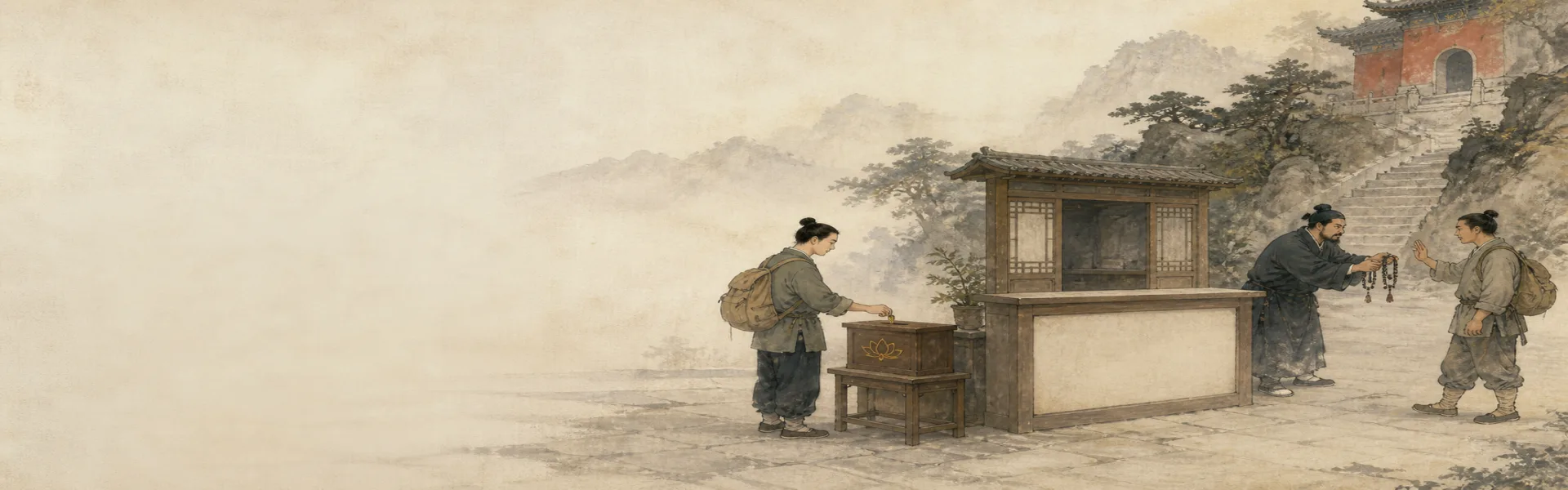
Donation boxes stand in and around halls. They take whatever amount you choose, including nothing, and ask nothing of you. There is no minimum, no expectation, and no record of who gave what. This is the standard way of giving money to a temple and it is the mechanism to use in almost every case.
Temple counters sell incense, printed material and sometimes small objects, at stated prices. Buying from these is straightforward and the money goes to the institution.
Rites requested from a temple are a formal arrangement made through the temple, with the contribution understood in advance. This is a normal and long-established function of such an institution. It is not marketed to foreign visitors and you are unlikely to be offered it.
What all of these share is that the price is knowable before you commit, and that nobody initiates the transaction except you.
The pattern to recognise
Pressure-based solicitation at religious sites worldwide follows one structure, and it is worth learning the structure rather than memorising a list of specific tricks.
First, contact is initiated by them. Somebody approaches you, rather than you approaching a counter. This single feature identifies most of what follows.
Second, something is given to you before a price is mentioned. Incense placed in your hand, an amulet, a written charm, a blessing already begun, a lot already drawn. Once you are holding an object or a service has started, the situation has changed, and it has changed deliberately.
Third, the price appears late and is large. It may be framed as a donation rather than a price, which makes refusal feel like meanness rather than a commercial decision, and it may rise during the conversation.
Fourth, refusal is made to feel costly. Suggestions of bad luck, of disrespect, of an incomplete rite that must now be finished, or simply persistent presence and an unwillingness to let the conversation end.
Fifth, there is urgency. A decision is needed now, the moment is auspicious, the opportunity is closing. Nothing legitimate at a temple requires an immediate decision, and manufactured urgency is the clearest single indicator available.
Notice that none of these steps requires anyone to lie. That is what makes the pattern effective, and why identifying the structure works better than trying to spot a false claim.
Specific things to refuse
Refusal is easier when you have decided in advance what you are refusing, so here is the list.
Anything handed to you by someone who approached you. Incense, an amulet, a charm, a bracelet, a printed blessing. Do not take it into your hand; once you are holding it the conversation becomes about payment.
Any service that begins without a stated price. A blessing, a reading of your face or hand, a fortune, a rite performed on your behalf, or an offering made for you. If it has started and no price was agreed, the price is being kept for later.
Any request for a donation with a suggested amount, from an individual rather than through a box or counter. Legitimate giving is anonymous and unprompted.
Any claim of special access: a hall not open to ordinary visitors, a senior priest available for a private audience, a ceremony you can join for a fee. Access at a temple is not sold.
Any offer of martial arts instruction, lineage certification or discipleship arranged on the spot. These are not things that exist as an impulse purchase.
Any transaction where the amount changes after you have agreed, or where change is not returned, or where you are moved somewhere quieter to conclude it.
And anything at all that must be decided immediately.
How to get out of it
Extraction is easier than people fear, and the technique is unglamorous.
Do not accept the object. This is the single most effective move, because the whole structure depends on you holding something. Keep your hands where they are, say no, and keep walking.
Do not engage with the reasoning. You will not win an argument about whether a rite is now incomplete, and attempting it extends the interaction, which is what the other person wants. A repeated, unelaborated no is far more effective than an explanation.
Keep moving. Standing still to sort it out is what makes it possible. Walking away is not rude in this situation and does not require a conclusion.
Do not pay to end it. Paying something small to escape teaches you that it works and teaches them the same. If you genuinely feel unsafe, that is different, and paying to leave a situation is a reasonable decision; but the ordinary case does not require it.
If someone is persistent, walk toward staff. Uniformed scenic area staff, a ticket point, or a temple counter changes the situation immediately, because the practice depends on being away from official attention.
And if you have already paid more than you wanted, let it go. It is a small loss and the annoyance costs more than the money. Do not let it colour the rest of the visit, which is the real cost.
Why refusing is not disrespectful
The reason this pattern works on decent people is that it borrows the authority of the religion, so it is worth dismantling that borrowing explicitly.
Declining to pay a stranger has no religious meaning. It is not disrespect to the temple, to Taoism, or to the figure in the hall. The temple has not asked you for anything, and the person asking is not acting for the temple.
Giving is voluntary in principle in this tradition, which is exactly why an amount cannot be demanded. A donation with a required figure is not a donation.
Clergy do not solicit. If somebody in religious dress approaches you and asks for money, you have almost certainly not met temple clergy, and treating the encounter as ordinary commerce is the correct reading rather than a cynical one.
And nothing bad happens when you refuse. There is no curse, no incomplete rite, no offence recorded. The suggestion that there might be is the mechanism, not the tradition.
If you want to give
Most visitors do want to leave something, and the mechanics are simple and worth knowing so that generosity does not become a vulnerability.
Use a donation box. It is the standard method, it is anonymous, it takes any amount, and it goes to the institution. If you want your money to reach the temple, this is how.
Buy from a temple counter. Incense, printed material or a small object bought at the temple's own counter supports the place directly and gives you something.
Give what you would give at home to a comparable institution, in small notes, and do not treat the amount as a measure of anything. Quantity is not devotion, and this applies to money as much as to incense.
If you want to support conservation or a specific building, ask at a temple counter whether there is a mechanism. Sometimes there is, and it will be an ordinary and posted one.
Bring cash in small notes. Boxes and small stalls do not take cards, and foreign cards are not smoothly integrated into everyday payment in China, so a visitor without cash often cannot give at all.
Keeping it in proportion
A closing corrective, because a page like this can leave a worse impression than the place deserves.
Most visitors to Wudang encounter none of this. The temples are ordinary registered institutions, the vendors are ordinary vendors, the staff are doing their jobs, and the overwhelming majority of days out here involve no pressure of any kind. The pattern described above exists at busy religious and tourist sites in every country and is not a feature of Wudang or of Taoism.
The defence is also very light. Do not take things from strangers, do not agree to anything with an unstated price, and do not decide anything immediately. Those three habits cover the entire field, cost nothing, and can be held in mind without vigilance.
Beyond that, the sensible attitude is generosity with attention rather than anxiety about money. Put something in a box, buy your incense at a counter, be unhurried, and spend the rest of the day looking at one of the more remarkable pieces of siting and building in China.
Sources and limits: this page describes patterns common at busy religious sites internationally and reported consistently by visitors. It makes no allegation against the temples at Wudang, their clergy, their staff or any licensed vendor, and names nobody. It contains no prices, because charges change and stale figures mislead. Notices, official channels and instructions at any specific site always take precedence over this page.
Key points
Normal spending has a knowable price and is always initiated by you: tickets, stalls, temple counters and donation boxes.
A donation box is the standard way to give. It takes any amount, including nothing, and asks nothing.
The pressure-based pattern is consistent: someone approaches you, something is given before a price is stated, the price appears late, refusal is made to feel costly, and the decision is presented as urgent.
The most effective defence is not accepting the object. The structure depends on you holding something.
Refuse anything with an unstated price, any suggested donation amount from an individual, any claim of special access, and anything requiring an immediate decision.
Repeat an unelaborated no, keep walking, and do not argue the reasoning.
Do not pay to end it in the ordinary case, and walk toward staff if someone persists.
Refusing has no religious meaning. Clergy do not solicit, and a donation with a required figure is not a donation.
To give: use a box or a temple counter, bring small cash notes, and remember that quantity is not devotion.
Most visitors meet none of this. Three habits cover it all, so read this once and stop worrying.