Taoist Clergy: How to Address Them
在武当山如何称呼和对待道长
Visitors are more nervous about talking to clergy than about anything else on the mountain, and the nervousness is unnecessary. The conventions are few, the tolerance for getting them slightly wrong is high, and the most common outcome of a polite question is a helpful answer. This page sets out the words, the recognition, and the small physical habits that make an interaction easy.
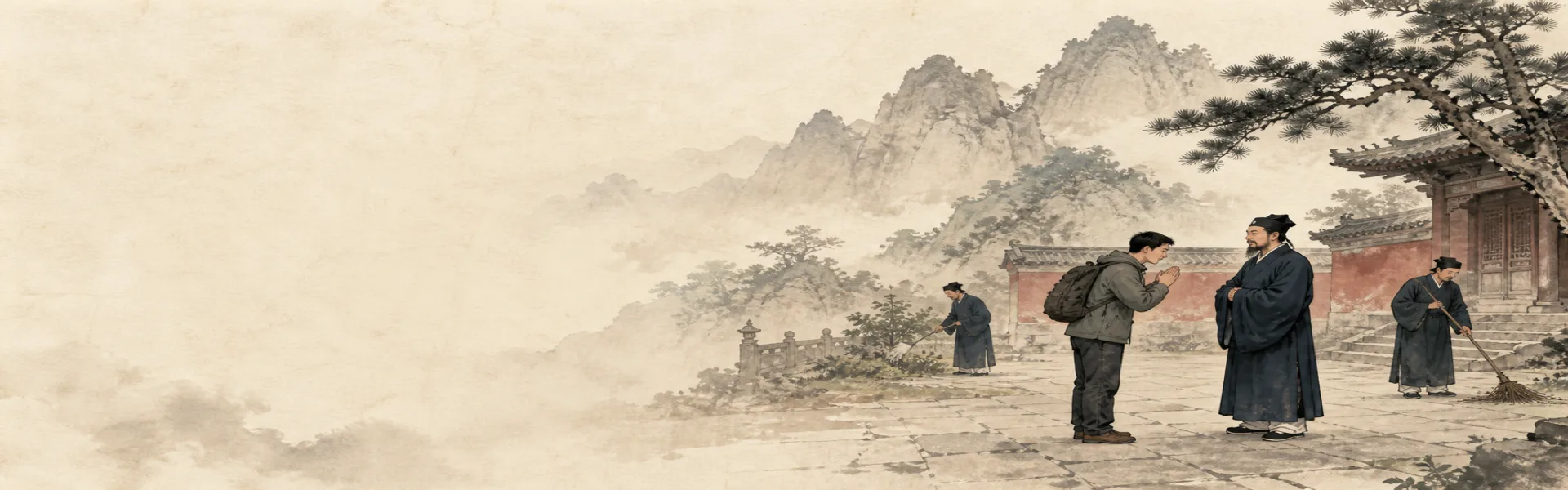
How to address them
The general term for a Taoist priest or nun is daozhang, which functions as a respectful form of address and can be used for any ordained person you meet, of either sex. If you learn one word before visiting, learn this one.
Used on its own it works as a greeting and as a way of getting attention politely, in the way that a general honorific does in any language. It requires no knowledge of the person's rank or role, which is precisely why it is useful to a visitor. There are more specific terms for particular positions and levels of seniority, and there is no expectation that you will know or use them.
Two things to avoid rather than errors to fear. Do not use Buddhist terms, since visitors sometimes transfer vocabulary from a more familiar tradition and the effect is a small but real category mistake. And do not use words like master in a way that implies martial arts instruction, since a temple priest is not a martial arts teacher and the conflation is one that people on this mountain encounter constantly.
If you have no Chinese at all, an ordinary greeting in your own language with a small bow of the head is perfectly acceptable. Nobody expects a foreign visitor to have the vocabulary, and the courtesy is legible without it.
The salute
A small hand gesture accompanies greeting, and using it or not using it are both fine.
The Taoist form holds the hands in front of the chest with one loosely enclosing or covering the other, with a slight bow of the head. It differs from the palm-to-palm gesture common in Buddhist contexts, and the distinction is the only part worth remembering.
You are not obliged to do it. A simple nod of the head with your hands at your sides is unambiguous, entirely acceptable, and impossible to get wrong. If you would rather do that, do that.
What is not appropriate is the more elaborate ritual hand forms used during a service. Those carry specific meanings within the rite, and reproducing one as a greeting is the equivalent of using a liturgical formula to say hello.
Handshakes are not the local convention and are best not initiated, though a priest who offers one is offering one and you should take it.
Recognising clergy
Recognition is less obvious than visitors expect, and getting it wrong in either direction is common.
The clearest markers are robes and hair. Formal robes appear for services and vary by occasion and rank. Hair is typically worn long and gathered rather than cut. Wudang's clergy are Quanzhen, which is the monastic branch of organised Taoism: celibate, living in community, resident at the temple.
The complication is that during ordinary working hours you may see the same people in plain clothes, sweeping a courtyard, carrying materials or dealing with a delivery. A temple is a working institution and most of a day's labour is not liturgical. Someone in ordinary clothes may well be ordained.
The reverse also holds. Not everyone in a robe-like garment is clergy, and the site holds employed staff, volunteers, heritage workers, and occasionally people in costume for photographs. Martial arts school staff and students in training clothes are also visible around the mountain and are not clergy at all.
The practical resolution is that recognition rarely matters. Ordinary politeness to everyone on site removes the need to classify people, and if you address a member of staff as daozhang, nothing happens beyond a mild correction at most.
Talking to them
Brief conversation is normal and usually welcome. The constraints are practical rather than ceremonial.
Time is the main one. Clergy are working, temple populations are small, and someone crossing a courtyard is generally on the way to do something. A short question is fine; an extended conversation is a request for someone's working time. If a person is clearly occupied, wait or come back.
Language is the second. Most clergy at Wudang do not speak English, and translation applications work variably with religious vocabulary. Keep questions simple and concrete, since abstract questions translate badly and produce confusion in both directions.
Good questions are specific and answerable: what this hall is called, who the figure on the altar is, when the morning service takes place, whether a particular hall is open. These are the questions clergy answer many times and can answer quickly.
Less good questions are large ones. What is Taoism, what do you believe, what is the meaning of the Tao. These are not offensive, but they cannot be answered to a stranger in two minutes across a language barrier, and asking them tends to produce a polite deflection that leaves both parties dissatisfied.
Also avoid the interview frame. Questions about someone's personal religious life, why they became a priest, whether they miss their family, or what they think of the government are private, or political, or both. A visitor is a stranger, and the ordinary boundaries of talking to strangers apply.
Physical conventions
A handful of physical habits are worth adopting, all of them small.
Do not touch clergy, including a hand on the arm or shoulder that would be unremarkable elsewhere. Physical contact with strangers is less usual in Chinese social convention generally, and more so with someone in a religious role.
Do not photograph clergy without asking, and accept refusal immediately. Being photographed constantly by strangers is a known irritation for anyone in visible religious dress, and a camera raised without a question is the single most frequent small discourtesy on this mountain.
Do not obstruct. If a priest is moving through a hall or a courtyard, they are going somewhere; step aside rather than continuing a conversation in their path.
Do not follow someone into a space you would not have entered on your own. Doorways that clergy pass through are not therefore open to you.
Do not hand something directly to a priest with one hand or across an altar. If you are giving something, use both hands, and if it is money, use a donation box instead, for reasons covered on the next page.
Remove hats when speaking to clergy inside a hall, which is the same convention that applies to being in the hall at all.
Money and offerings
The general principle is that money goes into a box rather than into a hand, and it removes almost all awkwardness.
Do not offer cash to a priest personally. It creates an ambiguous situation, it can be genuinely unwelcome, and a donation box or a temple counter serves the purpose without any ambiguity at all. If you want to give in acknowledgement of a conversation or a service, that is what the box is for.
Do not offer gifts, food, alcohol or cigarettes. Monastic communities are vegetarian, and the gesture that would be hospitable in another setting is misplaced here.
Do not tip. There is no tipping convention in this context and offering one recasts a courtesy as a transaction.
If a rite is performed at your request, that is a formal arrangement made with the temple, with the contribution understood in advance and handled through the temple's own channel. That is a different matter from an individual transaction and is entirely ordinary.
Clergy do not solicit. If somebody in religious dress approaches you and asks for money, or offers a blessing or an amulet for payment, you have almost certainly not encountered temple clergy, and the appropriate response is to decline and walk on.
Novices, staff and students
Several other groups are visible and it helps to know roughly who they are, since visitors often merge them.
Younger people in temple dress may be novices or in training. They are within the institution but not necessarily able to answer questions, and treating them with the same ordinary politeness is all that is required.
Employed staff and volunteers run counters, sell incense, manage donation boxes and keep halls in order. For practical questions about the temple they are often the best people to ask, and more likely than clergy to have time.
Scenic area staff, in uniform, handle tickets, transport, paths and crowds. They are the right people for access and timing questions and frequently know nothing about religious matters, which is not evasion but division of labour.
Martial arts students and school staff are numerous around the mountain and have no religious role. A teacher at a private school is not clergy, and a school's relationship to the temples ranges from close to nonexistent. Assuming otherwise is the most common category error visitors make here.
If you get it wrong
Something worth saying plainly, since it is the source of most of the anxiety: getting any of this wrong has almost no consequences.
Use the wrong term, make the wrong gesture, ask a question that is too large, or raise a camera before asking, and the realistic outcome is a mild correction, a deflection, or nothing at all. Nobody is testing you, and foreign visitors are not expected to know the conventions.
The correct response to a correction is small: stop, adjust, continue. Extended apology draws far more attention than the original error and is more disruptive than the thing being apologised for.
The one habit that covers everything is ordinary courtesy delivered slowly. Be quiet, be unhurried, ask before doing, and accept a no without negotiating. Everything else on this page is detail.
Sources and limits: this page describes general conventions of address and conduct at working Taoist temples. Terms of address, dress and internal roles vary between traditions, institutions and occasions, and individual temples differ in practice. Nothing here sets out doctrine. Notices and instructions at any specific site, and the wishes of the people you meet, always take precedence over this page.
Key points
- Daozhang is a respectful general term for any ordained Taoist, of either sex, and is the one word worth learning.
- Avoid Buddhist vocabulary, and avoid calling a priest master in a way that implies martial arts instruction.
- The Taoist salute encloses one hand with the other at chest height; a simple nod with hands at your sides is equally acceptable.
- Clergy at Wudang are Quanzhen: monastic, celibate and resident. They may be in ordinary clothes doing ordinary work.
- Keep questions short, simple and concrete. Large questions about belief cannot be answered to a stranger across a language barrier.
- Do not ask about someone's personal religious life, family or politics.
- Do not touch clergy, do not photograph them without asking, do not obstruct them, and do not follow them through doorways.
- Money goes into a donation box, never into a hand. Do not offer gifts, alcohol, cigarettes or tips.
- Clergy do not solicit. Anyone in religious dress asking you for money is almost certainly not temple clergy.
- Martial arts teachers and students are not clergy. Confusing the two is the commonest category error here.