Yuzhen Palace at Wudang Mountain: Zhang Sanfeng, Fire and Relocation
武当山遇真宫:张三丰、火灾与整体抬升
Yuzhen Palace stands on low ground near the foot of the range, and it has the strangest history of any building on the mountain. It was built to honour a man the court could never find, it burned down while being used as a martial arts school, and it was then lifted bodily about fifteen metres into the air to save it from a reservoir. Each of those facts is worth understanding, and together they compress the whole modern condition of Wudang into one site.
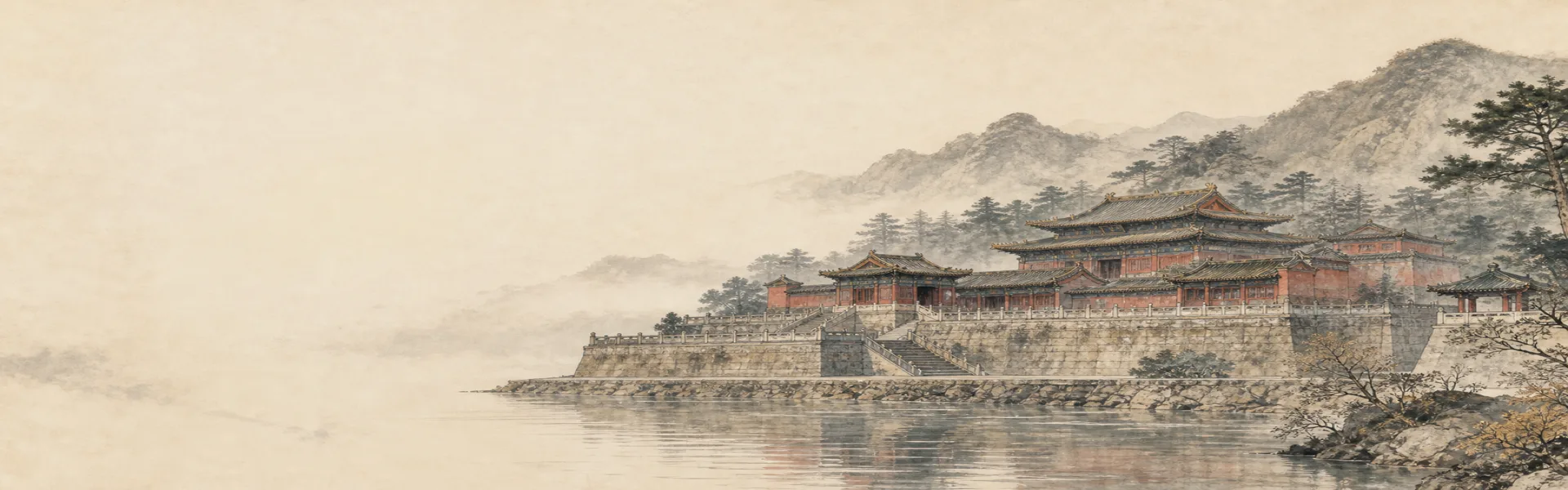
A name recording a meeting that never happened
The name means, roughly, the palace of meeting the perfected one, and it commemorates an encounter that did not take place.
The Yongle emperor made repeated efforts to find Zhang Sanfeng, the Taoist adept associated with this mountain. Envoys were dispatched, edicts were issued addressed to him personally and respectfully, and the search went on for years. He was never located. The emperor's response was to build a palace in his honour anyway, on the site associated with him, and to name it for the meeting he had wanted.
Read that as a piece of political theatre and it makes complete sense. A ruler who has seized a throne benefits from the endorsement of a holy man; failing to obtain the endorsement, he can at least demonstrate publicly and expensively that he sought it. The building is a monument to imperial deference, which was exactly the impression required. That the honoured party never appeared did not weaken the gesture and may have improved it, since an absent immortal cannot decline to cooperate.
Who Zhang Sanfeng was, as far as we can tell
Be careful here, because this is one of the points where popular accounts are most confident and the evidence is thinnest.
A Zhang Sanfeng appears in Ming records, including an official dynastic biography placed among accounts of unusual arts and practitioners. The portrait there is of an eccentric wandering Taoist of striking appearance, indifferent to hygiene and convention, credited with unusual abilities and with appearing in different places, and associated with this mountain. Dates given for him are inconsistent and in some accounts absurdly long, which is characteristic of hagiography rather than record.
What can be said honestly is that a figure of this name was known by the early Ming, was sought by the court, and was already the subject of legend in his own period or shortly after. What cannot be said is that we have a reliable biography, firm dates, or any contemporary account of him teaching a martial art. Attempts to fix him precisely tend to reveal more about the interests of whoever is doing the fixing.
Zhang Sanfeng and the martial arts claim
The standard story holds that Zhang Sanfeng founded the internal martial arts and specifically Taijiquan, and that Wudang is therefore their birthplace. This site does not endorse that claim and does not dismiss it either, and it is worth being precise about why.
The documentary difficulty is chronological. The attribution of internal boxing to a figure of this name appears in texts from the seventeenth century onward, and the specific attribution of Taijiquan to him becomes standard only in the nineteenth century, several hundred years after he is supposed to have lived. There is no early source in which he teaches or is described as teaching a fighting art. The Ming accounts of him are about a wandering adept, not a boxing master.
What follows is not that the tradition is worthless. Lineage claims of this kind do real work: they place an art within a religious and philosophical framework, distinguish it from other traditions, and assert a set of principles about softness, yielding and internal power. Those principles are genuine features of the arts concerned regardless of who originated them. But the claim is a claim about identity and meaning, not a documented historical fact, and a reader who confuses the two will misunderstand both the martial arts and the mountain.
Why an emperor searched for him
The search is easier to understand once you see what emperors wanted from adepts.
Recognition by a genuine immortal was a form of legitimation available nowhere else, because it could not be purchased, commanded or manufactured through the ordinary machinery of state. Courts also had practical interests: longevity techniques, alchemy and medicine were taken seriously at the highest level, and an adept credited with extraordinary powers was worth finding for reasons that were not purely symbolic.
There was also a competitive element. Zhang Sanfeng was associated with this mountain, and the mountain was being rebuilt as the dynasty's own sacred site. Securing its most famous living figure would have completed the programme. Building him a palace in absentia completed it well enough.
The fire
In 2003 the main hall was destroyed by fire. At the time the building was occupied by a martial arts school operating on the site, and the loss became a widely discussed case about the use of protected heritage buildings for unrelated purposes.
The circumstances matter more than the blame. A timber hall of the early fifteenth century, in daily use by an organisation with no conservation responsibility, with the electrical and heating arrangements that daily use implies, is a structure at high risk. Chinese timber architecture burns easily, and the history of this mountain is largely a history of fires. What made this one notable was that the building was legally protected and the risk was foreseeable.
The consequences went beyond one hall. The episode contributed to a tightening of practice about what may be done inside heritage structures on the mountain, which is part of why some buildings you would like to enter are now closed or restricted. There is a direct line between that fire and the rules you encounter as a visitor.
Raising the palace
Then the water arrived, and produced the most extraordinary engineering response anywhere on the mountain.
The Danjiangkou reservoir immediately north is the source for the central route of the South-to-North Water Diversion Project, and raising the dam raised the design water level to a height that would have submerged what remained of Yuzhen. Demolition was unacceptable for a protected monument. Dismantling and re-erecting elsewhere would have destroyed the relationship between the buildings and their site, which is part of what heritage status protects.
The solution adopted in the early 2010s was to lift the surviving structures where they stood. The buildings and their bases were separated from the ground, jacked up in a controlled operation, and set on new foundations roughly fifteen metres higher, clear of the new water line. It is one of the more remarkable heritage engineering projects carried out in China, and it is difficult to appreciate from a photograph, because a building that has been raised looks exactly like a building that has not.
The intellectual interest is in what the decision reveals. Physical relocation was rejected, but vertical relocation was accepted, on the grounds that lifting preserves the relationship between a building and its place while moving it does not. Whether that distinction holds is a real question, and it is a good one to stand on the site and think about.
What is there now
Expect a modest site rather than a spectacle. There is a gateway group and enclosure, reconstructed and rebuilt elements, the raised structures on their new foundations, and open ground. The main hall lost in 2003 has been reconstructed rather than restored, which is a different thing and is generally acknowledged as such.
The interest here is almost entirely historical and conservational rather than architectural. You are not coming to admire Ming carpentry; you are coming to stand at the place where an emperor honoured a man he never met, where a fire changed policy, and where a building was lifted out of the way of a national water project. If that interests you it is well worth an hour. If it does not, it is the one outlying site you could reasonably skip.
Practical notes
The site is near the foot of the range on relatively level ground, so it is physically easy compared with anything on the ascent and is among the more accessible significant sites, though surfaces are uneven in places.
It is the quickest of the outlying palaces to see, which makes it a sensible pairing with the great ruined complex nearby if you are giving a day to sites off the axis. Interpretation is limited and largely in Chinese. Shade and shelter are limited. Access arrangements and whether the site falls inside particular ticketing boundaries change, so confirm locally on the day rather than relying on anything published in advance, including this page.
Sources and limits. The Ming search for Zhang Sanfeng, the foundation of the palace, the 2003 fire and the raising of the structures follow the mountain's gazetteers, published conservation material and generally reported accounts; the lift height is the figure commonly given. The assessment of the Taijiquan attribution reflects the documentary record, in which the attribution appears long after the period concerned; traditions asserting more are reported as traditions rather than dismissed. Dates and details for Zhang Sanfeng himself are unreliable in the sources and are presented as such.
Key points
The palace commemorates a meeting that never happened: Yongle searched for Zhang Sanfeng for years and never found him.
Building it anyway was effective political theatre, demonstrating imperial deference to a holy man whose absence cost nothing.
A Zhang Sanfeng was known in the early Ming and has an official biography, but reliable dates and details do not exist.
Attribution of internal boxing to him appears from the seventeenth century, and of Taijiquan only in the nineteenth — centuries too late to be documentation.
Lineage claims still do real work in framing an art's principles, but they are claims about meaning rather than historical facts.
The main hall burned in 2003 while occupied by a martial arts school, tightening rules about use of heritage buildings mountain-wide.
In the early 2010s the surviving structures were jacked about fifteen metres onto new foundations to escape the rising reservoir.
The interest here is historical and conservational rather than architectural, and the site is quick, level and easy to reach.