Wulong Palace at Wudang Mountain: The Oldest Remote Temple Site
武当山五龙宫:最古老的偏远宫观遗址
Wulong Palace, the Palace of the Five Dragons, sits in a valley away from the visitor axis and is the oldest important foundation on the mountain. It is also the hardest of the major sites to reach, receives very few visitors, and is largely ruined. For a certain kind of traveller it is the best place on Wudang, and for others it would be a wasted day. This page tries to let you tell which you are.
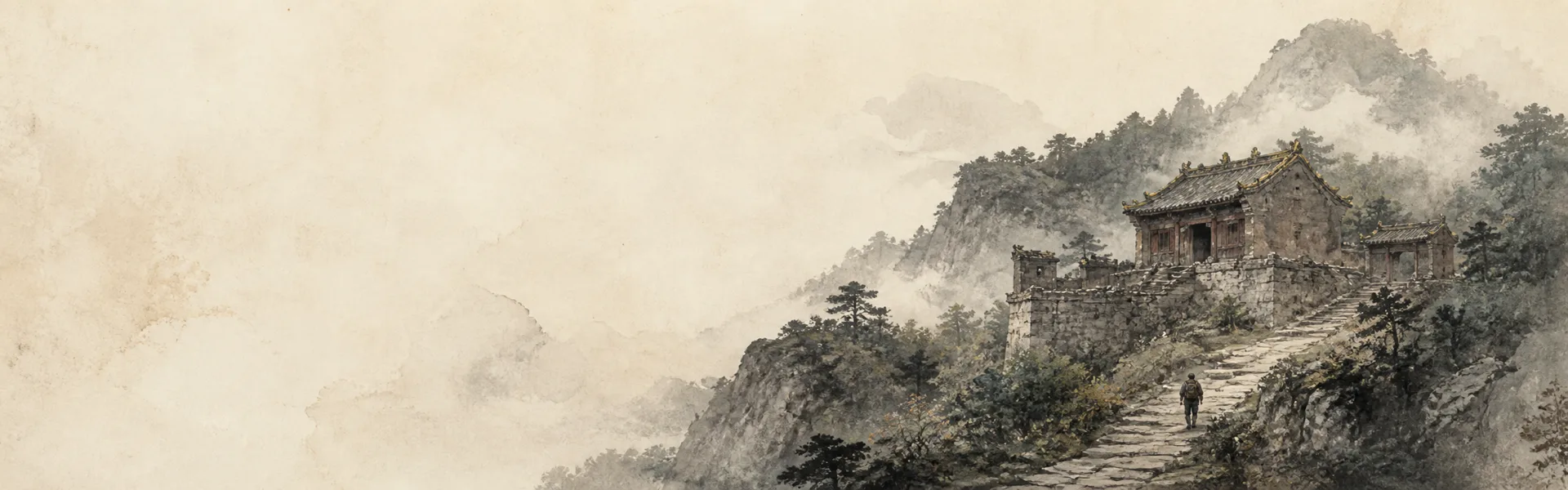
Why it is the oldest
Every other major complex on the mountain owes its present form to the Ming, and most owe their existence as institutions to the Song or Yuan. Wulong goes back further: state-sponsored building here begins in the early Tang, which makes this the point at which the mountain first enters official history as a place that governments funded.
That distinction is worth more than it might appear. Before Wulong, Wudang was a mountain with hermits on it — a reputation without an institution. After Wulong, it was a place with a shrine built by imperial order, on a court's decision, at public expense. The transition from reputation to institution happened here, and everything else on the mountain, including the vast Ming programme eight centuries later, follows from that first entry in the record.
It should be said clearly that what you see on the ground is not Tang. Buildings were rebuilt repeatedly, and the standing and ruined fabric is overwhelmingly Ming and later. What is old is the site's status as a foundation, not its stones.
What the founding story tells you
The traditional account is that a regional official prayed here during a drought, five dragons appeared, rain fell, and the court ordered a shrine built in acknowledgement.
Set aside the question of whether dragons appeared and look at the structure of the episode, because it is a template. A locality has a problem the state cannot solve by administration. An official performs a ritual at a place with a religious reputation. The problem resolves. The state, having received a result, formalises the arrangement by funding a building and thereby taking the site onto its books.
This is how sacred places were financed in imperial China. Efficacy was the criterion, and the relationship was transactional and openly so: a deity that produced results received recognition, titles and endowment, and one that did not could be demoted or ignored. Wulong's founding story is not a pious fable attached later; it is a record of a normal administrative procedure in the vocabulary the period used for it.
Note also the subject matter. Five dragons and a drought means water, and water is the portfolio that Zhenwu, a northern water deity, would later occupy on this same mountain. The mountain's first official function was rainmaking, and its eventual patron god was a water god. That is continuity of function across a change of personnel, which is exactly how the celestial administration is supposed to work.
Rank, and how it rose
The site's changing titles are a compact record of its fortunes, and they illustrate how Chinese religious institutions were graded.
It began as a shrine, the lowest of the formal categories. Under the Song, as the Zhenwu cult rose, it received an imperial name plaque, which is a specific act of recognition rather than a compliment. Under the Yuan it was promoted to the rank of palace, the highest category, which carried consequences in endowment, permitted scale and the size of the resident community. The Ming then rebuilt it as one of the principal palaces of the great programme.
Rank in this system was formal, legible and consequential. A promotion from temple to palace was not an honorific; it changed what the institution could build, how many clergy it could support and what income it was assigned. When you read that a site was elevated, read it as a budget decision.
What is there now
Expect a ruin in a beautiful place, with a small living presence.
There is a gateway and enclosure, terraces and platforms marking where major halls stood, column bases, paving, retaining walls, and the water features that were part of the site's identity. There are stone stele pavilions of the Ming with large inscribed tablets carried on stone animals, and these are among the most valuable things here. Some buildings stand or have been reconstructed, and there is generally a small clergy presence, so this is not a dead site.
Because the valley is enclosed and wooded and the visitor flow is negligible, the atmosphere is completely unlike the central route. This is the closest you will get on Wudang to what the mountain was like before mass tourism, and it is the strongest argument for making the effort.
The steles and the springs
Two features deserve particular attention.
The Ming steles are primary documents standing where they were erected, recording imperial orders, endowments and titles. As at other sites, stone outlasted the halls, so the written record of the place is better preserved than the place. If you read Chinese, spend time on them; if not, the pavilions and the animals beneath the tablets are still worth close looking.
The water is the other. Springs and pools here are not incidental amenities but part of why the site exists, given a founding story about dragons and rain and a later patron deity governing water. Named springs and wells acquired their own stories and small shrines. Standing beside them is the clearest way to grasp that Chinese sacred geography is frequently hydrological: the question asked of a landscape was often simply where the water comes from and whether it can be relied upon.
Why the seclusion is the point
It is tempting to treat the remoteness as an inconvenience. It is better understood as the site's original quality.
This valley was chosen long before there was any thought of visitors, at a time when the virtue of a religious site was that it was difficult to get to. Seclusion was not a side effect of poor transport; it was the specification. A place hard to reach filtered out the casual, imposed effort on the committed, and gave those living there the conditions that reclusive cultivation required — quiet, water, timber, distance from officials and markets.
The comparison with the great administrative palace at the foot of the range is the most instructive thing in this group of pages. One site was built to receive crowds and run a bureaucracy; the other was built to be difficult. Both are Wudang, and they represent two incompatible ideas about what a religious place is for, standing a valley apart from each other. Visiting both in one day is the single best way to understand the mountain's history.
What ruins in a wood are like
The condition here differs from the great ruined palace at the foot of the range, and the difference is worth anticipating.
That site sits on open flat ground, cleared and excavated, so its plan is exposed and legible at a glance. Wulong is in a wooded valley, and vegetation has been part of the site for a long time. Foundations emerge from undergrowth, trees stand where halls stood, moss and lichen cover dressed stone, and the outline of the complex has to be assembled in your head from fragments rather than read off the ground.
That makes it harder work and, for many visitors, more affecting. A cleared ruin looks like an archaeological project; an overgrown one looks like time passing. Neither impression is more accurate than the other, but they produce very different visits, and if you only have appetite for one ruined site you should choose according to which of those two experiences you actually want.
Getting there
Arrangements change and no route, distance, time or fare is given here, but the structure of the problem is stable and worth knowing.
This site is not on the main ascending circuit and is not reached casually. Approaches involve a substantial walk, and some routes connect it to sites on or near the axis by mountain paths, which is the most rewarding way to arrive and also the most demanding. Because the walk is long and the site is remote, the return journey needs to be settled before you set out rather than improvised afterwards, and starting early matters more here than anywhere else on the mountain.
Facilities are minimal or absent. Carry water and food, and do not count on buying either. Mobile coverage in valleys should not be assumed. Weather affects paths, and after heavy rain conditions can be poor. Ask locally on the day, and ask more than one person.
Whether to go
Go if you want to see where the mountain's recorded history begins, if ruins and ground plans interest you, if you value quiet enough to spend most of a day obtaining it, and if you are comfortable with a long walk and thin infrastructure.
Do not go if your time is short and the summit matters to you, if you need interpretation to enjoy a site, if you are travelling with people who will be unhappy walking for hours to see foundations, or if the weather is poor. There is no shame in deciding against it. It is the least convenient significant site on Wudang, and the honest position is that its rewards are real but narrow.
Sources and limits. The Tang foundation, the Song name plaque, the Yuan promotion and the Ming rebuilding follow the mountain's gazetteers and published studies; precise dates vary between sources. The founding story is reported as tradition and analysed as an administrative pattern rather than treated as an event. Nothing here should be read as a current description of routes, walking conditions, access or facilities, all of which change; confirm locally before setting out.
Key points
Wulong is the oldest important foundation on the mountain, with state-sponsored building beginning in the early Tang.
It marks the transition from a mountain with a reputation to a mountain with an institution on the state's books.
What is old is the foundation's status, not the visible fabric, which is overwhelmingly Ming and later.
The founding story of five dragons and a drought records a normal procedure: ritual produces a result, the state funds a building.
The site's first official function was rainmaking, and its eventual patron Zhenwu was a water deity — continuity of function across a change of personnel.
Its rising titles from shrine to palace were budget decisions, not honorifics.
Remoteness was the original specification, not an inconvenience, which makes it the perfect contrast with the administrative palace at the foot.
Reaching it needs a long walk, an early start, a settled return and no reliance on facilities.