Chinese Face Reading (Mianxiang): Methods, Meanings and Limits
中国面相术:方法、含义与局限
Face reading, known in Chinese as mianxiang, is the most developed branch of Chinese physiognomy. Its premise is that the face is a kind of map on which a person's temperament, relationships, and fortunes across the stages of life can be read. Over many centuries practitioners built up a detailed and internally organised scheme for dividing and interpreting the face, and this page sets out its main features as the tradition itself presents them.
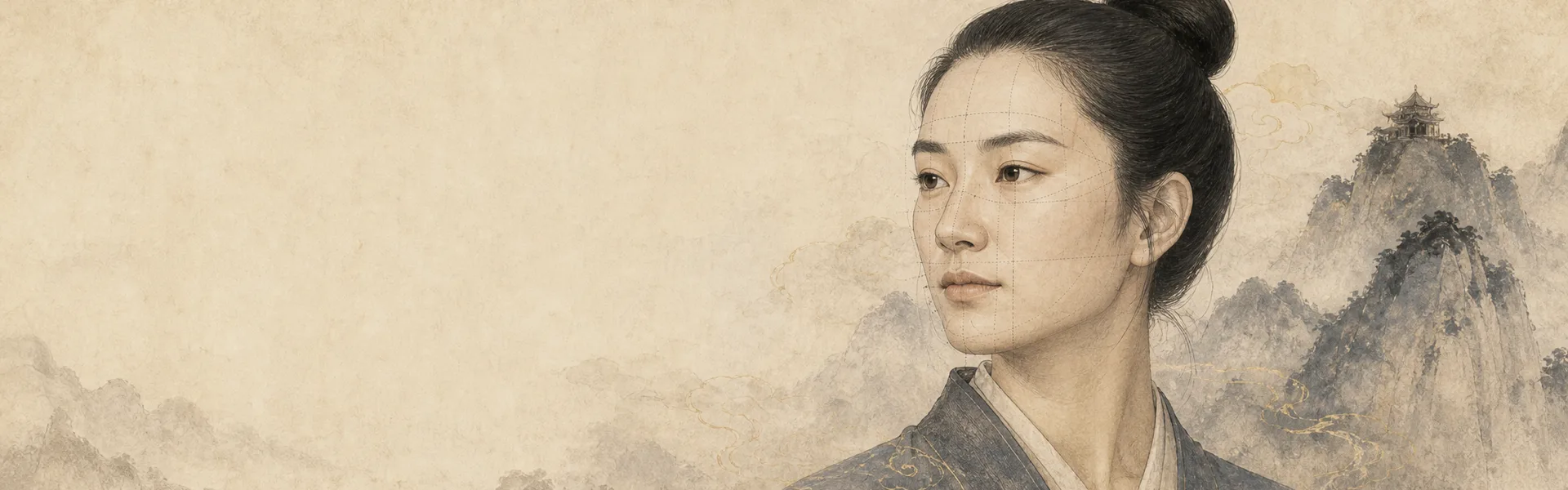
Divide first, judge second
Face reading proceeds by treating the face as a mapped diagram. A fixed set of rules divides the face into regions; each region is assigned a department of life; and the shape, colour and condition of that region are then read for a verdict on that department.
Every school works this way, and what distinguishes one from another is only how the divisions are drawn and what verdicts are attached to them. The procedure is constant even where the content is contradictory, which is worth noticing: it means the disagreements between schools cannot be resolved by any appeal to method, since the method is the same on all sides.
Several overlapping schemes of division are in use at once, and a reader is expected to hold them simultaneously — three horizontal zones, five features, twelve palaces, thirteen positions, and a year-by-year map. They do not always agree about which part of the face governs what, and no rule of precedence exists among them.
The three zones
One of the oldest organising ideas is the division of the face into three horizontal zones. The upper zone, from the hairline to the eyebrows, is associated with early life and with inherited fortune and intelligence. The middle zone, from the eyebrows to the tip of the nose, is linked to the middle years, to drive and self-assertion. The lower zone, from the nose to the chin, is connected with later life, with the emotions, and with one's relationships and descendants. A face in which the three zones are balanced and well-proportioned is traditionally read as a sign of a life that unfolds evenly; imbalance among them is read as unevenness in fortune across the corresponding stages.
The five features and their offices
Within this framework, each feature carries its own meanings. The forehead is taken as an indicator of early fortune and of the intellect. The eyebrows are read for temperament and for relations with siblings and friends. The eyes, considered the most important feature of all, are said to reveal vitality, honesty, and the underlying spirit of the person. The nose, occupying the centre of the face, is associated with the self, with wealth, and with the middle years. The mouth and chin are linked to appetite, speech, emotional life, and old age. The ears, read somewhat apart, are associated with early childhood, health, and longevity.
The twelve palaces
The finer of the standard divisions is a set of twelve palaces, named similarly to those of Zi Wei Dou Shu but located on specific parts of the face. The space between the brows is the Life Palace; the nose is Wealth; the eyebrows are Siblings; the upper eyelids are Property; the area beneath the eyes is Children; the outer corners of the eyes are Marriage; the bridge of the nose between the eyes is Illness; the temples are Travel; the mid-forehead is Career; the upper forehead is Fortune and Virtue; the ridges to either side of the upper forehead are Parents; and the sides of the lower jaw are Servants.
Like the palace list in Zi Wei Dou Shu, this scheme is itself a social document. What received a dedicated place on the face was kin, property, office and servants. Learning, inclination, friendship outside the clan, and inner life have no palace of their own. The map records what a particular society counted as the constituents of a life, which makes it genuinely interesting as history and poorly suited to describing anyone now.
The thirteen positions and the year map
A more elaborate scheme divides the face into a large number of named positions, sometimes counted as a sequence running from the top of the forehead down to the chin, each assigned to a particular year or period of life. In this system the reader can, in principle, locate the "age" being asked about on the corresponding part of the face and judge the fortune of that period from the condition of that spot. Marks, moles, scars, and changes of colour are read as signs bearing on the matter governed by their location. To this is added the reading of complexion and of the movement and expression of the features, which practitioners regard as at least as important as fixed shape, since they are thought to reveal a person's current state and spirit rather than their fixed endowment.
Five Phase classification of faces
The tradition also draws on the wider vocabulary of Chinese metaphysics. Faces and features are classified according to the five phases, so that a face may be described as belonging to a wood, fire, earth, metal, or water type, each with its own associated temperament and its own harmonies and conflicts with the others. The five features, the ears, eyebrows, eyes, nose, and mouth, are likewise brought into correspondence with the five phases and with various organs of the body, tying face reading to the same cosmology that runs through the rest of this section.
What the manuals actually value most
Behind all the itemised rules, the manuals themselves insist that the categories are secondary. The formula repeated throughout the literature is that form without spirit is not worth taking: what matters most is shen (神), the quality of presence, and qise (气色), the colour and lustre of the complexion. Is the gaze steady? Is the skin clear and well-coloured? Is the bearing composed?
This layer is the one closest to the defensible part of the art. Whether a person has slept, whether they are ill, whether they are frightened or at ease does show in complexion and expression, and it is what Chinese medical diagnosis attends to as well. A practitioner concentrating here is looking at something real.
But the same feature that makes it real makes it useful in another way. Spirit cannot be measured, described precisely, or checked by a third party, and so it functions as the system's most convenient reserve: when a reading based on the fixed categories turns out wrong, the explanation available is that the form was favourable but the spirit was insufficient. An unmeasurable quantity that can be invoked after the fact to explain any failure is not an observation, whatever else it may be.
Coherence is not evidence
It is important to hold all of this description at arm's length. The scheme is intricate, coherent on its own terms, and genuinely difficult to master, but its coherence does not make it true. There is no reliable evidence that the shape of a forehead, the set of the eyes, or the position of a mole predicts a person's character or the course of their life. Modern attempts to link facial appearance to personality or destiny have not found such connections, and the impression that a skilled reader is uncannily accurate is well explained by the general, flattering, and flexible nature of the statements involved, together with the reader's skill at observing ordinary social cues. Described honestly, mianxiang is a remarkable cultural artefact and a fascinating system of meaning, not a means of foretelling a life.
A layer that must be addressed
A description of face reading that omitted this would be dishonest. A substantial part of the traditional literature consists of moral verdicts attached to physical features.
Certain eye shapes are labelled treacherous or lustful. Certain noses are called mean. Sunken temples, a receding chin, a particular set of the mouth are read as marks of a bad character. A large body of judgement is directed specifically at women: faces described as harming the husband, as unchaste, as unlucky for the family into which they marry. These verdicts were used to decide whether a marriage went ahead, whether a person was hired, and whether they were trusted.
Two points need making about this material. First, it is not incidental to the system — it is a large fraction of what the manuals contain, and a description that presented only the neutral geometry would be misrepresenting the sources. Second, these judgements have no evidential basis and their historical use caused serious and one-sided harm, borne by people who had no means of contesting them. This site sets the material out as the content of a historical system and does not present it as a way of assessing anyone.
Lines, moles and marks
Beyond the regions themselves, the manuals read what appears on them. Moles are catalogued by position, with a verdict attached to each location — a mole here favouring wealth, there indicating tears, elsewhere signalling danger from water. Lines on the forehead are counted and read by number and continuity. Scars, discolourations and asymmetries are treated as damage to whichever palace they fall upon.
Two observations belong here. The first is that this layer generates the highest volume of judgements from the smallest amount of information, and it is correspondingly the part most used by street practitioners, since anyone can see a mole and the pronouncement can be made instantly.
The second is more serious. This is the part of the tradition that bears most heavily on people with visible differences — birthmarks, scarring, facial asymmetry, the effects of injury or illness. In a setting where these readings are taken seriously, such a person carries an additional and wholly undeserved burden of interpretation, assigned to them by an accident and unanswerable by anything they do. There is a commercial dimension too: the identification of an unlucky mole is a common preliminary to the sale of a removal or a remedy.
Where the boundary with medical diagnosis lies
Face reading and Chinese medical inspection share vocabulary, and the overlap causes real confusion, so the boundary is worth drawing carefully.
Medical inspection (望诊) examines complexion, the colour of the lips and tongue, the condition of the eyes, and the appearance of the skin, in order to form a judgement about a person's present physical state. That is an observational practice with genuine content: jaundice, cyanosis, pallor from anaemia, the flush of fever and the changes wrought by thyroid disease or prolonged malnutrition are all visible, and physicians in every tradition look for them.
Face reading uses some of the same signs to make claims of an entirely different type — about wealth, rank, marriage, character and lifespan. The signs are shared; the inferences are not comparable. That a yellow complexion may indicate liver disease is a medical observation; that a narrow nose indicates poverty is not an observation of any kind.
The practical consequence matters. Visible signs of illness should be taken to a doctor, and a physiognomic reading is not a health assessment and must never be used as one. Where a reading raises a worry about health, the correct response is a clinical examination.
Key points
Face reading, mianxiang, is the most developed branch of Chinese physiognomy.
Its premise is that the face maps temperament, relationships and fortune.
The face is divided into three horizontal zones associated with early, middle and later life.
Each feature carries its own meanings — the forehead for early fortune, and so on.
A more elaborate scheme divides the face into a long sequence of named positions.
Faces and features are also classified by the Five Phases, linking physiognomy to the wider system.
The scheme is intricate and internally coherent, but that is not evidence that it works.
Sources drawn on for this article include: Richard J. Smith's studies of Chinese divination and popular culture, general scholarship on physiognomy across cultures, and the traditional face-reading literature such as the Shenxiang Quanbian.