Origins and History of Chinese Physiognomy
中国相术的起源与历史
The idea that a person's character might be read from their outward appearance is very old and by no means uniquely Chinese; it appears in ancient Greece, in India, and across the medieval and early modern world. In China, however, this intuition was developed into an unusually elaborate and long-lived system, one that drew on the same conceptual vocabulary, of yin and yang, the five phases, and the correspondence between the human body and the cosmos, that underlies the rest of Chinese metaphysics. This page traces how physiognomy grew from scattered ancient observations into a codified art with its own classic texts and professional practitioners.
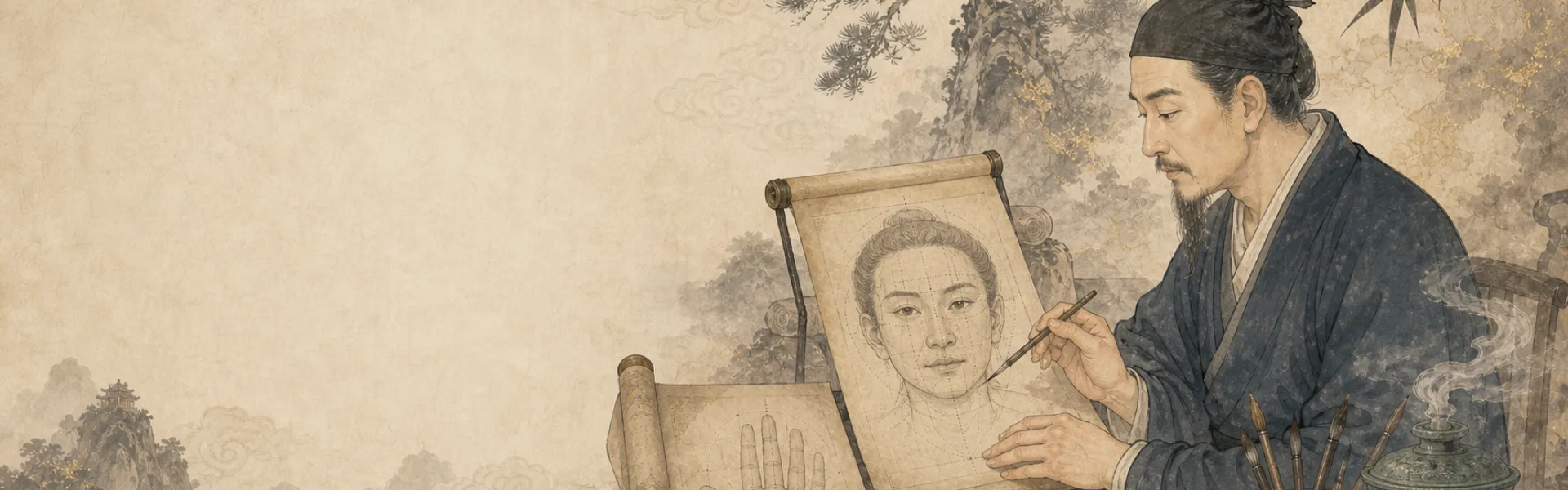
Early roots
The roots of the practice reach back into early China. References to judging people by their appearance appear in texts from the Zhou and Warring States periods, and by the Han dynasty the reading of faces was a recognisable activity associated with court advisers and travelling specialists. The famous historian Sima Qian records anecdotes in which a person's future greatness or ruin is foretold from their bearing and features, and such stories became a standard part of the biographical tradition. In these early centuries physiognomy was not yet a single organised system but a loose body of lore, closely tied to the belief that Heaven's decree could be glimpsed in a person's outward form.
The earliest criticism came from within
Before the art had produced a single manual, it had produced a systematic refutation, and the refutation is one of the most familiar texts in Chinese philosophy.
The Xunzi contains a chapter titled "Against Physiognomy" (非相). Its method is to list counter-examples: sages of antiquity who were deformed or ugly, tyrants who were tall and imposing. Having established that the correlation fails in the cases everyone knows, it draws the conclusion that has been quoted ever since — judging the form is inferior to judging the heart, and judging the heart is inferior to judging the methods a person chooses.
Two things about this deserve emphasis. The argument is empirical rather than moral: Xunzi does not say that reading faces is impious, he says it does not work, and he shows why. And it appears more than a thousand years before most of the physiognomic literature it is usually cited against.
As with feng shui and with date selection, the pattern is the same. Scepticism about this art is native to the tradition and present from the beginning, not a modern import that arrived with Western science. The objections now raised were raised at the outset, in China, by a canonical author, and they did not slow the practice down at all.
The Han: entering the divinatory system
Over the following centuries this lore was gradually organised. Physiognomy came to be treated as one of the branches of divination alongside astrology, the almanac, and the various fate-calculation systems, and it acquired a technical literature of its own. Practitioners developed named schemes for dividing the face into regions and the palm into zones, each associated with particular aspects of life. As with other Chinese arts of prognostication, much of this material was transmitted through manuals that combined diagrams, mnemonic verses, and case examples, allowing the system to be learned and passed on.
Wang Chong is worth a separate note here, because his position is revealing. In the Lunheng he demolishes feng shui, fate calculation and a long list of calendrical taboos one after another — and then, in the chapter on bone physiognomy, he accepts that bodily structure does indicate destiny, on the grounds that heaven's decree must leave some visible sign. The same rigorous sceptic draws the line in a different place on this question, which tells us that in the first century, "appearance is connected to fate" was regarded as considerably more commonsensical than choosing days or siting houses. Physiognomy has always enjoyed this advantage: it begins from something everyone does anyway, which is to form impressions of people by looking at them.
Character appraisal in the Wei-Jin period
The third to sixth centuries saw an intense fashion for appraising people, and it is important to distinguish two things that this period ran together and that later physiognomic writing was happy to keep confused.
Liu Shao's Renwu Zhi (人物志, "Treatise on Personalities") proposes nine indicators by which talent and disposition may be assessed from bearing, voice and expression. Its purpose is administrative: it is a manual for selecting officials, and its observations are broadly of the empirical kind — that a person's manner under pressure reveals something about their temperament. The famous character judgements collected in the Shishuo Xinyu are similar in spirit, and are largely aesthetic and social evaluations of presence and bearing.
This is not the same enterprise as calculating a person's lifespan, wealth or number of sons from the width of a nose. The two overlap in vocabulary and they overlap in practitioners, but they make claims of quite different orders. Later physiognomic manuals routinely borrow the prestige of the first to underwrite the second, and a reader who does not keep them apart will credit fortune-telling with the respectability of civil-service assessment.
The manuals take shape
A number of texts became especially influential. The tradition looks back to a legendary early master, Guiguzi, and to figures of the Song dynasty, when physiognomy reached a mature and widely transmitted form. The best-known classic is the Shenxiang Quanbian, a comprehensive compilation of face-reading knowledge assembled in the late imperial period, which gathered earlier material into a single reference and became the standard source for later practitioners. Works of this kind gave the art a fixed vocabulary, a recognised canon, and an appearance of systematic completeness, even though they in fact preserved a range of older and sometimes inconsistent traditions.
The attributions in this group follow the standard convention of the trade. The Taiqing Shenjian is credited to Wang Pu of the Later Zhou, the Yuguan Zhaoshen Ju to Song Qiqiu of the Southern Tang, and the Yuebo Dongzhong Ji has no ascertainable origin at all. Attaching a book to a famous name of the past is how authority was established in this field, exactly as feng shui manuals were credited to Guo Pu and fate-calculation texts to Li Xuzhong. These ascriptions are conventions of the genre and are not evidence about authorship.
The Ming: reaching the court
The Ming provides the best-documented practitioners in the history of the art. Yuan Gong (袁珙) was famous as a physiognomist and is recorded as having read the face of the Prince of Yan, later the Yongle emperor. His son Yuan Zhongche (袁忠彻) rose to office as vice-director of the Seal Office and wrote the Gujin Shijian (古今识鉴), a collection of his own cases.
The most widely circulated compendium of face reading, the Shenxiang Quanbian (神相全编), is attributed to Chen Tuan and was compiled with the involvement of Yuan Zhongche and others. It remains the standard reference from which most later popular manuals derive.
The court's attitude was ambivalent, and the ambivalence is instructive. Physiognomy was consulted, and it was also watched, because an art that pronounces on a person's future prospects is politically dangerous. A physiognomist who told a prince he had the face of an emperor was making a statement with consequences, and dynasties that had come to power through rebellion understood this better than most.
The Qing, and the verdict of the Siku Quanshu
The Qing produced more systematic writing. Chen Zhao's Xiangli Hengzhen (相理衡真), from the later eighteenth century, reorganises the scattered mnemonic verses into ordered categories and is the most clearly arranged of the Qing manuals.
More revealing is the treatment the art received in the Siku Quanshu, the vast imperial library project of the same century. Its classification includes a heading for fate and physiognomy books within the divinatory arts, and a number of works were collected under it. The editorial abstracts, however, are consistently reserved. The compilers' position was to preserve the textual lineage while declining to endorse the efficacy — an attitude that recurs throughout the Siku treatment of the divinatory arts, and one that a modern reader may find surprisingly close to their own.
Palmistry: a shorter and more mixed lineage
The Chinese tradition attended to the face and paid comparatively little attention to the hand. Palm material does appear in manuals from the Song onwards, but it occupies far less space than the face, and its categories were never standardised in the way the facial regions were.
The palmistry now current in the Chinese-speaking world is a different matter. The life line, head line, heart line and fate line, together with the mounts named for planets — Venus, Jupiter, Saturn — are substantially Western palmistry, translated into Chinese in the early twentieth century. The most influential single source was the work of the Irish palmist who wrote as Cheiro, whose books were translated and widely reprinted.
The consequence is worth stating plainly, because popular books almost never do. "Chinese palmistry" as practised today is largely a modern hybrid, and its most recognisable features are European in origin. Presenting the mount of Jupiter as ancient Chinese wisdom is an error of about two thousand years, and it is repeated in a great many books.
The modern period
In the late Qing and early Republic, Western phrenology and physiognomy were translated into Chinese and merged with the native tradition, producing works such as Chen Gongdu's Gongdu Xiangfa that attempted to place the art on a scientific footing.
The attempt failed, and it is worth being precise about why. The European material being borrowed for its scientific prestige had already been rejected by European science. Phrenology was discredited by the end of the nineteenth century. What survived of it was not a method but a habit of thought — that visible physical form reveals inner moral quality — and in Europe and America that habit was applied to racial classification and criminology with severe consequences.
After 1949 the practice was suspended for a long period on the mainland while continuing without interruption in Hong Kong, Taiwan and among communities abroad. It returned to the mainland from the 1980s, frequently under modernised labels — talent identification, image management, personality assessment — which is the same repackaging described on the introduction page, and it deserves the same scepticism in its new clothes as in its old.
Key points
Reading character from appearance is an old idea found in Greece, India and medieval Europe as well as China.
References to judging people by appearance appear in Zhou and Warring States texts.
By the Han, face reading was a recognisable activity with named practitioners.
It was later organised as one of the recognised branches of divinatory learning.
The tradition looks back to a legendary early master, Guiguzi, among other attributed sources.
That physiognomy was practised is documented; the attributions of specific texts often are not.
By the late imperial period it was a thoroughly popular art practised alongside learned versions.
Sources drawn on for this article include: Richard J. Smith's studies of Chinese divination and popular culture, general scholarship on the history of Chinese prognostication, and the traditional physiognomic literature such as the Shenxiang Quanbian.