Chinese Palm Reading (Shouxiang): Traditions, Methods and Limits
中国手相术:传统、方法与局限
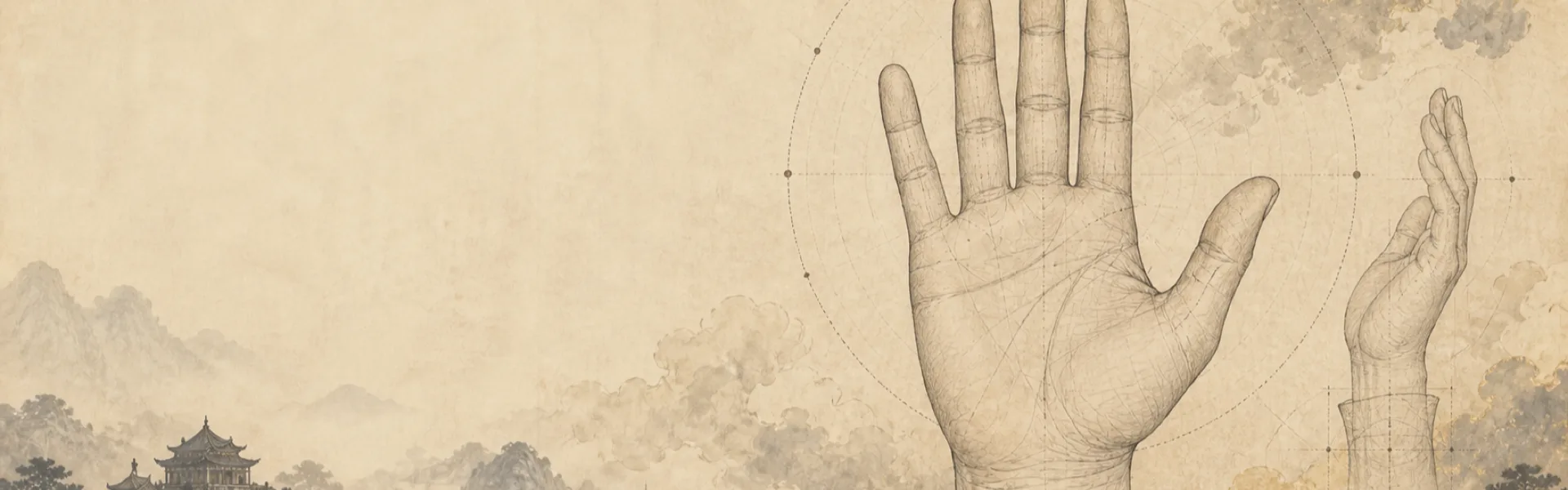
Palm reading, known in Chinese as shouxiang, is the second great branch of Chinese physiognomy. Where face reading interprets the features of the face, palm reading interprets the shape of the hand and the lines, mounts, and marks of the palm. Like face reading, it rests on the assumption that a person's nature and fortune are written on the body, and it developed its own detailed vocabulary for reading them. It is worth noting at the outset that the palmistry practised in China today blends an older indigenous tradition with ideas absorbed from Western palmistry, so that the systems one encounters are often a mixture rather than a single pure lineage.
Where it comes from
Chinese physiognomic literature attended to the face and paid little attention to the hand. Palm material does appear in manuals from the Song onward, but it occupies little space, its statements are not consistent with one another, and it never acquired a fixed framework comparable to the twelve palaces of face reading.
The palmistry current in the Chinese-speaking world today is something else: a product of the early twentieth century, when Western palmistry was translated into Chinese and merged with the older native material. The clearest evidence is in the terminology. The whole apparatus of mounts — the mount of Venus, of Jupiter, of Saturn, of the Sun, of Mercury, of the Moon, of Mars — is named after the planets of Western astrology, and no such scheme exists in the old Chinese manuals.
Calling this "ancient Chinese palmistry" is therefore inaccurate, and the inaccuracy is not trivial: it misdates the material by roughly two thousand years. A reader who wants to know what the Chinese tradition actually said about hands has to look past almost everything in a modern popular book.
The native layer: heaven, earth and man
What the Chinese tradition did have is a reading of the three most prominent creases, named for the triad of heaven, earth and humanity: the heaven line (天纹) above, the human line (人纹) in the middle, and the earth line (地纹) below.
When Western palmistry arrived, these three were identified with the heart line, the head line and the life line respectively. The names changed; the creases being pointed at did not. Beyond the three, the older material mentions the jade pillar line (玉柱纹), now generally called the fate or career line, along with marriage lines and children lines.
The substitution of vocabulary is itself the most useful thing here. It is a visible seam, marking exactly where the modern reconstruction was joined to the older material, and it lets a reader work out which parts of a contemporary manual have any Chinese pedigree at all.
Hand shape and the flesh of the palm
The reading usually begins not with the lines but with the overall hand. Practitioners consider the size and proportion of the hand, the length and shape of the fingers, the firmness of the flesh, and the general quality of the skin, taking these as broad indications of temperament and constitution. As in face reading, the hand may be classified according to the five phases, with different shapes assigned to wood, fire, earth, metal, or water types, each carrying its own associations of character.
The three major lines
Attention then turns to the major lines. Three are treated as most important. The line traditionally associated with life curves around the base of the thumb and is read as bearing on vitality and constitution rather than, as is sometimes wrongly assumed, on the length of one's life. A second major line, associated with the head, runs across the palm and is read for intellect and disposition. A third, associated with the heart, runs above it and is read for the emotions and relationships. A further line running vertically up the palm is often taken to bear on career and the general course of fortune. The exact naming and interpretation of these lines vary between the older Chinese tradition and the Western-influenced systems now common.
The mounts
The raised areas of the palm below the fingers and along its edges are read as mounts, each named for a planet and each assigned a set of qualities: Venus at the base of the thumb for warmth and appetite, Jupiter below the index finger for ambition, Saturn below the middle finger for seriousness, and so on. A prominent mount is said to strengthen its quality, a flat one to weaken it.
Two things should be said. First, as noted above, this scheme is European and was imported; presenting it as Chinese tradition is a straightforward error of fact. Second, the physical basis of a "mount" is muscle bulk and fat distribution, which vary with build, age, occupation and how much a hand is used. The thenar eminence at the base of the thumb is a muscle group, and its size tells you about grip and use rather than about a person's capacity for affection.
A decisive fact
One piece of ordinary anatomy bears on palmistry more directly than any argument about evidence, and it is worth stating on its own.
The major creases of the palm form before birth. They are flexion creases, produced by the way the developing hand folds, and they are established in the foetus at around the third month of gestation. After that, apart from injury or skin disease, their course does not materially change.
This has two consequences for the tradition. The first bears on prediction. A claim such as "a short life line means a short life" requires a causal path between a crease and events decades later — accidents, infections, diet, medicine, war — and the crease was fixed before any of those existed. There is no mechanism, and studies looking for an association between life-line length and lifespan have not found one.
The second consequence is internal, and it is the more interesting of the two. Palmistry frequently explains away failed readings by saying that the lines change as a person's fortunes change, and readers report that a client's lines have altered in recent years. If the creases are fixed in the womb, that explanation is not available, and the tradition cannot have it both ways: either the lines are stable, in which case they cannot register a changing life, or they change, in which case they are not a record of anything given.
What remains true is the mundane part. The hand does carry real information about a person, and a reading can feel strikingly apt for reasons common to every practice described in this section: statements phrased broadly enough to fit almost anyone, a client who supplies confirming detail without noticing, and a reader genuinely skilled at observing the person in front of them.
What medicine genuinely reads from the hand
There are real clinical signs in the hand, but the range is narrow and their nature is entirely different from anything in palmistry.
A single transverse palmar crease occurs with higher frequency in some chromosomal conditions, including Down syndrome, but it also occurs in a substantial proportion of the general population, and on its own it diagnoses nothing. Changes in the nails — clubbing, spooning, pallor of the nail bed — are associated with cardiopulmonary disease and with iron-deficiency anaemia. Deformity of the finger joints is a sign of arthritis. Tremor, wasting of the small muscles, and certain colour changes have their own significance.
These are morphological signs pointing to a person's present physical condition, they require a clinician to interpret alongside other findings, and they have no relationship whatever to a career line or a marriage line. Anything unusual noticed on the hand is a reason to see a doctor, not a reason to consult a palmist.
The left and right hand problem
Which hand should be read? The tradition does not agree. Some hold left for men and right for women; some that the left shows what was given at birth and the right what has been made of it; some that the dominant hand leads and the other supports; some that both must always be read together.
A system that has failed to reach consensus on so basic a procedural question, over a very long period, is telling you something about the status of its rules. These are conventions rather than discoveries, because a discovery would have settled the matter. Wherever this pattern appears — foundational disagreement persisting indefinitely — the same inference is available about everything built on top of it.
The practical effect for a client is worth noting too: two readers using different conventions will read different hands and may reach different conclusions from the same person, with no way to adjudicate.
What a handshake actually tells you
Something genuine can be learned from a hand, and it is worth separating from the rest because it is the part people are half-remembering when they say palm reading works.
Calluses show what a person does: their pattern differs between manual work, string instruments, weight training and rowing. Ingrained dirt, chemical staining and scarring indicate a trade. Nail condition indicates grooming and sometimes anxiety. Skin texture and thickness reflect exposure and labour. Grip strength and the temperature and dryness of the hand vary with health, circulation and nervousness. Rings, or their absence and the mark left by one, carry information.
All of this is ordinary observation of the present, available to anyone paying attention, and a perceptive reader making use of it will seem uncannily accurate. The skill is real and belongs to the observer; the doctrine of lines and mounts contributes nothing to it. This is the same distinction drawn on every page in this section, and here it is unusually easy to see.
Fingerprints, dermatoglyphics and "palm diagnosis"
Fingerprints and palmar ridge patterns are a genuine subject of study, called dermatoglyphics. The patterns form in the womb, are highly individual, and were investigated during the twentieth century for statistical associations with certain congenital conditions. Some weak associations exist at the level of populations.
This research is regularly misused. Commercial services offer "dermatoglyphic multiple intelligence testing" for children, claiming that fingerprint patterns reveal innate talents, learning style or optimal career. These claims have no scientific support; they take a real but narrow area of statistical morphology and extend it into a domain where nothing supports it, and they are sold to parents at considerable cost.
A related offering is "palm diagnosis," which claims that lines and colours on the palm identify specific diseases. The genuine clinical signs described above are the whole of what the hand offers, and they are used by physicians as one input among many. No pattern of palm lines diagnoses cancer, diabetes or heart disease, and a service claiming otherwise is delaying somebody's medical care.
Its place in the tradition was lower than it is today
It is worth ending with a point of proportion, because the modern balance is the reverse of the traditional one.
In the classical literature palm reading was a minor annexe to face reading. The great compendia devote the bulk of their space to facial regions, the five features and the reading of spirit and complexion; hands appear as a supplementary chapter. A traditional practitioner would have regarded a reading based principally on the palm as thin.
Today the position is inverted, particularly outside China, where palmistry is the branch most people have heard of. The reasons are practical rather than doctrinal: a hand can be offered to a stranger without the awkwardness of having one's face studied, the reading can be done quickly, and the Western tradition supplied a ready-made popular vocabulary. The prominence of palmistry is a fact about modern demand rather than about the Chinese tradition, and a reader who wants to understand Chinese physiognomy will find far more of it in the pages on the face.
Key points
Palm reading, shouxiang, is the second main branch of Chinese physiognomy.
It interprets the shape of the hand as well as the lines on the palm.
A reading begins with the whole hand — proportion, finger length, firmness and texture.
Three major lines are treated as most important.
The fleshy pads at the base of the fingers, often called mounts, are also read.
The result is a set of themes the reader weaves together, not a single fixed prediction.
Some hand features are genuinely informative about a person’s work and health, but the fortune-telling claims are not supported.
Sources drawn on for this article include: Richard J. Smith's studies of Chinese divination and popular culture, general scholarship on the history of palmistry in China and the West, and the traditional physiognomic literature.