Chinese Physiognomy in History, Literature and Everyday Culture
中国相术在历史、文学与日常文化中
To understand how deeply physiognomy is woven into Chinese life, it helps to look beyond the consulting room and into the culture's stories. For more than two thousand years, the reading of faces has furnished writers, dramatists, and historians with a ready language for character. Long before it was a professional craft, it was a way of thinking about people, and that way of thinking left its mark on some of the most enduring works of the tradition.
In the histories
The early histories already treat physiognomy as a serious matter. In the Records of the Grand Historian, compiled by Sima Qian in the first century BCE, the fortunes of statesmen and generals are sometimes foreshadowed by a telling remark about their appearance. A famous physiognomist might appear at a crucial moment to declare that a young man's features mark him for greatness or ruin, and the narrative then unfolds to confirm the judgment. Whether or not such episodes record real events, they show that educated readers of the Han period took it for granted that the face could carry the signature of destiny. The practice was respectable enough to sit inside the official record of the state.
The extraordinary marks of sages and emperors
Running alongside the anecdotes of skilled readers is a related convention: the tradition of extraordinary bodily marks. The Shiji records that Confucius was born with a depression in the crown of his head. Shun and Xiang Yu are described as having double pupils. Emperors and sages throughout the early literature are furnished with physical features no ordinary person possesses.
The logic is straightforward — an extraordinary person must have an extraordinary form. When Buddhism arrived it brought a fully elaborated version of the same idea in the thirty-two major and eighty minor marks of a Buddha, a detailed description of what a sage's body looks like, and this merged with the native tradition to make the assumption that form carries virtue considerably more secure.
What deserves notice is the direction of inference. These descriptions were derived backwards from status that was already known. The sage came first and the marks were supplied afterwards. No one identified Confucius by his skull; they recorded a remarkable skull because they had already decided he was remarkable.
Opera masks: painting good and evil directly onto the face
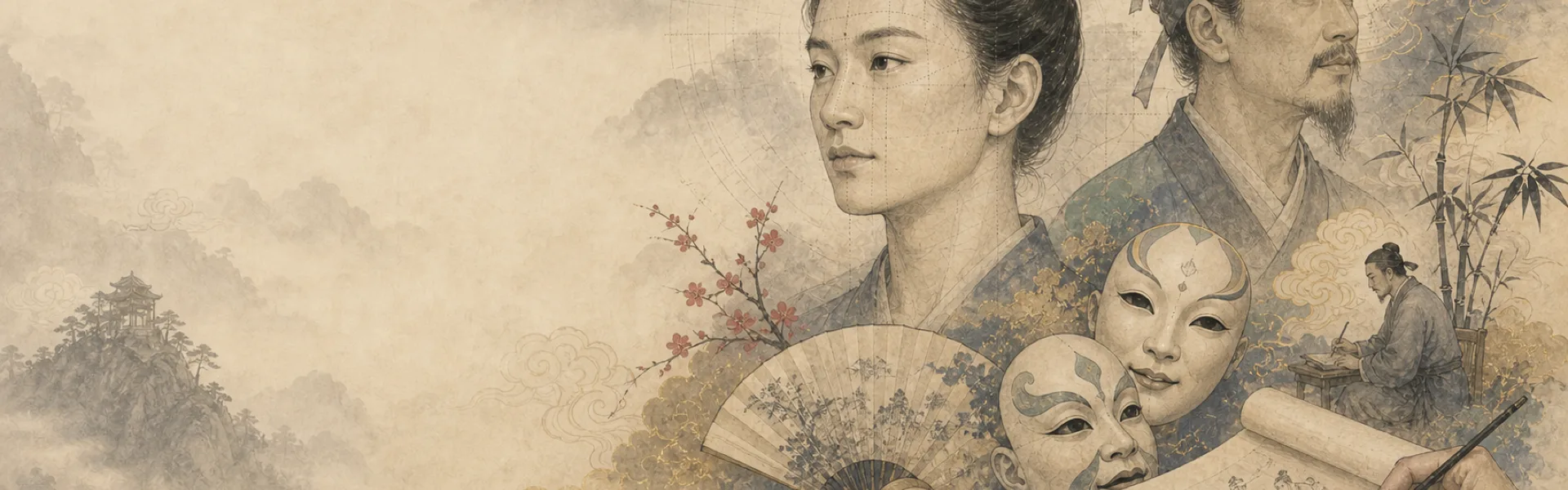
The painted faces of Peking opera are the most complete visual expression of this habit of mind. Red signifies loyalty and integrity, black uprightness and blunt honesty, white treachery, blue and green are used for outlaws and bandits, gold and silver for gods and supernatural beings. An audience knows at a glance who a character is and whether he can be trusted.
There is an instructive reversal here. Face-reading works infallibly on the operatic stage precisely because the faces are conventional signs designed to be read. The agreement came first and the recognition followed from it. A painted face means treachery because everyone involved has agreed that it does.
What holds on stage does not transfer to living people, because a real face was never assigned a meaning by anybody. This contrast is very nearly a key to the whole subject: physiognomy treats the human face as though it were an opera mask, as though somebody had set the code in advance, and the entire difficulty lies in the fact that nobody did.
How fiction uses it
From history the theme passed easily into fiction and drama. Classic novels are populated by characters whose faces announce their natures before they speak. A hero is given a broad forehead and piercing eyes, a villain a cramped brow or a sinister cast to the mouth, and readers steeped in physiognomic lore grasped the signal at once. In the great vernacular novels of the Ming and Qing dynasties, an author could sketch a personality in a single line by describing the set of the eyebrows or the shape of the chin. This shorthand worked precisely because the audience already shared the vocabulary; the writer did not need to explain what a phoenix eye or a tiger's gaze implied.The stage carried the same conventions in an even more visible form. In traditional opera, painted faces and stylized features told the audience immediately who was loyal and who was treacherous, who was rash and who was wise. The colors and patterns of operatic makeup are not physiognomy in the strict sense, but they draw on the same underlying conviction that the face is a legible map of character. A spectator did not need a program to know that a particular mask signified integrity or cunning; the tradition had trained everyone to read the meaning of a face at a glance.
It has dissolved into the language
Beyond formal art, physiognomy shaped the moral imagination of everyday life. Proverbs and set phrases distilled its lessons into common speech, warning against those whose looks seemed to betray a mean or dangerous spirit and praising the open, generous countenance thought to accompany a noble heart. Judgments of this kind guided decisions about marriage, friendship, and trust, and they were often bound up with ideas of virtue: a good life was believed to leave its trace on the face, so that character and appearance slowly grew to match. In this moral vision, physiognomy was less a tool for predicting fortune than a mirror held up to conduct.
Its relationship with Taoism and Buddhism is not straightforward
Both religions supplied vocabulary to physiognomy, and neither supports its central claim.
Taoism has the expression "the bearing of an immortal and the bones of an adept," and immortals in religious painting are depicted according to idealised physical types; manuals of physiognomy frequently borrow Taoist names and titles to lend themselves authority. But the fundamental Taoist position on fate is "my destiny lies with me, not with heaven" — the whole emphasis falls on transforming oneself through cultivation, which points in the opposite direction from reading a fixed fate off a fixed form.
Buddhism describes the auspicious marks of enlightened beings, but places far greater weight on karma and on mind. The phrase most often borrowed by physiognomic writers — that appearance arises from the heart — originally meant that mind is fundamental and form derivative. Both traditions lent their language and neither endorsed the conclusion drawn from it, and a reader who notices this will be better placed to evaluate the religious authority such manuals claim.
What it did in ordinary social life
In traditional society these judgements had practical work to do. They were used in deciding marriages, in choosing apprentices and hired workers, and in gauging strangers in commerce.
Seen in that light, physiognomy supplied two things a society without records or references badly needed: a method for making decisions under severe shortage of information, and a language for justifying decisions after they had been made. The second function is easy to overlook and was probably the more heavily used.
The cost fell on those the standards judged inauspicious. A person whose face did not conform acquired a moral evaluation along with it, and the constraints fell most heavily on women, whose marriage prospects could be settled by a verdict about the shape of a forehead. Setting this out is not an accusation against people of the past, who had few alternatives. It is worth stating because the same mechanism is still running, with the vocabulary changed.
This is not peculiar to China
Inferring the inner from the outer is an idea that has appeared in many civilisations, and the comparison is useful for keeping proportion.
Ancient Greece produced a treatise on physiognomy transmitted under Aristotle's name. Physiognomy circulated widely in medieval and early modern Europe. In the eighteenth century the Swiss pastor Johann Caspar Lavater made facial analysis genuinely fashionable across educated Europe, and his illustrated volumes were enormously influential. Phrenology took up the project in the nineteenth century, and was rejected by science before the century ended.
Two conclusions follow from the cross-cultural pattern. The first is that this is not a Chinese peculiarity or a mark of Chinese credulity — it appears to be a general human tendency, and the impulse to read faces is probably older than any of the systems built on it. The second is more sobering: the tendency's universality is exactly why it needs watching, since something everyone does spontaneously is difficult to notice oneself doing.
What this cultural role means
Seen in this cultural light, the tradition is far more than a set of predictive claims. It is a shared imaginative resource, a way of seeing and describing human beings that has enriched Chinese literature, theatre, and moral reflection for millennia. One need not believe that the shape of a nose foretells wealth to appreciate the depth of this inheritance. To read the classic novels or watch the old operas with an eye for their faces is to enter a world in which character is written on the body, and that world remains one of the most vivid legacies of the physiognomic tradition.
Key points
Physiognomy’s cultural reach goes well beyond the consulting room.
Early histories treat it seriously — Sima Qian records the fortunes of statesmen foreseen from their appearance.
Classic novels and drama are full of characters whose faces announce their nature.
This gave writers a shorthand their readers already understood.
Proverbs and set phrases carried the same assumptions into ordinary speech.
As a shared imaginative vocabulary it shaped how people described and judged one another.
That cultural role is real and worth studying regardless of the predictive claims.
Sources drawn on for this article include: Richard J. Smith's studies of Chinese divination and popular culture, scholarship on the Records of the Grand Historian and traditional Chinese fiction and drama, and general histories of Chinese physiognomy.