Governance & the Sage Ruler
治国:无为落到政治上是什么样,又怎么被用歪
A large proportion of the Tao Te Ching is about governing. Readers who meet the book as a guide to inner peace are often surprised by this, and translations that consistently address an individual reader can conceal it almost entirely. But the vocabulary is unambiguous: the text speaks of lords and kings, of the state, of taxation, of law and punishment, of armies, and of the effects of policy on a population.
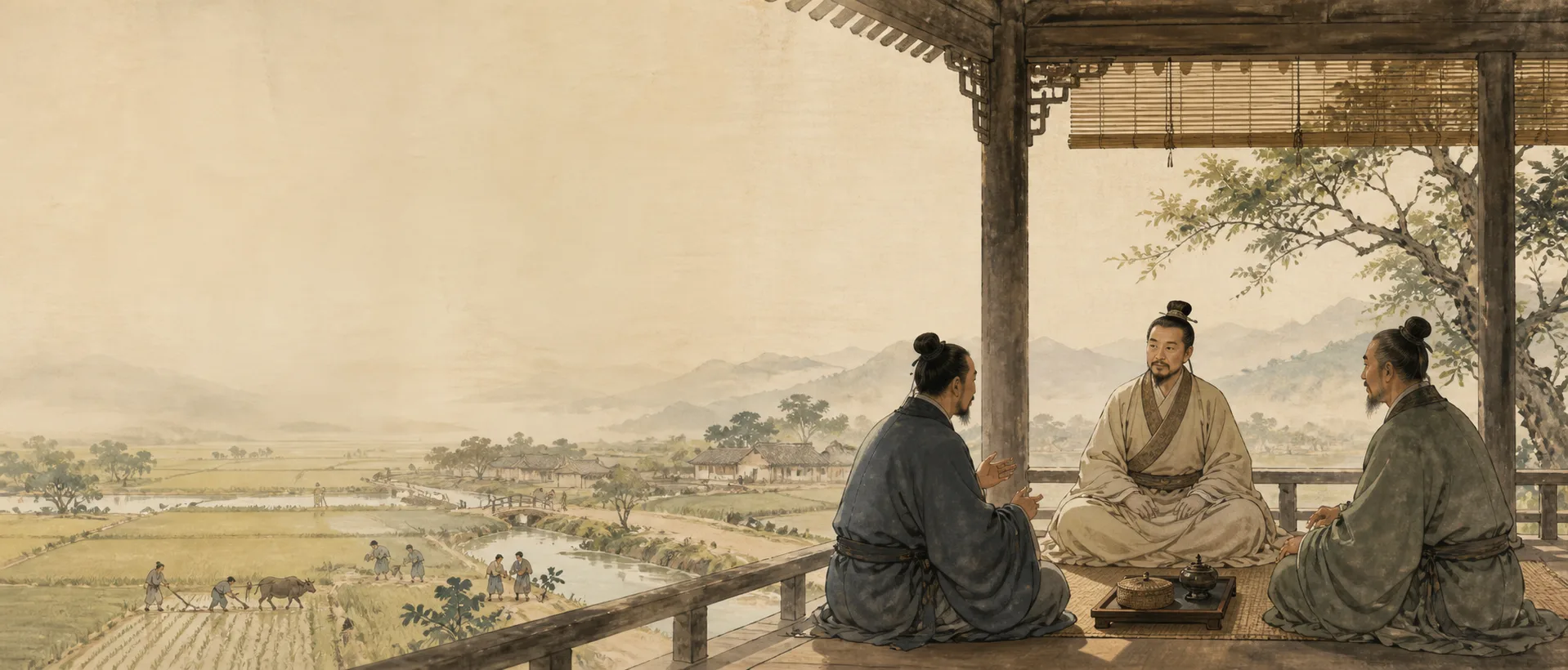
This page sets out the political argument, the specific recommendations, and the position on war. It then deals with the part of the subject that most introductions leave out: the fact that this material was used for centuries to justify a particular kind of rule, that some of it is genuinely uncomfortable, and that the restraint it recommends has no mechanism behind it.
How much of the book is political
There is no exact count, because many chapters can be read either way. But a substantial minority of chapters use explicitly political vocabulary, and a larger number make more sense as advice on statecraft than as advice on private conduct.
A rough test: where a chapter recommends refraining from something, ask who has the power to do that thing. If the answer is a government, the chapter is probably political. Not displaying wealth, not multiplying prohibitions, not promoting standards of merit, not making war for gain, not taxing heavily — these are not options available to a private individual.
Recognising this changes the character of the book. It is not a work of consolation. It is, among other things, a critique of the governing practices of its own period, and a fairly pointed one.
The core causal argument
The political case rests on one claim, repeated in several forms: intervention generates the thing it opposes.
Multiply laws and you multiply offences, because an offence is defined by a law. Promote and reward men of recognised merit and you create competition, ambition and pretence, because you have made merit a currency. Display valuable goods and you produce theft, because you have taught people what is worth taking. Prohibit and you make desirable, because prohibition marks out its object. Order people to be good and you produce the performance of goodness rather than the thing.
Two images carry the point. Governing a large state is compared to cooking a small fish: handle it repeatedly and it disintegrates. And a distinction is drawn between a government that is indistinct and unobtrusive, under which the people are described as unspoilt, and a government that is scrutinising and precise, under which the people are described as damaged.
The argument is causal, not sentimental. It does not say that intervention is unkind. It says that it is counterproductive, and that the counterproductivity is systematic rather than accidental.
The specific recommendations
Assembled from across the book, the programme is reasonably concrete.
Reduce law and prohibition. Reduce taxation, with one passage attributing popular hunger directly to the amount consumed by those above. Avoid conspicuous consumption at court. Do not multiply offices, titles and standards of merit. Do not undertake ambitious projects. Do not make war for gain. Do not attempt to educate the population into virtue. And do not draw attention to yourself as the source of order.
The last item is the most distinctive. The best ruler is described as one whose people are barely aware of him, so that when things are accomplished they attribute the result to themselves. The measure of success is therefore invisibility, which is precisely the opposite of the measure most political systems actually use.
On war
The passages on warfare are more careful than either the pacifist or the strategic reading suggests.
Weapons are called instruments of ill omen. Military success is not to be celebrated. A victorious commander is advised to conduct himself as at a funeral, and the large-scale killing of people is treated as an occasion for grief rather than ceremony. Armies are said to leave the land ruined behind them.
But the text does not forbid fighting. It permits the use of force when there is no alternative, and it distinguishes sharply between defensive necessity and aggression for advantage. It also contains observations that read as tactical: not meeting force directly, yielding ground, avoiding the enemy's strength. Later military writing drew on this, and later internal martial arts drew on it further.
So the position is neither pacifism nor realism. It is that force is sometimes unavoidable, always a loss, and never an achievement.
The sage ruler
The figure the text recommends is described mostly in negatives, and the negatives are consistent.
He does not accumulate. He does not contend. He does not place himself in front. He does not act on his own preferences. He is described as having no fixed mind of his own but taking the mind of the people as his own, and as treating the population's own tendencies as the material he works with rather than the obstacle he works against.
Positively, what he does is remove impediments and then stop. The formula that captures it is that he acts without contriving, so that things complete themselves. The claim is not that nothing gets done under such a ruler; it is that what gets done is not visibly attributable to him.
How this was read in practice
The political material had a real institutional history, and knowing it changes how the text looks.
In the early Han a set of ideas combining this text with legal and administrative thought became something close to state doctrine. In that reading the ruler remains still while officials act; the emperor's non-intervention is not inactivity but a division of labour, and it functions as a technique for maintaining authority. There were periods of deliberately light government associated with this outlook, and the tradition remembered them as successful.
The earliest surviving commentary on the text comes from a very different quarter. It is embedded in a work of hard political theory concerned with law, technique and control, and it reads the book as advice to a ruler on remaining unfathomable to his ministers. That reading is not a distortion invented later; it is contemporary with the text's rise to prominence, and it shows how easily restraint can be reinterpreted as method.
Later emperors patronised the text and at least one wrote a commentary on it. A book recommending minimal government was, for long stretches, a book studied by the government.
How it was used to justify control
Two passages need to be faced directly rather than explained away.
One states that those who governed well in ancient times did not seek to enlighten the people but to keep them simple. The word used means something between simple and stupid, and while commentators have argued for the gentler reading, the harsher reading is available in the Chinese and has been taken.
Another recommends emptying the people's minds, filling their bellies, weakening their wills and strengthening their bones. A charitable reading takes this as reducing the artificial appetites created by court culture. A hostile reading takes it as a programme for a fed and pacified population without political will. The hostile reading is not a mistranslation.
The honest summary is that the text is anti-interventionist without being in any sense democratic. It has no conception of participation, accountability, representation, or limits on authority enforced by anything other than the ruler's own restraint. A ruler who keeps his subjects materially satisfied and politically inert is entirely compatible with what the text recommends, and rulers have noticed.
The missing mechanism
This is the central weakness as political thought, and it is worth stating plainly because admirers of the text rarely do.
Every recommendation in the book depends on the ruler choosing to follow it. There is no institution, no law binding the sovereign, no procedure for removing a bad ruler, no separation of powers, and no external check of any kind. The text tells a ruler that restraint works better; it provides nothing whatever for the case in which the ruler disagrees.
By contrast, the tradition it argues against most sharply had an answer to this, however unattractive: law applied uniformly and mechanically, precisely so that it would not depend on the character of the person in charge. The Tao Te Ching's objection to that answer is strong and largely correct about its costs. It does not supply a replacement.
What survives as political thought
Set aside the parts that do not travel, and a real contribution remains.
The causal argument about unintended consequences is durable and has modern parallels: rules generate the behaviour they define, incentives are gamed, measurement changes what is measured, and enforcement can create the category it polices. The observation that a government's visible activity is a poor measure of its usefulness is worth having. So is the point that a population's own tendencies are a resource rather than an obstacle. And the description of the successful ruler as invisible is a genuinely unusual criterion of success, which is why it is still quoted.
What does not survive is the assumption that a sufficiently good ruler makes institutions unnecessary. That is the part readers should decline, and declining it does not require rejecting the rest.
Key points
- A substantial part of the book addresses rulers and uses explicitly political vocabulary about law, tax, war and administration.
- The core argument is causal: intervention systematically generates the problems it is meant to solve.
- The recommendations are concrete — fewer laws, lighter taxation, no display, no ambitious projects, no war for gain, no manufactured standards of merit.
- On war the position is that force is sometimes unavoidable, always a loss, and never a cause for celebration.
- The material was read early as a technique for rulers to remain unfathomable, and two passages support a reading in which the population is kept satisfied and politically inert.
- The decisive weakness is the absence of any mechanism: everything depends on the ruler's voluntary restraint.