Simplicity, Humility & the Uncarved Block
朴、素、水:为什么推崇未加工的状态
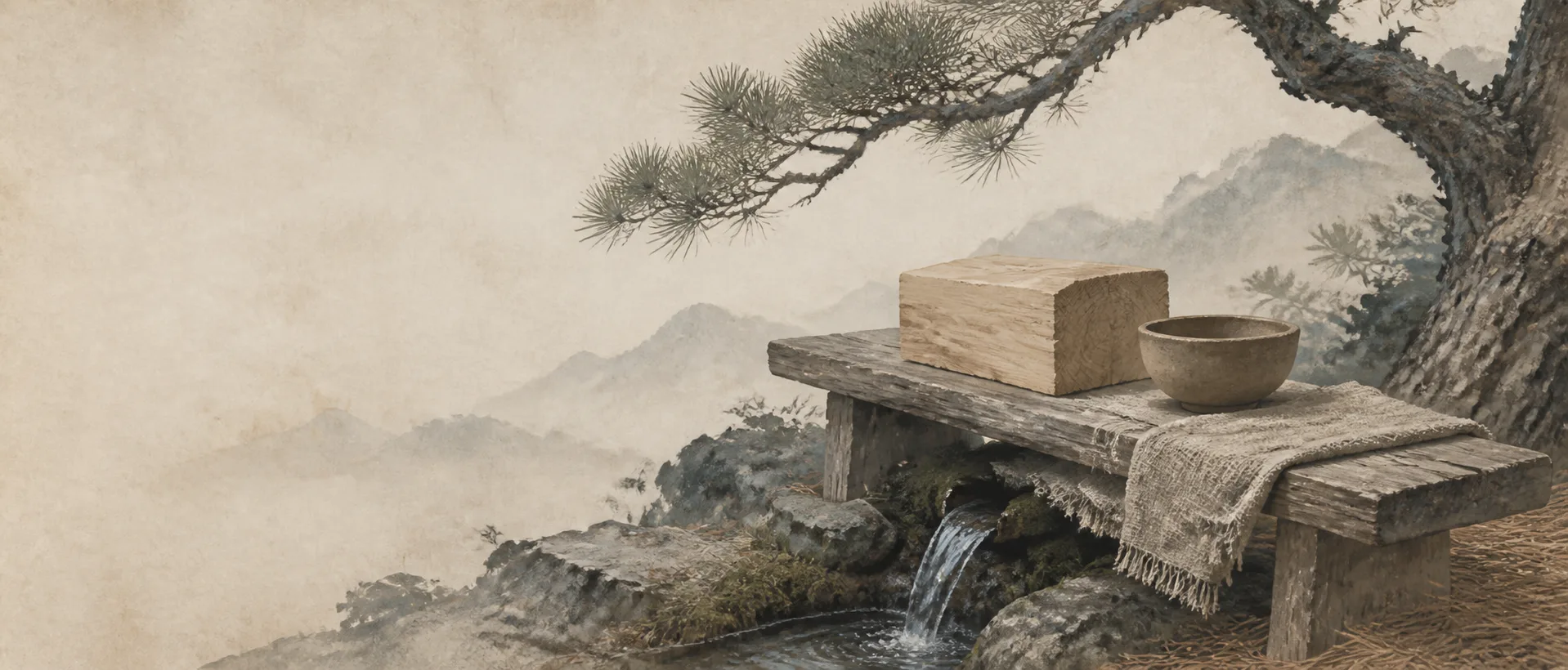
A cluster of related images runs through the Tao Te Ching: unworked timber, undyed cloth, water, the valley, the infant, the low place, the soft and the weak. These are not decorative variations on a mood. Each is chosen for a specific property, and together they make an argument about why the unelaborated condition is preferable to the finished one.
This page sets out what each image is doing, states the argument they add up to, and then addresses the three readings that most often go wrong: that this is asceticism, that it is primitivism, and that the recommended humility is self-abasement. None of the three is what the text says, and the last is almost the opposite of what it says.
The unworked block
The key term is a word for timber in its natural state, before carving. It is not a mystical term; it was the ordinary word for unprocessed wood, and the text uses it as an image for a condition prior to elaboration.
The point of the image is what carving does. Carving a block into a vessel makes it useful for one purpose and unusable for every other. The block has more possibility in it than the finished object, and the finished object cannot be returned to the block. The text uses this to describe what happens when a person, or a society, is shaped by training, categories, and instituted standards: capacity is converted into specialised function, and something is lost that cannot be recovered.
A companion term is a word for undyed, unpatterned silk. The pairing is exact: one is unworked material, the other is uncoloured material, and both are contrasted with the products of skilled labour. The recommendation attached to them is to hold to the plain state and to reduce what has been added.
Water and the low place
Water is the most persistent image in the book, and it is chosen for four properties that are stated rather than implied.
It goes to the low place, and does so without being compelled. It yields to whatever it meets and is not damaged by yielding. Over time it wears away things much harder than itself, so that softness defeats hardness given duration. And it is indispensable while being unvalued, which is used as an argument about what genuine usefulness looks like.
The low place is a theme in its own right. One passage explains that the sea receives all the rivers precisely because it lies below them. This is not modesty as a virtue. It is a claim about position: the low position collects, and the high position sheds. A ruler who places himself below those he governs is described as gaining rather than losing.
The valley, the female, the infant
Three further images extend the same claim in different directions.
The valley is empty and receives; it is the shape of a container rather than of a thing. Emptiness in this book is repeatedly treated as the functional part of an object — the hollow of a bowl, the space in a room, the hub of a wheel — and the valley generalises that observation to a way of being placed in the world.
The female is invoked for receptivity and for the capacity to generate, and the text recommends holding to it in contexts where a reader would expect the opposite advice. It is worth saying plainly that this imagery sits inside a society organised on assumptions about women that the text does not challenge; the imagery is doing philosophical work, and it is not a programme of social reform.
The infant appears for a different property: it is soft, it is not yet trained, its capacities are undirected, and it survives without contrivance. In one passage the person of abundant potency is compared to a newborn. The comparison is about the absence of accumulated habit, not about innocence in a moral sense.
Soft and weak, hard and strong
The text repeatedly pairs the soft and the weak against the hard and the strong, and asserts that the first prevails. Read as a general rule about the world this is plainly false, and readers are right to be suspicious of it. Read as the text presents it, the claim is narrower and defensible.
The supporting observation is biological: living tissue is soft and pliable, and it becomes rigid at death. Rigidity is therefore treated as a mark of the terminal condition and flexibility as a mark of the viable one. Applied to conduct, the claim is that a position which can yield can also recover, while a position which cannot yield breaks when it is exceeded.
Applied to conflict it becomes something close to strategy, and it was read that way. A force that does not meet pressure directly, that gives ground, that outlasts, is preferred to one that confronts. This is the point at which the text connects to the internal martial arts described elsewhere on this site, though the connection was made much later and should not be projected backwards.
Knowing enough
A related group of passages concerns sufficiency, and this is where the text is at its most directly practical.
The formula is that a person who knows what is enough is wealthy, and that knowing what is enough prevents disgrace. The argument is not that poverty is good. It is that the harm attributed to lack is very often caused by the pursuit of more, and that a limit recognised in advance costs less than a limit discovered by collapse.
A further term recommends sparing use, husbanding resources rather than expending them. Applied to a state this is fiscal restraint; applied to a person it is a caution about expenditure of effort and attention. The three qualities the text names as its own treasures include frugality and a refusal to put oneself at the front, which places restraint at the centre rather than the margin of the position.
What this is not: asceticism
The text contains no fasting rules, no prohibitions on food or drink, no recommendation of physical hardship, and no suggestion that discomfort is improving. It criticises elaborate cuisine, elaborate music and elaborate visual display, but the criticism is that these dull the senses and generate appetite, not that pleasure is wrong.
This matters because later religious Taoism did develop dietary rules, retreats and forms of austerity, and readers coming from the religion sometimes find them in the text. They are not there. The recommendation is against elaboration and accumulation, which is a different thing from mortification.
What this is not: primitivism
This objection is harder to dismiss, and it should not be dismissed.
One chapter describes a small state with few people, where implements exist but are not used, where writing is replaced by knotted cords, and where people do not travel. Whatever the intention, that is a picture of a reduced society, and readers who find it unattractive are responding to something real in the text. Other passages recommend abandoning learning and discarding cleverness, and one manuscript version of a famous chapter is noticeably less hostile to Confucian virtues than the received text, which suggests the polemical edge sharpened over time.
The honest position is that the text contains a genuine suspicion of technical and institutional development, and that this is not a misreading imposed by translators. What can be said in qualification is that the target is usually specific — the apparatus of the state, the display culture of courts, the manufacture of standards and titles — rather than material culture as such, and that the smallest-state passage is one chapter among eighty-one and is not the framework of the whole.
What this is not: self-abasement
The humility recommended here is not the humility of Christian moral tradition, and reading it that way inverts the argument.
The text recommends the low position because the low position is advantageous. The sea is called the king of the valleys. Not contending is described as the reason nothing can contend with you. Not putting oneself forward is described as the mechanism by which one comes to be recognised. In several passages the sage's self-effacement is explicitly connected to durability and to actual influence.
Whether this is admirable is a fair question, and the tradition attracted the criticism that its humility is calculating. That criticism is old and internal, not a modern discovery. But it is a criticism of an efficacy argument, and readers who take the passages as an appeal to selflessness are not disagreeing with the text so much as failing to notice what it claims.
The political edge
Set in its own period, this cluster of images is not gentle at all. Unworked timber and undyed silk are contrasted with the manufactured goods of an elite. Criticism of the five colours and elaborate music is criticism of court culture. Objections to promoting the worthy are objections to the recruitment systems of contemporary states. And a passage attributing popular hunger to heavy taxation names a cause.
Reading these chapters as advice on personal contentment removes the target. The recommendation to reduce is directed, in a large number of cases, at people with the power to impose elaboration on others.
Key points
- Unworked timber and undyed silk are ordinary words for unprocessed materials, used as images for the condition before elaboration.
- Carving makes a block useful for one purpose and unusable for the rest; the loss is treated as irreversible.
- Water is chosen for four stated properties: it goes low, it yields without damage, it outlasts what is harder, and it is indispensable without being valued.
- The soft-defeats-hard claim rests on the observation that living tissue is pliable and dead tissue rigid.
- The text is not ascetic and does not condemn pleasure, but it does contain a real suspicion of institutional and technical development.
- The recommended lowliness is an argument about efficacy, not about self-denial, and much of it is addressed to rulers.