Structure of the Text
八十一章是怎么分的,这本书为什么难读
People who abandon the Tao Te Ching usually blame themselves, or blame the book for being mystical. Neither is quite right. A large part of the difficulty is structural and can be described plainly: the text is extremely short, extremely compressed, written in a language that omits most of what English requires, divided into chapters by a later hand, and addressed to a reader who is not you.
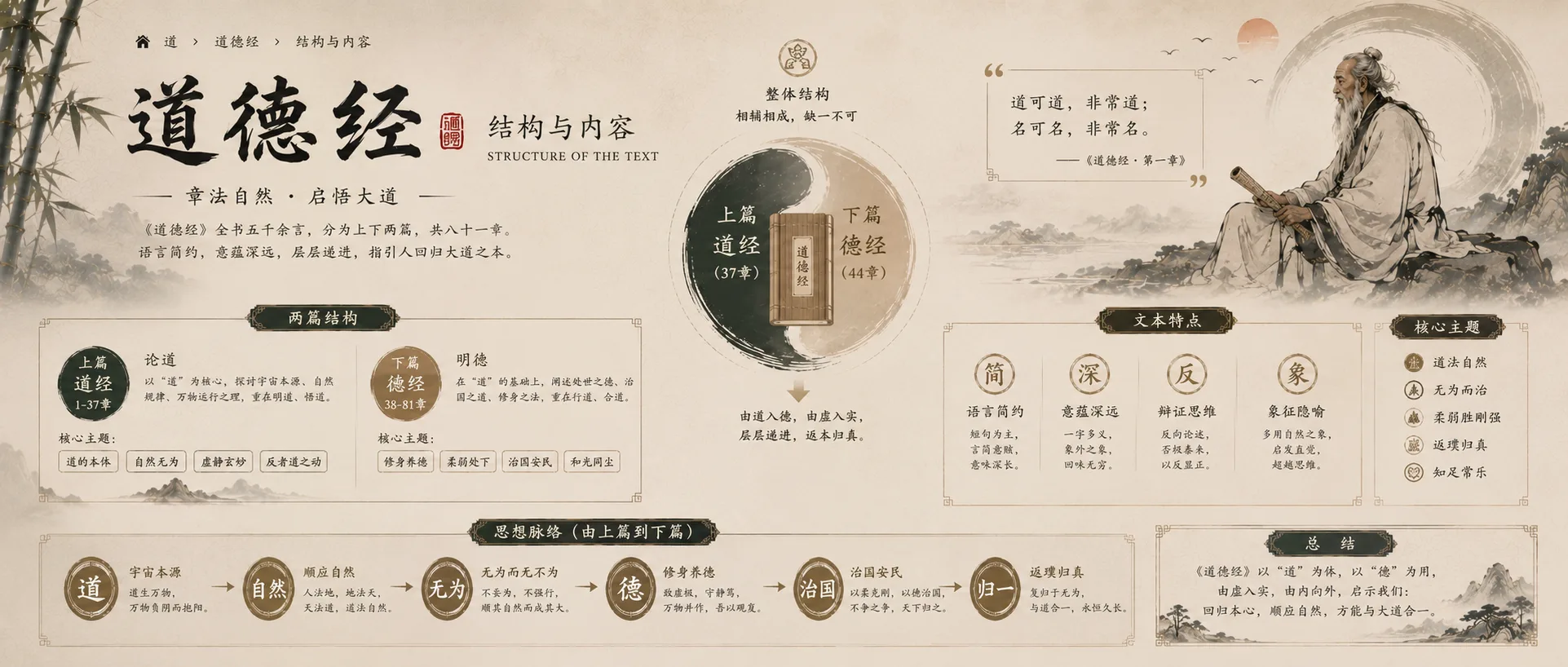
This page describes the object rather than interpreting it. Knowing how it is put together removes a good deal of unnecessary frustration, and it also explains why translations differ so much.
What the book physically is
The received text runs to a little over five thousand characters, which is why it is traditionally called the five thousand words. Different editions differ by a few hundred characters because of variant readings and the inclusion or omission of grammatical particles. Five thousand characters is short: shorter than many single chapters of the works it is compared with, and short enough that a reader could work through the whole of it in an afternoon and understand almost none of it.
The brevity is not incidental. The compression is what produces both the density that readers find compelling and the ambiguity that makes commentary necessary.
The two divisions
The text is divided into two parts. In the received arrangement the first part runs from the opening chapter to the thirty-seventh, and the second from the thirty-eighth to the end. The two are named after words that appear at or near their beginnings: the first after the term usually translated as the Way, the second after a term usually translated as virtue or power. Combining them gives the title by which the book is now known.
The division is real but loose. The first part contains more of the cosmological and epistemological material and the second more of the political and practical, but there are substantial exceptions in both directions, and no reader would reliably guess which part an unlabelled chapter came from.
Manuscripts recovered from a Han tomb place the two parts in the opposite order. Several modern translations follow that arrangement, and the difference in reading experience is greater than it sounds: opening with the material on virtue and conduct makes the book feel practical, while opening with the material on the Way makes it feel metaphysical.
Where the eighty-one chapters came from
The chapter divisions are not original. The bamboo manuscripts of around the end of the fourth century BC have no chapter divisions at all, and their material is grouped in a way unrelated to the received arrangement.
The number eighty-one is nine times nine, and nine carried strong associations of completeness and maximum. Other divisions were used: at least one early commentator arranged the text in a substantially smaller number of sections, and various figures circulated. The eighty-one arrangement became standard during the Han and has been stable since.
This matters practically. Chapter boundaries are editorial decisions, and some of them cut across material that belongs together while others join material that does not. Where a chapter seems to change subject halfway through, the most likely explanation is not hidden depth but a seam.
The form
Much of the text is verse, and this is invisible in most translations.
Rhyme is extensive. Many chapters are wholly or partly rhymed, and rhyme patterns sometimes reveal where a passage begins and ends more reliably than the chapter divisions do. Parallelism is pervasive: paired lines of matching length and matching grammar, with one term substituted. There are chains in which the last word of one clause becomes the first of the next. There are numbered lists. And there are strings of paradoxical formulations built on a fixed template.
Reading a few chapters aloud in the original, or in a transliteration, changes one's sense of the book considerably. It is a good deal more like a collection of formulae designed to be memorised than like a treatise. That is almost certainly what it was: material shaped for oral transmission, where rhyme and parallelism are mnemonic devices rather than ornament.
Why the language is hard
Classical Chinese omits, as a matter of normal usage, most of what an English sentence is obliged to specify.
There is no marking of tense: a line can describe what happens, what happened, or what will happen. There is no obligatory subject: a great many lines simply do not say who is doing the thing. There is no marking of singular and plural. Definite and indefinite reference is not distinguished. Words are not sharply divided into parts of speech, so the same character can function as noun, verb or adjective in different lines, sometimes in the same line.
In ordinary classical prose, context resolves most of this. In an extremely compressed rhymed text with no narrative, context often does not resolve it. The result is that a translator has to decide, for almost every line, who the subject is, what the tense is, and whether a term is being used as a thing or as an action. Different defensible decisions produce different books.
One further feature causes specific trouble. Connectives such as the word usually rendered “therefore” appear frequently, and in this text they often join material that has no logical relation, functioning as a marker of transition rather than of inference. Translations that render them as strict logical connectors make the text look like bad reasoning when it is not attempting reasoning of that kind.
Recurring formulae
A handful of phrases recur so often that they function as structural signals, and noticing them helps.
A formula introducing the sage appears dozens of times and generally marks the shift from a general observation to its application in conduct. A formula meaning “under heaven” marks the political scale, and its presence is a strong indication that a passage is about governing rather than about private life. Formulae introducing quotation or proverb suggest that the material being cited was already current. Negative constructions of the form “does not act, and therefore” carry the characteristic argumentative move of the whole book.
Learning to spot four or five of these gives a reader something to hold on to in a text that otherwise offers few landmarks.
Who is being addressed
This is the structural feature most often missed, and it changes the meaning of a large fraction of the text.
Many chapters address a ruler. They use terms for feudal lords and kings, they discuss the management of a state, warfare, taxation, punishment, and the effects of law on a population. Chapters that read as gentle personal advice in translation are frequently advice on statecraft, and the recommendation to refrain from intervention is a recommendation about policy.
Other chapters address a practitioner of self-cultivation, and some address no one in particular, presenting a general observation. A reader who assumes throughout that the book is speaking to an individual seeking peace of mind will systematically misread the political material, which is a substantial part of the whole.
The first question to ask of any chapter is therefore: who is being told this? It is usually answerable from vocabulary, and answering it removes a great deal of vagueness.
The chapter as a unit
Some chapters are single coherent compositions with a clear beginning and end. Others are evidently composite: two or three sayings placed together, sometimes linked by a shared word rather than a shared idea.
Signs of a composite chapter include an abrupt change of addressee, a shift between rhymed and unrhymed lines, a change of grammatical style, and a closing formula appearing in the middle. Once you can see these, chapters that previously seemed to make a mysterious leap turn out to contain a join.
This has a practical consequence for reading. Do not assume that a chapter is arguing one thing. Ask how many pieces it has, and read each piece on its own before asking how they relate.
How to read a chapter
A workable procedure, which takes a few minutes per chapter and is far more productive than reading straight through.
Read it once for the shape. Identify the addressee. Look for the reversal, since most chapters contain a claim that something works by way of its apparent opposite. Ask what position is being denied, because most of the book is arguing against something. Note whether the chapter looks like one piece or several. Then compare a second translation, and pay attention specifically to the places where the two diverge — those are the places where the original is ambiguous, and that information is not available from one translation alone. Finally, resist the urge to harmonise the chapter with others.
Working through five chapters in this way teaches more than reading all eighty-one twice.
What this means for translations
Everything above explains why versions of this text differ so radically, and it also gives you a way to assess them.
A translation that reads with complete smoothness has resolved ambiguities silently. A translation that preserves ambiguity is harder work and tells you more. A translation that renders the connectives as strict logic has imposed a structure. A translation in which every chapter has an evident single message has made editorial decisions about the seams. And a translation that consistently addresses an individual reader has quietly removed the politics.
None of these is a fatal flaw, and every translation makes some of these choices. The point is to know which ones your translation has made.
Key points
- The text is about five thousand characters, and its compression produces both its power and its ambiguity.
- The two divisions are named after their opening terms; excavated manuscripts reverse their order.
- Chapter divisions are a later editorial imposition, and the number eighty-one is symbolic rather than structural.
- Much of the book is rhymed and parallel, shaped for memorisation rather than as continuous argument.
- Classical Chinese omits subject, tense and number, so a translator must supply them on nearly every line.
- Identifying the addressee is the single most useful move a reader can make, because a large part of the text is about governing.