Origins & Authorship of the Tao Te Ching
《老子》是谁写的,什么时候成书
Almost everything commonly stated about the authorship of the Tao Te Ching is either unsupported or was already doubted by the earliest historian to write about it. That historian said so himself, in the text that is the source of all the later confident accounts. This page sets out what he actually wrote, what the stories about the author are for, what can be said about the date of the text, and what the manuscript discoveries of the last fifty years have established.
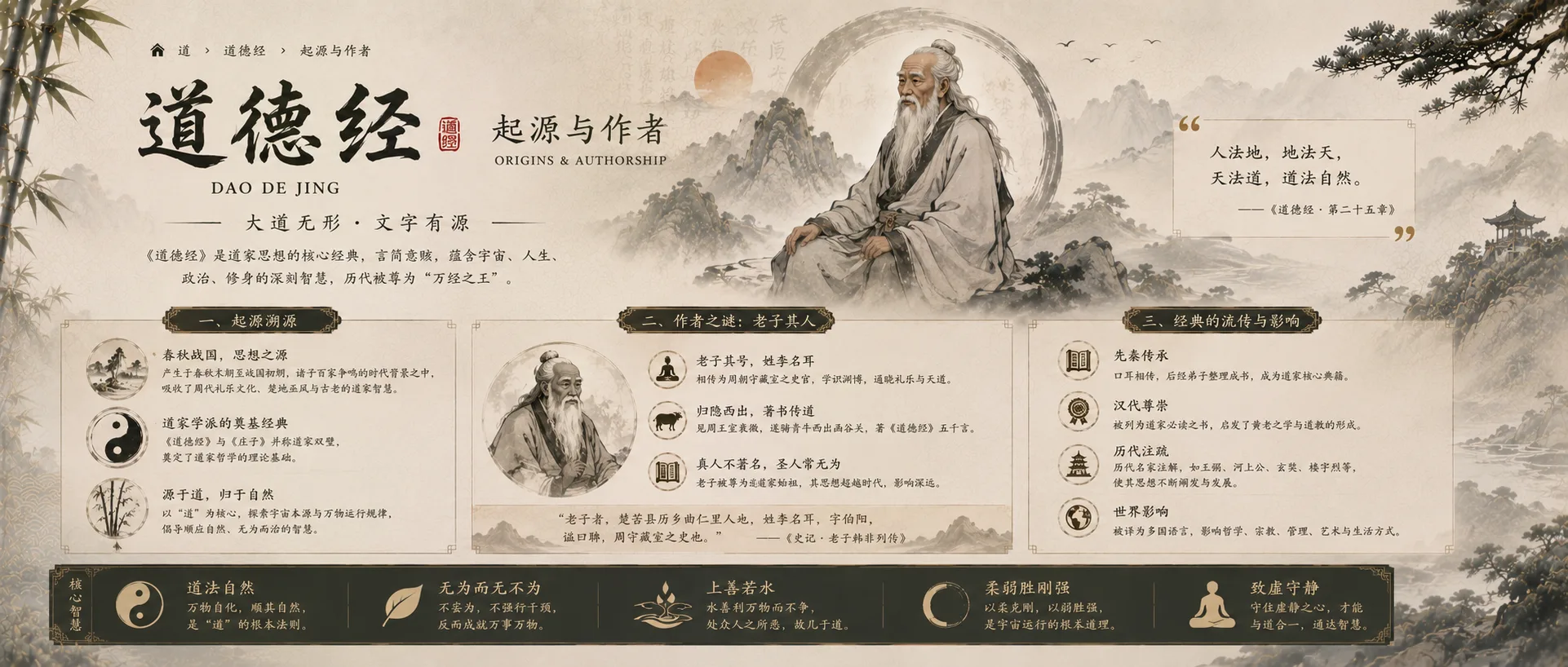
The conclusion is not that we know nothing. We know a good deal, and most of it is more interesting than the traditional biography. What we do not have is an author.
For the wider picture—the traditional master, the text called the Laozi and the later divine Lord Lao—continue with Who Was Laozi?
What the name means
Start with the name, because it does much of the work of creating a person. Laozi is not a personal name. It means the Old Master, or the Old One, and it is a form of respectful designation of the same kind as the titles by which several other early thinkers are known.
A title of this sort can attach to an individual, and in some cases clearly does. It can also attach to a role, a lineage of teachers, or a body of transmitted sayings. Nothing in the name itself settles which. Modern Chinese scholarship generally refers to the text as the Laozi rather than as a work by Laozi, and that usage is a deliberate piece of caution rather than a stylistic preference.
The title Daodejing, the Classic of the Way and Its Power, came later. It combines the opening words of the text's two divisions with the word marking canonical status, and it is a statement about how the book was regarded rather than about what its author called it.
The earliest biography, and its own doubts
The first substantial account appears in the great history compiled at the end of the second century BC, several centuries after the events it describes. It says that the man was a native of a southern state, gives a surname and a personal name, and reports that he served as an archivist at the Zhou court.
Then, remarkably, it offers alternatives. It mentions another figure, a contemporary of Confucius, who some said was the same man. It mentions a court historian of a much later period, who others said was the same man. It records a lifespan of well over a century as something people said. And it ends the discussion by observing that nobody knows whether any of it is so.
That last remark deserves emphasis. The foundational biography of Laozi is an account by a careful historian who assembled the available traditions, noticed that they contradicted each other, and declined to decide. Every later account that presents a settled life story has removed the doubt that its own source expressed.
The stories, and what they are for
Three episodes carry almost all the traditional material, and each is doing a job.
In the first, Confucius visits Laozi to ask about ritual and is rebuked for pedantry and ambition, leaving impressed and shaken. This story appears in several early sources, including the Zhuangzi, where it occurs in multiple incompatible versions. It is best read as a partisan device: it subordinates the founder of one tradition to the founder of another, and it is exactly the sort of story that a competing school invents. Confucian sources unsurprisingly do not tell it that way.
In the second, Laozi, disillusioned with the decline of the Zhou, travels west. At a frontier pass the officer in charge recognises him and asks him to leave a record of his teaching before disappearing, and he writes a work in two parts of about five thousand characters. This story explains the existence of the book, its length, its division and its abruptness, all at once. A story that neatly explains the physical features of a text is more likely to have been constructed from those features than to have produced them.
In the third, he passes beyond the frontier and is never heard of again. Departure without a recorded death is a standard feature of biographies of transcendent figures, and it makes later claims about him difficult to falsify.
None of this means the stories are worthless. They are excellent evidence about what later Taoists wanted the origin of their tradition to look like. They are poor evidence about the sixth century BC.
When the text was compiled
The traditional date places Laozi in the sixth century BC, slightly older than Confucius. The scholarly consensus places the text considerably later, with most of it taking shape during the fourth and third centuries BC and reaching something close to its received form by around the end of the third century BC.
Several kinds of evidence point that way. The vocabulary and grammar fit the later period better than the earlier. The positions the text argues against are those of the Warring States debates: the Confucian programme of cultivation through ritual, the schools concerned with definition and distinction, the legalist emphasis on technique and law. A text is usually contemporary with its opponents.
The earliest external evidence is also informative. A late Warring States work includes two chapters that explain and illustrate passages from the Laozi, which shows that by then the text existed, circulated, and had enough authority to be worth commenting on.
What the manuscripts show
Two discoveries changed the picture, and both are recent enough that older popular books do not reflect them.
Silk manuscripts recovered from a tomb sealed in the early second century BC contain two copies of the text. They are close to the received version in content, which is reassuring, but they place the two divisions in the opposite order, putting the section on power and virtue before the section on the Way. Some translations following these manuscripts therefore reverse the familiar arrangement.
Bamboo slips from a tomb of around the end of the fourth century BC are the more consequential find. They contain material corresponding to roughly two fifths of the received text, distributed across separate bundles, in an order unrelated to the received one, and without chapter divisions. Several passages differ in ways that matter: in one famous instance the text is markedly less hostile to Confucian virtues than the received version, which bears directly on how the book's polemical edge developed.
Two conclusions follow. First, the text is genuinely old — older than nineteenth-century sceptics allowed. Second, at the earliest point we can reach it was not a fixed book. It was a body of material circulating in partial collections, arranged differently by different copyists. The eighty-one-chapter book is the end of a process of consolidation, not its beginning.
Evidence inside the text
Even without manuscripts, the received text carries marks of composite origin that a reader can notice directly.
Phrases and whole lines recur in different chapters, sometimes with slight variation, in the manner of a collection drawing on a common stock of sayings. The voice shifts: some passages are compressed and rhymed, some are discursive prose, some read as proverbs, some as instructions to a ruler, some as descriptions of a cosmological principle. Chapters occasionally combine material that does not obviously belong together, and rhyme patterns sometimes break at exactly the point where a seam would be expected.
None of this is a defect. It is what an anthology of transmitted wisdom looks like. But it is very hard to reconcile with a single author writing in one sitting at a frontier post.
From book to scripture
The next stage is the more consequential one for Taoism as a religion, and it is a separate story from the text's authorship.
By the Han period Laozi was receiving cult. An emperor of the second century AD offered sacrifice at a site associated with him. Around the same time, the founder of the first organised Taoist movement reported a revelation received from him, no longer as a philosopher but as a deity. A commentary produced within that movement reads the text as a scripture containing instructions for practice and community discipline, which is a very different kind of reading from any philosophical commentary.
He was eventually installed as one of the highest figures of the Taoist pantheon, understood as an eternal principle that takes human form in successive ages to transmit teaching. On this understanding the man at the frontier pass was one appearance among many, which resolves the biographical problem by dissolving it.
This is the point at which the two Taoisms described elsewhere on this site come apart. The philosophical tradition has a text of uncertain authorship. The religious tradition has a god. They are connected, and they are not the same claim.
The westward journey and the polemic
The story of the departure west acquired an afterlife worth knowing about, because it shows how such material was used.
During the centuries of competition between Taoism and Buddhism in China, Taoist writers developed the claim that Laozi had travelled west and taught the peoples there, and in the strongest version that he had appeared as the Buddha himself. The purpose is transparent: it makes Buddhism a derivative and simplified form of Taoism, suitable for foreigners. Texts were produced to support the claim, Buddhist writers attacked it vigorously, and at various points the state intervened, at least once ordering the offending scriptures destroyed.
The episode is a useful corrective to the idea that these traditions coexisted in tranquil mutual respect. It also illustrates a general point: origin stories in this literature are frequently arguments, and identifying what the argument is for tells you more than asking whether the story is true.
Does authorship matter?
Practically, less than one might think, and it is worth being clear about why.
The text does not depend on its author for authority. It contains no proper names, no historical references, no biography, and no claim to revelation. It never says who is speaking. In this it differs sharply from most scriptures, and the difference is one reason it travels so easily.
Where authorship does matter is in reading the text as an argument. If it is a composite anthology assembled over generations, then internal tensions are to be expected and need not be harmonised. Readers who assume a single author spend a great deal of effort reconciling passages that were never meant to agree, and translators who assume a single author sometimes smooth the text to produce a consistency it does not have.
Key points
Laozi means the Old Master; it is a title, not a personal name, and it may designate a role or a lineage rather than an individual.
The earliest biography offers several incompatible identifications and concludes that nobody knows which, if any, is correct.
The famous stories — the meeting with Confucius, the frontier pass, the disappearance — each serve a recognisable purpose and are poor historical evidence.
The text most likely took shape during the fourth and third centuries BC, contemporary with the positions it argues against.
Excavated manuscripts show it is genuinely old but was not a fixed book: it circulated in partial collections with different arrangements.
The deification of Laozi is a separate development from the text's composition, and conflating the two produces most of the confusion about him.