Taiji and Internal Martial Practice
太极拳为什么叫太极:从哲理到动作
An art practised by millions of people is named after a metaphysical term from a commentary on a divination manual. That is an odd fact, and it deserves a direct explanation rather than the usual gesture towards ancient wisdom.
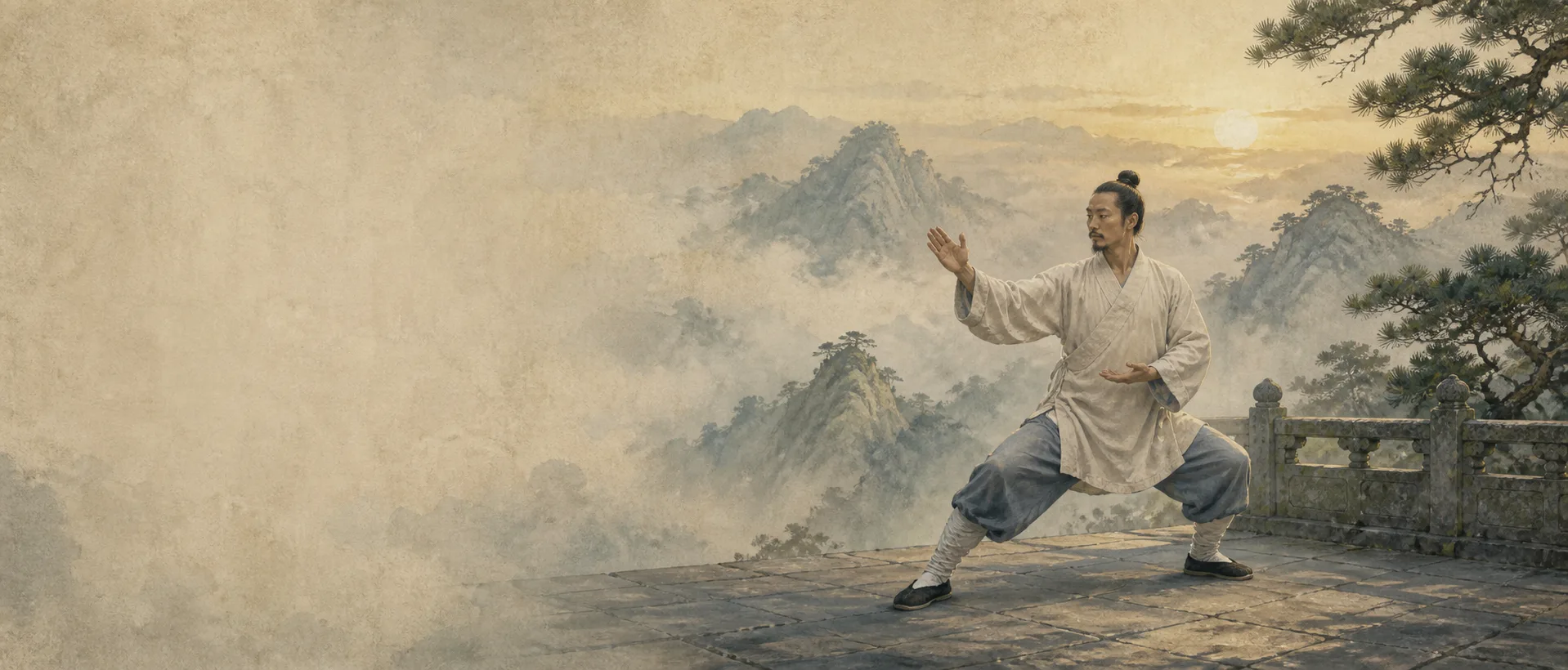
This page asks a specific question: does the philosophy actually explain the movement? The answer is mixed and worth having in detail. Some of the correspondences are real and do work in practice. Others are numerological fits applied to an existing art after the fact. Distinguishing the two is useful whether you practise or not, and it is the kind of distinction that teachers are rarely asked to make.
When the name was applied
The art was not always called this. The boxing traditions from which it developed went under other names — descriptive names referring to continuous soft movement, to long sequences, or to a set of thirteen basic elements. The term taiji was attached to it comparatively late, in the nineteenth century.
What happened at that point is reasonably clear in outline. A body of short theoretical texts was compiled and circulated in manuscript, one of them attributed to an earlier figure whose historical connection to the material is disputed. Those texts frame the art explicitly in the vocabulary of Song cosmology, and the opening lines of the best-known of them paraphrase the cosmological scheme directly, describing the taiji as born of the limitless and as the mother of yin and yang.
Shortly afterwards the art spread from a rural setting into the capital, acquired urban and elite students, and was taught in a form that emphasised health and cultivation as much as combat. In the early twentieth century, when martial arts were being systematised and promoted as national culture, the philosophical framing became standard.
So the sequence is: an existing martial practice, then a theoretical literature applying cosmological vocabulary to it, then wide dissemination under the new name. Accounts that reverse this — presenting the art as a physical realisation of ancient philosophy — have the history backwards.
What the classics claim
The short theoretical texts are worth reading, and they are short enough to read in an evening. They make a set of specific claims, and most of them are technical rather than mystical.
Movement should be continuous, without break between one action and the next. Weight and intention should be unevenly distributed rather than split equally, and the fault of being equally committed on both sides is named and warned against repeatedly. Where an opponent presses, one should be empty; where he is empty, one should be present. One should abandon one's own initiative and follow the other party. Force should be led into emptiness so that it finds nothing to act against. A small force correctly applied can redirect a large one. Intention rather than muscular effort should govern the movement.
These are instructions about how to move and how to respond. The cosmological language surrounds them, but the content is technical.
The correspondences that do real work
Four connections between the philosophy and the practice are substantive, in the sense that the concept changes what a practitioner does.
Substantial and insubstantial. The requirement that weight and commitment be unequal, and that the inequality shift continuously, is directly describable as a relation of two complementary aspects in constant alternation. The fault of being equally weighted on both sides is exactly the static division that the curved boundary of the diagram is designed to deny. This is not a metaphor; it is the same structure applied to a body.
Reversal at the extreme. The instruction to yield when pressed and to arrive when the opponent is committed is an application of the principle that a maximum is a turning point. A practitioner who understands this is doing something different from one who is simply retreating.
Acting without forcing. The instruction to abandon one's own plan and follow the other party's movement is the bodily case of the recommendation not to force. It is unusually well suited to physical training, because in partner work you can feel immediately whether you are opposing or following, which is a rare thing in this area: a philosophical claim with direct proprioceptive feedback.
Continuity. The requirement that movement not break, and that the whole body participate in each action, corresponds to the account of process without discrete stages. Whether or not the cosmology is true, the instruction is coherent and produces a recognisable difference in movement.
The correspondences that are decorative
Others are numerological, and it is worth being frank about them.
The classic scheme presents the art's basic elements as eight hand methods and five stepping directions, and correlates the eight with the eight trigrams and the five with the five phases. This mapping is tidy and memorable and almost certainly retrospective. The techniques were not derived from the trigrams; a set of techniques that happened to number eight was matched to a scheme that numbered eight. Where sources assign specific trigrams to specific techniques they do not always agree with one another, which is what one expects of a fit rather than a derivation.
Similarly, correlations of postures with directions, of movements with seasons, and of sequences with hexagram cycles are frameworks laid over the practice. They can be useful as memory aids and as a shared vocabulary between teacher and student. They do not explain why a technique works.
The general pattern is worth naming, because it recurs across Chinese technical traditions. A practice acquires prestige and intellectual respectability by being given a cosmological grounding, and the grounding is constructed after the practice exists. Recognising this is not debunking. The practice may be excellent and the philosophy interesting; they are simply not related as premise and conclusion.
The reverse-engineering problem
There is a specific difficulty in assessing any of these claims, and it should be stated.
Because the cosmological vocabulary is extremely flexible, almost any physical instruction can be expressed in it after the fact. A movement can be described as yang because it expands, or as yin because attention is gathering. Both descriptions are available, and the availability of both means neither is constrained by the movement. This is the same failure mode described on the page about assigning yin and yang: when the axis of comparison is chosen after the desired answer, the assignment carries no information.
The practical test is whether the philosophical claim makes a difference. If you removed the vocabulary, would the instruction change? Sometimes yes: the rule against being equally weighted is a real constraint that rules out real errors. Sometimes no: describing a posture as corresponding to a particular trigram does not tell you to do anything differently.
What is actually taught
In a working class, most of the time goes on things that are not philosophical at all.
Structural alignment and the release of unnecessary muscular tension. Weight transfer and the ability to stand and turn without collapsing or stiffening. Coordinated whole-body movement, usually spiral rather than linear. Sequences learned and refined over long periods. Partner exercises in which two people maintain contact and each tries to feel the other's balance and commitment. And, in schools that retain it, application work.
The philosophical vocabulary functions mainly as a teaching heuristic and as shorthand between people who already share the practice. That is a legitimate and useful role, and it is different from being the foundation of the art.
The martial arts section of this site deals with the art itself, its lineages, and its practice at length. This page is only about the relation between the name and the concept.
The tension the name conceals
One further point belongs here, because the philosophical framing tends to obscure it.
The art is now practised overwhelmingly for health, and in that form it is a slow, low-impact, coordination-intensive exercise with a substantial body of research behind it, particularly on balance in older adults. It is also, in its origins and in some surviving lines, a combat art with a specific tactical doctrine. These two purposes make different demands, and training that serves one well may serve the other poorly.
Cosmological language can paper over this, because it describes both at a level of abstraction where the difference disappears. A practitioner is better served by knowing which of the two a given class is actually training.
How to assess a philosophical claim
Four questions are useful when a teacher or a book makes a conceptual claim about the art.
Does it change what I do? A claim that alters practice is doing work; one that only labels practice is decoration.
Is it falsifiable within the practice? The rule against equal weighting can be checked by being pushed. A correspondence between a posture and a trigram cannot be checked at all.
Does the source distinguish history from lineage story? Teachers who are clear that the name is nineteenth-century, and that lineage narratives are traditional rather than documented, are usually reliable about other things too.
And does the vocabulary substitute for instruction? If the answer to a technical question is a cosmological phrase, no answer has been given.
Key points
- The art was called other things before the nineteenth century, when a body of theoretical texts applied cosmological vocabulary to an existing practice.
- The theoretical classics are mostly technical: continuity, unequal weighting, yielding where pressed, following rather than opposing, intention rather than force.
- Four correspondences do real work: substantial and insubstantial, reversal at the extreme, not forcing, and continuity.
- The mapping of eight hand methods to eight trigrams and five steps to five phases is a retrospective numerological fit, not a derivation.
- The vocabulary is flexible enough to describe any movement after the fact, so the test of a claim is whether it changes what you do.
- Philosophical framing can conceal the real tension between training for health and training for combat.