The Taiji Diagram (Taijitu)
太极图:阴阳互动与变化的象征
The taijitu is one of the most recognisable symbols of Chinese culture. Its dark and light forms turn within a single circle, each carrying a point of the other. With remarkable economy, the image expresses difference, interdependence, continuity and transformation.
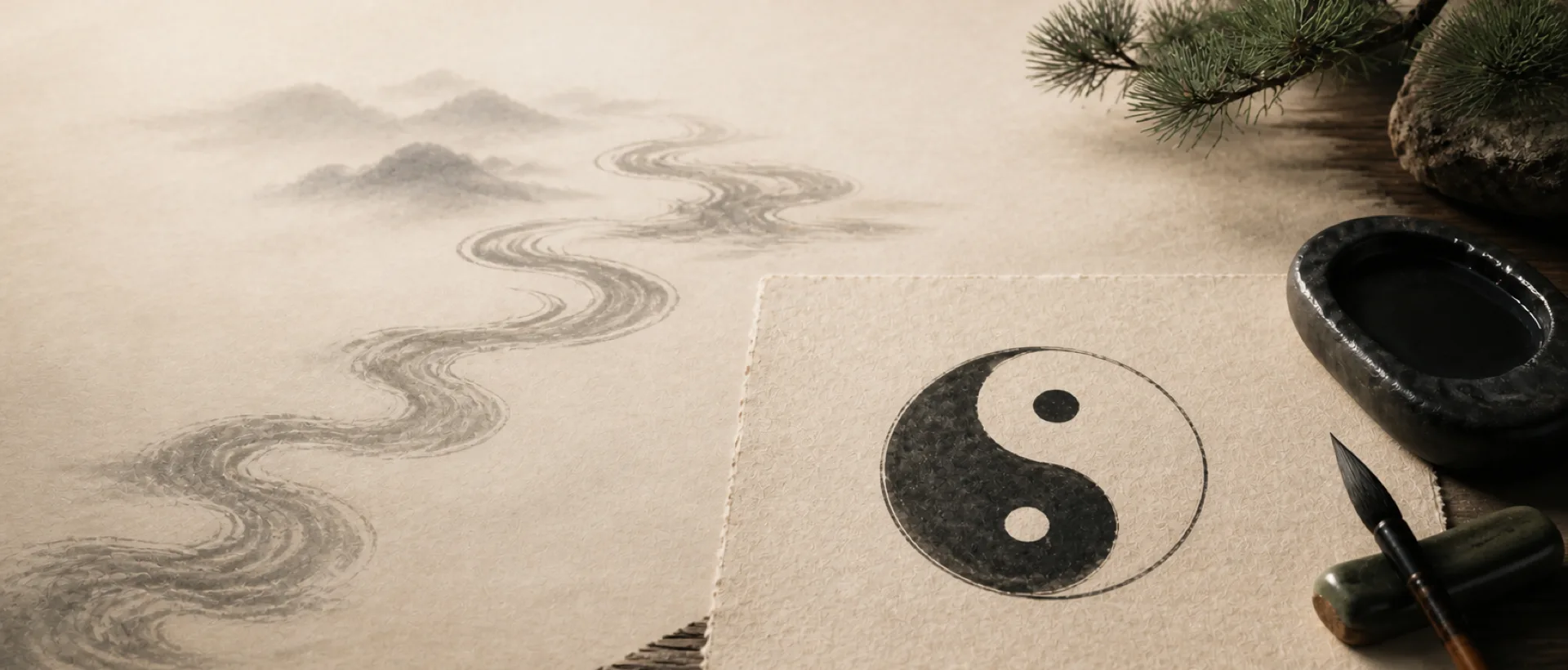
In Taoist temples, martial traditions, books, paintings and ritual objects, the diagram can serve as a visual reminder that life unfolds through relationship. Stillness contains the readiness for movement; fullness prepares a return; every distinct quality participates in a larger whole.
The name taijitu also belongs to more than one historical diagram. The familiar interlocking form and Zhou Dunyi’s multi-layered cosmological chart are related through the language of taiji and yin-yang, yet they have different structures and histories. Understanding both makes the tradition more, not less, meaningful.
Taiji as relationship and generative order
The term taiji (太极) appears in the Yijing commentarial tradition, where it stands at the beginning of a sequence leading to the two modes, four images and eight trigrams. Later thinkers used the term to explore how differentiation arises within an underlying unity.
Taiji is therefore more than the name of a picture. It is a way of speaking about the ordered potential from which relationships become visible. Yin and yang are distinct but never isolated; their interaction gives rise to further patterns and to the “myriad things” of the lived world.
A taijitu makes this reasoning visible. Instead of explaining change only in words, it lets the eye follow division, alternation, proportion and return.
Reading the familiar interlocking form
The familiar taijitu is carefully constructed, and each feature contributes to its meaning.
One enclosing circle. The outer form holds difference within wholeness. Yin and yang are aspects of one field rather than two independent worlds.
A flowing boundary. The S-shaped division turns rather than standing still. It suggests that the relation is alive, continuous and capable of transformation.
Equal yet changing areas. The two colours occupy the same total space, while the width of each expands as the other narrows. The eye encounters waxing and waning instead of a rigid split.
A point of the other within each side. Each broad area contains a small circle of the contrasting colour. This expresses mutual presence: no phase is entirely separated from the conditions of its transformation.
Rotational movement. The diagram has no single privileged top or bottom. It can be read as a continuing turn, a visual echo of cycles in nature and practice.
Together these features present harmony as dynamic relationship. The diagram does not ask difference to disappear. It shows how distinct tendencies can remain connected and responsive.
The five-layer Taijitu
Zhou Dunyi’s eleventh-century Explanation of the Diagram of the Supreme Ultimate (Taijitu shuo) is associated with a different visual form. Its diagram is arranged vertically in a series of circular and linked figures rather than as two interlocking halves.
Read from top to bottom, it presents a generative sequence. The opening circle is linked with the relation between wuji and taiji. Movement and stillness bring forth yang and yin; their interaction gives rise to the Five Phases; further differentiation leads to human life and the myriad things.
The accompanying essay connects cosmology with ethical cultivation. Human beings participate in the same order as Heaven and Earth, and the sage responds through centredness, clarity and sincerity. The diagram is therefore not only an account of cosmic origins. It also asks how a person may embody harmony within conduct.
This form became central to Neo-Confucian discussion and also stands in conversation with Taoist diagram traditions. Scholars have long explored the precise history of those connections. The conversation itself reflects the close exchange among Chinese intellectual and religious currents during the Song period.
The interlocking diagram’s historical development
Circular diagrams of alternation flourished in Song, Yuan and Ming intellectual culture. They appeared in different configurations, sometimes linked with the Yijing, cosmology, alchemy or the transmission stories of particular teachers.
Forms approaching the familiar swirling taijitu are documented in late medieval and early modern sources, and the paired “fish” shapes with contrasting dots became especially widespread in the later imperial period. Through printing, temple art, ritual objects and martial culture, this design gradually became the best-known visual emblem of yin and yang.
The historical record is layered, and not every surviving form belongs to the same lineage. Rather than seeking one simple moment of invention, it is more illuminating to see the familiar symbol as the mature expression of a long Chinese practice of thinking through diagrams.
Its comparatively later visual form does not diminish its cultural depth. Symbols often gather power through centuries of interpretation and use. The taijitu’s history shows how a diagram can become a shared vessel for philosophy, religious practice, art and everyday memory.
Taijitu and the eight trigrams
The taijitu is often surrounded by the eight trigrams. This composite image links the primary differentiation of yin and yang with the richer field of natural forces and situations represented by the bagua.
In the Earlier Heaven arrangement, structurally opposite trigrams face one another across the circle. The design emphasises symmetry, completion and an underlying order. In the Later Heaven arrangement, the trigrams relate to directions, seasons and processes unfolding in the manifest world.
The arrangement matters. On a cosmological chart, temple ceiling, ritual robe, traditional compass or architectural plan, the same symbols may serve different purposes. Reading them begins with attention to placement, orientation and context.
Taoist and Neo-Confucian developments
Both Taoist and Neo-Confucian traditions developed the language of taiji, yin-yang and the Five Phases. Their aims and vocabularies are not identical, yet centuries of exchange created a shared visual and conceptual world.
Neo-Confucian thinkers used taiji to connect cosmic order with moral cultivation and social life. Taoist traditions related it to cosmology, ritual space, alchemical transformation, the body and return to original unity. Diagram, commentary and practice gave the concept different accents in each setting.
Seen in this light, the taijitu does not belong to one narrow category. It is part of a broader Chinese heritage in which philosophy, religion, art and self-cultivation continually interact.
From diagram to embodied practice
In internal martial arts, taiji is expressed through paired qualities such as opening and closing, rising and sinking, substantial and insubstantial, firmness and yielding. The practitioner learns to maintain connection while weight, direction and intention change.
The diagram offers a visual analogy for this training. A curved transition is more responsive than a rigid division. Fullness in one side is supported by emptiness in another. Stillness and movement remain present within one continuous body.
The same principle can guide breathing, meditation, calligraphy, music and tea practice. Each art has its own methods, yet all can cultivate sensitivity to rhythm, centre and transition.
Reading the diagram with historical and cultural context
A careful reading holds symbolism and history together.
Use the familiar interlocking form to discuss yin-yang movement, later imperial visual culture and living practice.
Use Zhou Dunyi’s multi-layered diagram when explaining his cosmology and its Neo-Confucian development.
Keep the curved boundary and the two contrasting dots when reproducing the familiar form, because they carry central aspects of its meaning.
Avoid assigning moral superiority to either colour; each has value within relationship and circumstance.
Describe harmony as responsive proportion and transformation rather than a motionless equilibrium.
Identify the arrangement of surrounding trigrams and the purpose of the object on which they appear.
Traditional cosmological interpretations should be presented through their historical frameworks, with methods, claims and limits stated clearly. They need not be presented as scientifically established certainty in order to be appreciated as enduring systems of meaning and practice.
A symbol that continues to live
The taijitu endures because it communicates several ideas at once. Unity makes room for difference. Each tendency carries the possibility of the other. Growth and decline form one continuous rhythm. The point of fullness is also the beginning of return.
These ideas are encountered not only in books but in temple courtyards, clothing, movement, craft and daily reflection. The diagram remains alive whenever it helps a person notice relationship more clearly and respond to change with greater balance and awareness.
Key points
The taijitu expresses yin-yang difference, interdependence and transformation within one whole.
The flowing boundary, changing widths and contrasting dots each contribute to its meaning.
Zhou Dunyi’s five-layer diagram and the familiar interlocking circle are related but distinct visual traditions.
Circular diagrams developed through Song, Yuan and Ming intellectual, religious and artistic culture.
Taoist, Neo-Confucian and martial traditions each gave taiji a characteristic form of practice and interpretation.
Historical context deepens the symbol’s cultural meaning and supports responsible presentation.