Taiji, Wuji & Cosmology
从无极到万物:这套生成图式是怎么拼起来的
The best-known Chinese account of how the world comes to be is a sequence: from a limitless condition to an utmost limit, from that to movement and stillness, from those to yin and yang, from yin and yang to the five phases, and from the five phases to the myriad things. It occupies about two hundred and fifty characters in the essay that made it famous, and it became the standard cosmology of educated China for eight centuries.
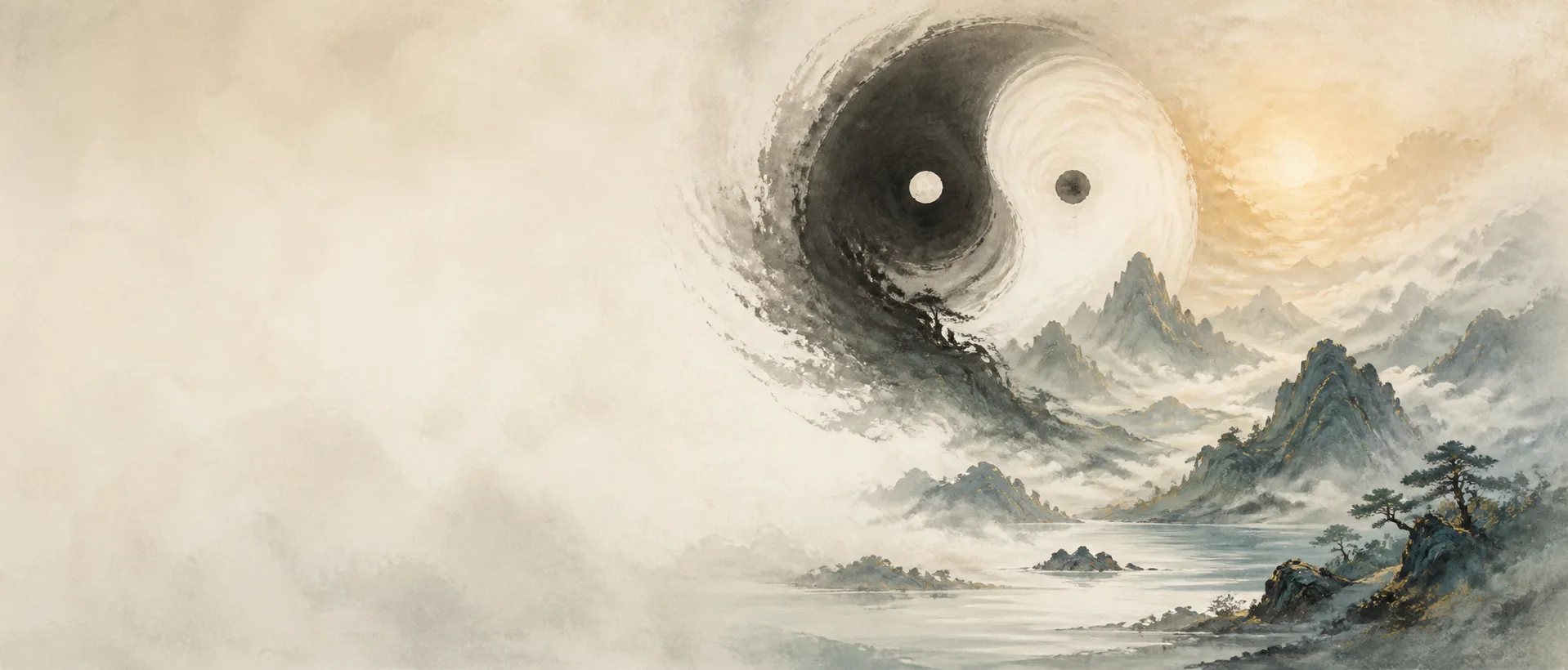
This page sets out the scheme, explains what each step is doing, shows how it was assembled from sources that had nothing to do with one another, and describes the dispute it provoked. It ends with an assessment, since the scheme's elegance and its truth are separate questions.
The scheme in outline
The essay's argument, stripped to its skeleton, runs as follows.
The limitless and the utmost limit are related in a single opening phrase. The utmost limit moves and thereby generates yang; when movement reaches its extreme there is stillness, and stillness generates yin; when stillness reaches its extreme there is movement again. Movement and stillness are each the root of the other. With the separation of yin and yang, the two modes are established. Yang transforming and yin combining produce the five phases. The five phases distribute in order and the four seasons proceed. The two forces interact and the myriad things are produced, generating and transforming without end.
Notice what is absent. There is no maker, no decision, no moment of creation, no purpose stated, and nothing standing outside the sequence to initiate it. The whole account is of a self-differentiating process.
Wuji, the limitless
The first term has its own history, quite separate from the second, and its arrival in this scheme is the point at which the trouble starts.
The word means having no pole, no extremity, no limit. It appears in the Tao Te Ching in a passage recommending a return to it, where it means something close to boundlessness. It appears in later Taoist writing for an undifferentiated condition prior to any distinction. What it does not appear in is the appended commentaries to the Book of Changes, which is where the second term comes from.
So the opening phrase of the essay yokes together a term from the Confucian classical canon and a term from the Taoist tradition. That is a significant move, and it was noticed.
The opening phrase and its readings
The phrase joining the two terms is four characters long and can be read in at least three incompatible ways. The dispute over which reading is correct is one of the most substantial in Chinese philosophy, and it is not a quibble.
On the first reading, the limitless becomes, or gives rise to, the utmost limit. This makes the limitless prior, and implies a stage before the utmost limit — which in turn implies that the utmost limit is not in fact ultimate.
On the second reading, the utmost limit is itself limitless: the phrase is not describing a transition but qualifying the second term, saying that the ultimate has no boundary and no form. On this reading nothing precedes it and the two terms name one thing.
On the third, the two are two descriptions of the same reality, one negative and one positive, in the way that a thing can be described both by what it lacks and by what it is.
The orthodox later interpretation took the second and third readings together: the utmost limit is formless and boundless, and calling it limitless prevents anyone from imagining it as a thing with edges. On that account the phrase is a guard against reification, not a statement about sequence.
Movement and stillness
The next step is more interesting than it looks, because it does not say what one would expect.
A reader might expect the scheme to identify yang with movement and yin with stillness as fixed equations. It does not. It says that the utmost limit moves and thereby generates yang, and that stillness generates yin, and then immediately adds that movement and stillness are each the root of the other. Movement is not a property belonging to yang; it is the operation by which yang comes about, and it is itself produced by the extreme of stillness.
This is the same structure as the reversal at extremes described in the Book of Changes section, and it is doing the same work. It prevents the scheme from being a static classification and makes it an account of a cycle with no first term.
The five phases
From yin and yang the scheme derives the five phases, and this is the step where its composite character shows most clearly.
The five phases are a separate system with its own history, developed in the Warring States and Han periods as a scheme for classifying and correlating things in fives, with two standard orderings: a generating sequence in which each produces the next, and an overcoming sequence in which each restrains another. It has five terms. Yin and yang has two. Two does not divide into five, and the join between the systems is the weakest point of every cosmology that uses both.
The essay handles it by saying that yang transforms and yin combines, and the five phases result. This is assertion rather than derivation, and commentators wrote a great deal to make it feel less abrupt.
From the five phases the scheme reaches the seasons, then the two modes of generation associated with male and female, then the interaction of the two forces, then the myriad things. The last steps are rapid, and their function is to get from an abstract scheme to the observable world.
What kind of account this is
It is worth being precise about the genre, because readers with a Western background tend to assimilate it to something it is not.
It is not creation. There is no agent, no will, no act, and no relation of maker to made. Nothing is brought into being from nothing by a decision.
It is not emanation in the Neoplatonic sense, although it is closer to that than to creation. Emanation involves a descent through degrees of reality, with each level less perfect than the one above. The Chinese scheme has no such hierarchy of being: the myriad things are not less real than the utmost limit, and the utmost limit is fully present in each of them.
It is not evolution in the modern sense, and comparisons to it are anachronistic. There is no mechanism, no variation, no selection, and no time-scale.
What it is, is a derivation: an attempt to show that the complexity of the world follows from an undifferentiated condition by a small number of intelligible steps, requiring nothing external. Its purpose is to make the world self-explanatory.
How the scheme was assembled
Each component came from a different place, and knowing the seams is the best protection against treating the whole as a single ancient revelation.
The utmost limit comes from one sentence in a commentary appended to the Book of Changes, where it describes the undivided state of a divination system. The limitless comes from Taoist usage. Movement and stillness as a paired principle comes from both the commentaries and Taoist writing. Yin and yang as cosmic terms come from late Warring States thought. The five phases come from Han correlative cosmology. The diagram form itself appears to derive from Taoist diagrammatic traditions, and there has been a long scholarly argument about whether the eleventh-century chart was adapted from an existing Taoist alchemical diagram — an argument that began in China centuries ago and is not settled.
So the most famous Confucian cosmology is built substantially from Taoist and Han cosmological materials. That is not a scandal, and it was not hidden; but it is the reason the scheme reads so smoothly across traditions.
The dispute
The joining of the two opening terms provoked a celebrated exchange of letters between two major thinkers, and the substance is worth stating because it is easy to mistake for pedantry.
One party argued that the word for limitless is Taoist, does not occur in the classic being commented on, and should be dropped: prefixing it suggests that something lies beyond the utmost limit, which would put a nothing above the natural and moral order and undermine the whole point of the scheme.
The other party argued that the word is a necessary safeguard: without it, readers will imagine the utmost limit as a thing, a something with a shape, and the scheme will collapse into a cosmology of objects. Calling it limitless denies that it has form while affirming that it is real.
What was actually at stake, then, is whether the natural order is self-sufficient, and how to say that it is without turning its ground into either an object or a void. That is a live question, and both sides were arguing about it competently.
What it was competing with
The scheme did not arise in a vacuum. Buddhist metaphysics had been dominant in Chinese intellectual life for centuries and offered a sophisticated account in which phenomena lack independent existence.
Confucian thinkers of the eleventh century needed an alternative that made the world real, morally significant, and worth acting in, without borrowing Buddhist premises. A cosmology deriving everything from an ultimate that is pattern rather than mind, and treating the resulting world as fully real, did precisely that. Understanding the scheme as a move in that competition explains features of it that otherwise look arbitrary — in particular its insistence that the process is real and that the ultimate is not a consciousness.
Assessing it
Two things should be said, and they do not contradict each other.
The scheme is a genuine intellectual achievement. It is economical, internally consistent, avoids both a creator and a void, and accounts for change without a first mover. As a piece of systematic philosophy it stands comparison with anything produced elsewhere in the same period.
It is also not empirical. No observation would confirm or refute it, and the step from two to five is asserted rather than shown. Internal consistency is not evidence, and a scheme can be elegant, complete and well argued without describing the world. Chinese critics made this objection too, particularly from the seventeenth century onward, and the point does not depend on modern science to be worth making.
Key points
- The scheme runs from a limitless condition through the utmost limit, movement and stillness, yin and yang, and the five phases to the myriad things, with no maker anywhere in it.
- The two opening terms come from different traditions, and the four-character phrase joining them admits several incompatible readings.
- Movement and stillness are each said to be the root of the other, which makes the account a cycle rather than a hierarchy.
- The step from two terms to five phases is asserted, not derived, and is the weakest join in any cosmology using both systems.
- The account is neither creation nor emanation nor evolution; it is a derivation intended to make the world self-explanatory.
- The famous dispute over the word limitless was really about whether the natural order is self-sufficient without becoming either an object or a void.