Taiji in Neo-Confucian & Taoist Thought
同一个“太极”,理学与道教各取所需
Taiji is one of a small number of technical terms that belong fully to two traditions at once. Confucian philosophers of the Song and after made it the foundation of a systematic metaphysics that became state orthodoxy and was taught for six centuries. Taoist writers on internal cultivation used it as the name of a stage in a process they were trying to reverse. Both usages are legitimate, both are old, and they are doing almost opposite things.
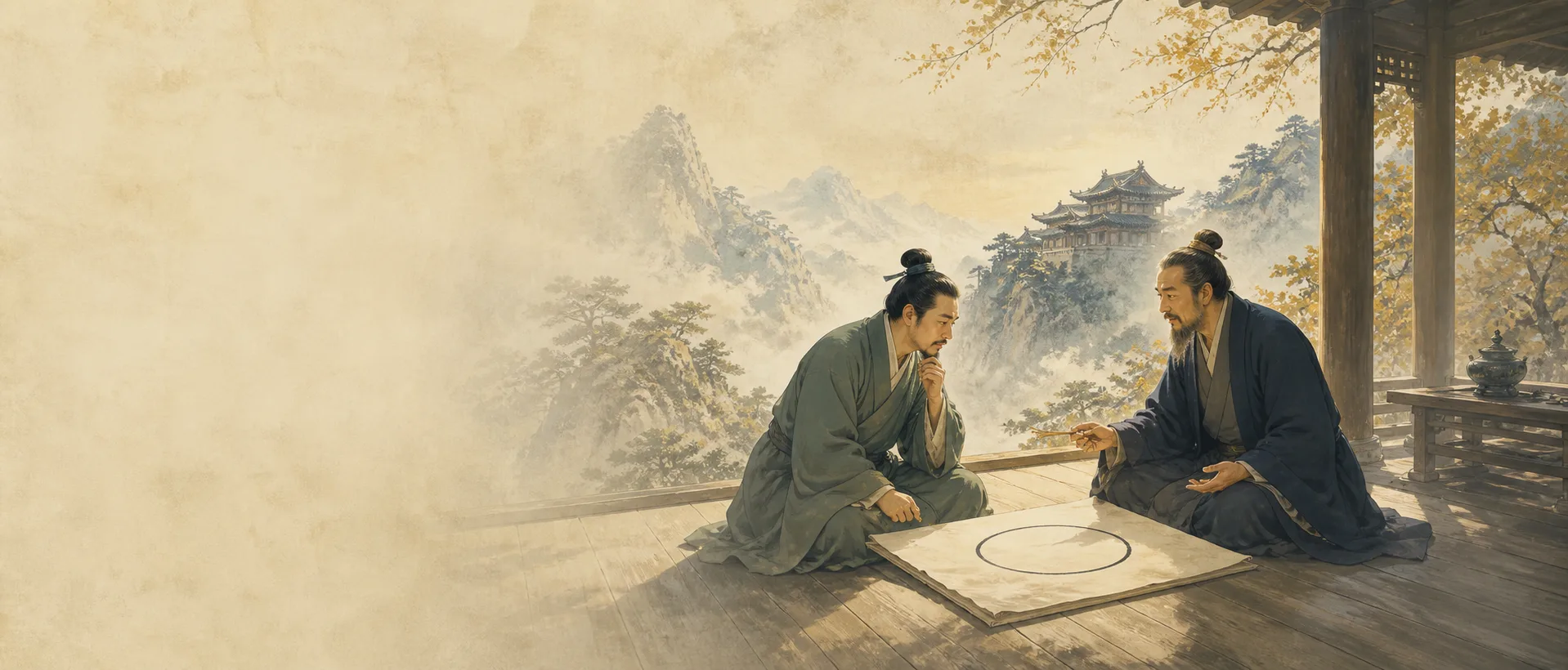
This page explains what each tradition needed the term for, what each built with it, how the two uses differ in direction, and how to tell from a few sentences which sense a text is employing.
Why the term ended up in two traditions
The word came from a commentary appended to the Book of Changes, which was a classic of the state and scholarly tradition rather than a Taoist scripture. So its home was Confucian. But it named something undifferentiated and prior, which is exactly the sort of thing Taoist cosmology and Taoist cultivation had always needed a word for.
There is also a historical accident. The essay and diagram that made the term central were produced in the eleventh century by a Confucian thinker, but the diagram form itself belongs to a tradition of cosmological charts that had been developed largely by Taoists, and a long argument has been conducted, beginning in China several centuries ago, about whether his chart was adapted from an existing Taoist diagram. The question is unsettled. What is not in doubt is that the materials were circulating in both worlds.
The problem the Confucians needed it to solve
To see why Song thinkers cared so much about a single clause, you have to know what they were up against.
Buddhist metaphysics had dominated Chinese intellectual life for centuries and offered a sophisticated account on which phenomena lack independent existence. Confucian scholars found this unacceptable, not primarily on abstract grounds but because their whole programme depended on the world being real: family relations, ritual obligation, public office and moral cultivation all require that ordinary things and ordinary duties matter.
What they needed, therefore, was an account of reality that grounded the world in something ultimate without making that ultimate a mind, a god, or a void. A term from their own canon, denoting an ultimate limit that is neither a being nor an absence, was precisely the tool required.
Taiji as pattern
The interpretation that became orthodox identified the taiji with pattern — the intelligible coherence that things exhibit. Not a substance, not a state of matter, not an agent: the order that makes anything the kind of thing it is.
Three features of this account are worth having clearly.
It is not prior in time. Pattern does not exist first and then get realised. There is no moment at which pattern was alone.
It is fully present in each thing, not divided among things. The standard formulation is that pattern is one and its particularisations are many, and the favoured images are of a single moon reflected in a thousand streams, or of the same order visible in each part of a whole. Each thing has the taiji entire; it does not have a fragment of it.
It is inseparable from material force. The other basic term of this philosophy is a word for the stuff and energy that things are made of and that moves and condenses. Pattern without material force would be nowhere; material force without pattern would be unintelligible. The two are distinguishable in analysis and never found apart.
Why this mattered for ethics
The metaphysics was not an idle exercise, and the payoff is what made it worth six centuries of study.
If pattern is fully present in each thing, then it is fully present in each person, and a person's nature is not something added to the natural order but that order in a particular case. From this the tradition derived its central ethical claim: human nature is continuous with the coherence of things, so moral cultivation is not the imposition of an external standard but the clarification of what one already is. Failure is explained by obscuration — by material force being turbid, by habit, by circumstance — rather than by a defect in nature.
This also gave a rationale for investigation. If the same pattern is present everywhere, then examining anything carefully contributes to understanding oneself and one's obligations. The programme of extending knowledge by attending to particular things follows directly from the cosmology.
Later thinkers shifted the emphasis, arguing that pattern is to be found in the mind rather than sought in external things, which produced a major internal division. But the shared premise was the one described above.
The Taoist use: taiji as a stage
Taoist writing uses the term quite differently. In cosmological passages it names a phase of a sequence, and in internal alchemy it names a condition to be reached or recovered.
The structure is easiest to see through the pair of terms usually rendered prior heaven and posterior heaven. The prior condition is the undifferentiated state before division; the posterior condition is the differentiated state a person actually inhabits. Ordinary life proceeds from prior to posterior: the endowment differentiates, disperses and is expended. Cultivation is described as running the sequence the other way.
This is the crucial difference, and it is easy to state. Confucian philosophy reads the cosmological scheme forwards, in order to explain the world. Internal alchemy reads it backwards, in order to return. A formula in alchemical writing puts it directly: following the sequence produces a human being, reversing it produces a transcendent.
Taiji in internal alchemy
Within that reversal, the term marks a specific point, and the stages of practice are laid out against the cosmological sequence.
The published outline of internal alchemy proceeds by refining one thing into another and finally into emptiness, and the stages are mapped onto the descent from an undifferentiated condition through the two forces to the multiplicity of things. To move back up is to gather what has dispersed, to reunite what has divided, and finally to arrive at the condition prior to division. The term for the limitless names the endpoint of that ascent; the term taiji names the stage just below it, where division has not yet occurred but the capacity for it is present.
Two cautions belong here. First, this is technical vocabulary internal to a practice, and the stages named are not observable to a reader; the texts are notation, not description. Second, different lineages use the terms differently, and even individual texts are not always consistent. The reasonable approach is to treat each work's usage as its own convention.
The direction of the two projects
Setting the two side by side clarifies both.
The Confucian project is outward and social. Its aim is to act well in a family, a community and an office, and its cosmology exists to show that such action is grounded in the nature of things. It reads the generative sequence as an explanation and accepts the differentiated world as the place where life is to be lived.
The alchemical project is inward and individual. Its aim is a transformation of the practitioner, and its cosmology exists as a map of the route back. It treats the differentiated condition as a depletion to be reversed.
Both use the same scheme. One takes the arrow as descriptive; the other takes it as a road to be travelled in the wrong direction on purpose. Almost every apparent contradiction between a Neo-Confucian and an alchemical passage about taiji comes down to this.
Cross-borrowing
The traffic between the two was heavy and went both ways, which is worth saying because polemical accounts on both sides deny it.
Confucian philosophy took the diagram form, probably some of the diagram content, the vocabulary of prior and posterior conditions, and a good deal of the language of stillness and quiet sitting. Taoist writing took the term pattern, the vocabulary of nature and endowment, and the moral framing that appears in later cultivation texts. Neither tradition acknowledged much of this at the time, and both accused the other of borrowing.
For a reader, the practical consequence is that shared vocabulary tells you very little about affiliation. What tells you is the aim of the passage.
How to tell which sense is in use
A few signals settle it quickly.
If the passage is talking about pattern and material force, about human nature, about the investigation of things, or about sincerity and reverence, it is Neo-Confucian, and taiji means pattern.
If it is talking about lead and mercury, water and fire trigrams, firing times, the prior and posterior conditions, or refining one substance into another, it is alchemical, and taiji names a stage.
If it is talking about substantial and insubstantial, about opening and closing, or about the movement of the waist, it is a martial arts text using the term for its associations.
And if the passage is arguing about whether the word for limitless should precede the term at all, it is engaging with the Song dispute described on the cosmology page.
Key points
- The term came from a Confucian classic but named something Taoist cosmology also needed, so both traditions claimed it.
- Song Confucians needed an ultimate that was neither mind, god nor void, in order to answer Buddhist accounts on which phenomena lack independent existence.
- The orthodox reading makes taiji pattern: not prior in time, fully present in each thing, and never found apart from material force.
- The ethical payoff is that human nature is continuous with the coherence of things, so cultivation clarifies rather than imposes.
- Taoist internal alchemy reads the same cosmological sequence backwards, as a route to be retraced, with taiji naming a stage on the way.
- Shared vocabulary indicates nothing about affiliation; the aim of a passage indicates everything.