Origins & History of the I Ching
《易经》是怎么来的
The history of the Book of Changes is unusually well documented for a text of its age, and unusually badly reported. The traditional account of its authorship is repeated in most popular editions as though it were established fact. It is not. What historians can support is a slower and more interesting story, in which a working divination manual was gradually turned into a philosophical classic by people who had no intention of writing philosophy when they started.
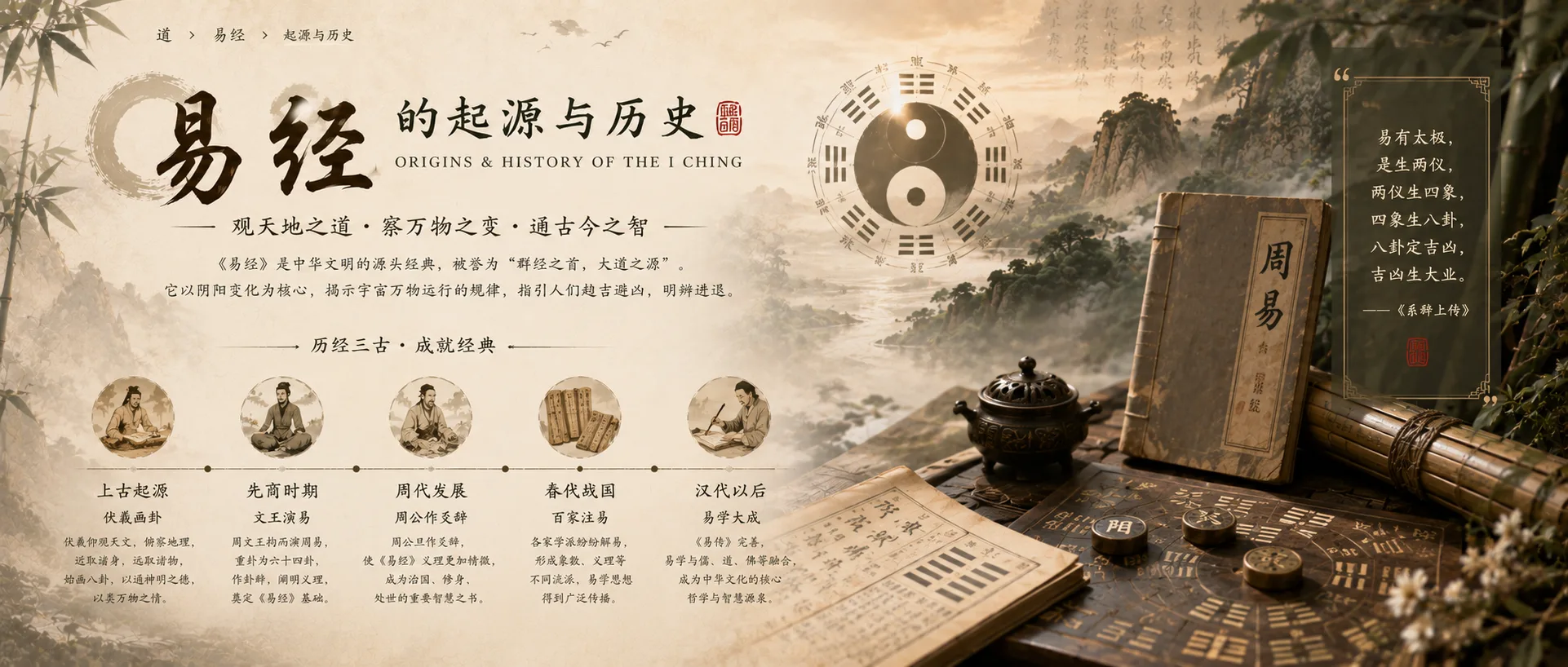
This page separates the two accounts, sets out what the excavated manuscripts of the last fifty years have actually shown, and follows the book through the periods in which its meaning was decided. It ends with how it reached readers outside China, which matters more than it sounds, because the version most English readers meet was shaped by that journey.
The traditional account
In the received story, the book has four authors spread across roughly a thousand years.
The eight trigrams are attributed to Fu Xi, a culture hero of the mythical period, who is said to have perceived them in the markings of animals and the patterns of the natural world and to have used them to invent writing, fishing nets, and much else. The sixty-four hexagrams and the short judgements attached to them are attributed to King Wen of Zhou, composed while he was held prisoner by the last Shang king. The texts attached to the individual lines are attributed to his son, the Duke of Zhou. And the philosophical appendices, the Ten Wings, are attributed to Confucius.
The sequence is elegant, and it does a specific job. It gives the book a mythical origin, a royal origin, a dynastic origin and a sagely endorsement, which between them justify its position at the head of the classics. It is a claim about authority rather than a record of composition.
None of the four attributions survives examination. Fu Xi is not a historical figure. The imprisonment of King Wen is at best a frame narrative. The division of labour between father and son is a later tidying. And the ascription of the Ten Wings to Confucius was doubted inside China long before Western scholarship arrived, on grounds of language and content.
What historians can actually establish
The base text was compiled during the Western Zhou period, most probably somewhere in the ninth to eighth centuries BC, from material that had been accumulating in divination practice. Its language is early, its formulae are technical, and its subject matter is the ordinary business of a bronze-age court: sacrifice, warfare, hunting, marriage alliance, travel, captives, illness.
The compilation looks like an edited collection rather than an authored composition. Phrases recur in ways that suggest a stock of set responses. Some line texts fit their hexagram loosely or not at all. Rhymes and rhythmic patterns survive in places, which points to oral transmission before writing. The most economical description is that professional diviners kept records of formulae and outcomes, that these were organised around a set of sixty-four figures, and that at some point the organisation was fixed.
Independent evidence of use comes from the historical narratives. The Zuozhuan and the Guoyu, which describe events of the Spring and Autumn period, contain a number of episodes in which a hexagram is cast and interpreted at court. These passages are valuable because they show the book being used before it was philosophical. The interpretations in them are pragmatic, sometimes disputed, and occasionally overruled by an official who argues that conduct matters more than the omen.
What the excavated manuscripts changed
Three groups of finds from the second half of the twentieth century transformed the field, and their implications have not yet reached most popular editions.
A silk manuscript recovered from a tomb sealed in the second century BC contains a version of the base text together with several commentaries that were completely unknown. Its hexagram sequence is not the received one, which shows that the familiar order was one option among several rather than an original feature. Some of its commentaries take the form of dialogues, and they treat the book in ways that do not match the received Ten Wings.
A set of bamboo slips from a tomb of the late fourth century BC gives an even earlier witness to the base text. It confirms that the text was already substantially in the form we have, which pushes the date of stabilisation back and settles some long-running arguments about individual characters.
Other finds have recovered fragments of divination manuals that are related to the Book of Changes but distinct from it. These are important for a reason that is easy to miss: they show that the received book was not the only manual of its kind. It was the one that survived, and it survived partly because it was canonised.
Two general lessons follow. First, the base text is older and more stable than sceptical scholarship once assumed. Second, the interpretive tradition is much more varied and much less continuous than the received tradition presents it. There was no single line of transmission from an original meaning.
The Ten Wings and the turn to philosophy
The Ten Wings are the hinge of the whole story. They are not one work. They are a set of texts of different dates, styles and purposes, gathered under one label and eventually printed as part of the book.
Some are glosses that explain the hexagram names and judgements phrase by phrase. Some are systematic treatments of the trigrams and their correlations. One, the most quoted, is a discursive essay that presents the book as a model of the cosmos: Heaven and Earth as the two primal terms, the alternation of firm and yielding, a continuous process of generation with no maker standing outside it, and the sage as the person who reads the tendency of that process and acts accordingly.
These texts were composed over several centuries, roughly from the Warring States period into the early Han. They were the work of scholars who had inherited a divination manual and wanted it to be about the structure of reality. They succeeded so completely that most readers now assume the manual was always about that.
It is worth being precise about what they added. The base text does not use the paired terms yin and yang. It does not describe the cosmos. It does not contain a theory of change. All of that arrives with the appended commentaries, and it arrives in the vocabulary of the intellectual debates of the late Warring States, which is exactly where you would expect it to come from.
Canonisation and the examination system
Under the Han the book was fixed as one of the Five Classics, and that decision determined the next two thousand years. Canonical status brought official editions, appointed specialists, state-sponsored commentaries and a permanent place in elite education.
The consequence that matters most is bureaucratic. Once the classics became the syllabus of the civil examinations, every candidate had to master an approved commentary. This produced generation after generation of officials who could quote the book fluently, and it also meant that the approved reading of any given period was a political fact as much as a scholarly one. When the state changed which commentary was authoritative, it changed what educated Chinese people thought the book meant.
It also produced the odd double life described elsewhere in this section. The same text was a required subject for the governing class and a working tool on the street. The two uses ran in parallel, sometimes with mutual contempt, for most of recorded Chinese history.
The two great reinterpretations
Two shifts in commentary did more than any others to shape how the book is read.
The first came in the third century AD, with a young commentator who cut away the elaborate correlative apparatus that Han scholars had built around the hexagrams — the mappings onto months, directions, musical notes and calendrical cycles — and read the text instead as a set of statements about situation, timing and human conduct. His commentary, later transmitted with a continuation by another hand, became the standard for centuries. Much of what English readers find philosophically attractive in the book descends from this reading.
The second came under the Song, when a group of thinkers rebuilt a cosmology around the figures, produced the diagrams that are now printed in almost every edition, and argued at length about the relation between the numbers and the moral order. The most influential Song reading combined a strictly moral and political interpretation of the line texts with a renewed defence of the legitimacy of consulting the book. That combination became orthodoxy under later dynasties and is the reading transmitted to the modern period.
The point of naming these two turns is not to add names to memorise. It is that a reader who does not know they happened will mistake the results of a particular commentarial project for the plain meaning of an ancient text.
Its place in later Chinese thought
Beyond commentary, the book supplied a vocabulary that spread into almost every technical field. Medical writing used the trigram correlations to describe bodily processes. Military treatises borrowed hexagram names for types of strategic situation. Musicology, agriculture, architecture and ritual all drew on the correspondences. Taoist alchemical texts used the figures as notation for stages of internal transformation, which is the route by which they arrived on temple walls.
Some of this usage was technically serious. A great deal of it was ornamental, the equivalent of an educated flourish. Being able to tell the difference is a genuinely useful skill, and the honest position is that it is often hard.
How it reached the rest of the world
Jesuit missionaries in China from the seventeenth century onward studied the classics closely, and one of them corresponded with Leibniz about the trigram arrangements. Leibniz, who had been working on binary arithmetic, believed he saw his own system in the ancient diagrams. This is the origin of the persistent claim that the Book of Changes anticipated binary computation. The claim is a European reading imported into a Chinese text, not a discovery within it.
A Latin translation prepared by Jesuit scholars circulated in manuscript long before it was printed in the nineteenth century. The first widely read English version appeared in the 1880s as part of a large series of translated Asian scriptures; it is careful, heavily annotated, and rendered in the elevated register that Victorian translators used for anything they considered sacred.
The version that made the book famous in the West was a German translation completed in the 1920s by a missionary who worked in close collaboration with a Chinese scholar of the old school. It presents the received Song reading, with the philosophical vocabulary intact, and it is a beautiful and highly interpretive book. Its English rendering, published at mid-century with a foreword by a well-known psychologist, became the standard for two generations and the basis of the book's reception in the counterculture of the 1960s.
Since the 1990s a different kind of translation has appeared: versions that reconstruct the base text as a bronze-age divination manual, versions based on the excavated manuscripts, and versions that translate one named commentary rather than blending several. These are much less quotable and much more informative.
What the history should change about your reading
Three practical consequences follow from all of the above.
First, when you read a translation you are reading a commentary, whether or not it says so. Ask which one. A translation that renders the base text as bronze-age divination and a translation that renders it as moral philosophy are both defensible, and they will not resemble each other.
Second, the philosophical content that most readers value is genuinely ancient but not original. Knowing that it was added does not make it less worth reading. It does mean that attributing it to the earliest layer is a mistake.
Third, claims about unbroken transmission of a secret original meaning are not supportable. The manuscript evidence shows variety at the earliest stage we can reach. There is no recoverable single intention behind the book, and looking for one is the wrong project.
Key points
- The traditional four-author account is a statement of authority, not a record of composition; none of the four attributions holds up.
- The base text was compiled in the Western Zhou from accumulated divination material and reads like an edited collection, not an authored work.
- Excavated manuscripts show the text was stable early, but that the hexagram order and the interpretive tradition were not.
- The Ten Wings, composed centuries later, added the cosmology, the yin-yang vocabulary and the theory of change that most readers assume are original.
- Canonisation and the examination system made the approved commentary a political matter, and two later reinterpretations shaped what the book now appears to say.
- The famous Western translation transmits a particular Song reading; recent scholarly versions differ from it sharply and deliberately.