A path into the reading
The 64 Hexagrams
Browse all sixty-four GUA in sequence and understand their figures, changing lines, and practical meaning for modern life
Start here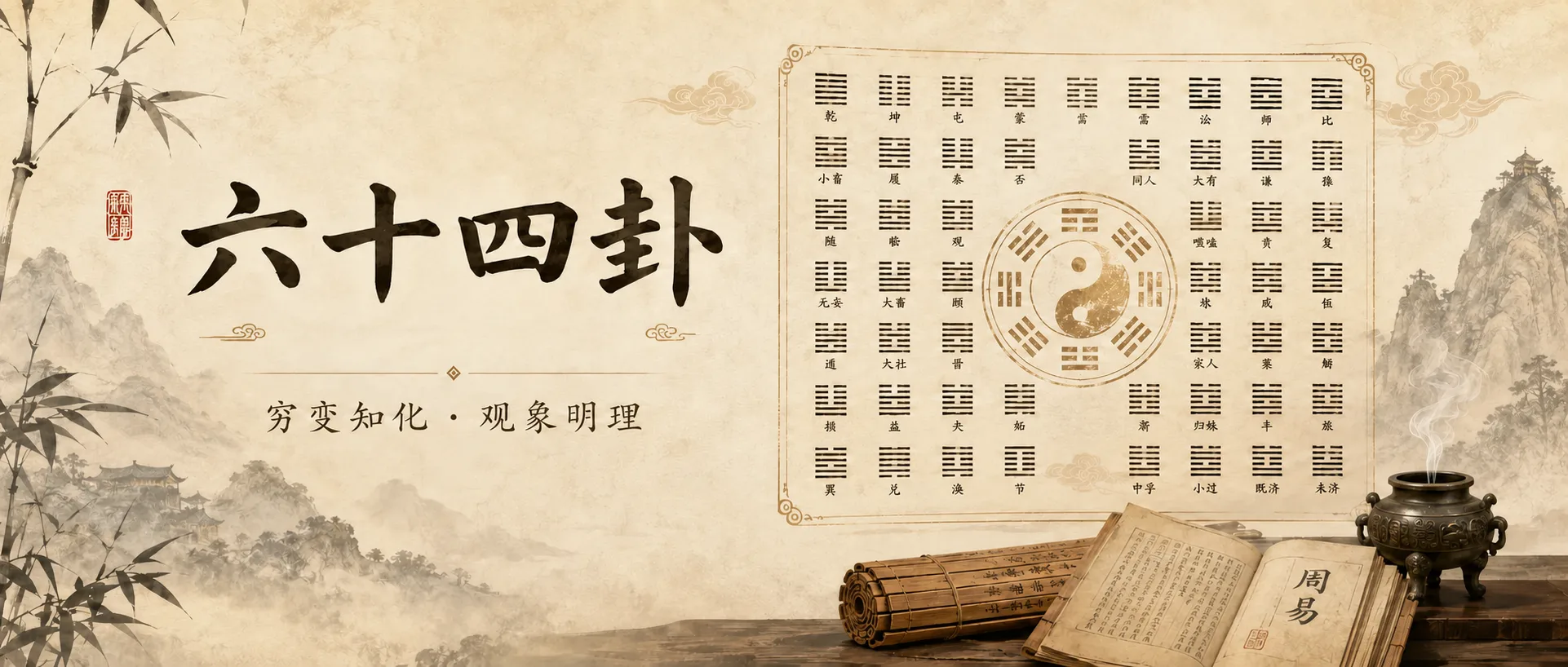

01 Find your bearings
1 · Qian 乾 ䷀
A practical beginner’s guide to using strong creative energy steadily, without pushing beyond the right time.
Explore this section
02 Explore the subject
23 · Bo 剥 ䷖
A practical beginner’s guide to accepting decline, protecting essentials, and avoiding unnecessary expansion while supports fall away.
Explore this section
03 Keep reading
45 · Cui 萃 ䷬
A practical beginner’s guide to forming a real centre for community while preparing for the risks that crowds create.
Explore this sectionGo further
Deeper reading
- 1 · Qian 乾 ䷀A practical beginner’s guide to using strong creative energy steadily, without pushing beyond the right time.
- 2 · Kun 坤 ䷁A practical beginner’s guide to supporting growth through patience, openness, dependable work, and clear boundaries.
- 3 · Zhun 屯 ䷂A practical beginner’s guide to organising confusion at the beginning of a new undertaking.
- 4 · Meng 蒙 ䷃A practical beginner’s guide to learning with humility, good questions, structure, and patient instruction.
- 5 · Xu 需 ䷄A practical beginner’s guide to waiting actively while preparing resources, information, and inner steadiness.
- 6 · Song 讼 ䷅A practical beginner’s guide to handling formal conflict early, fairly, and without making victory the only goal.
- 7 · Shi 师 ䷆A practical beginner’s guide to leading collective action through discipline, clear purpose, and responsible command.
- 8 · Bi 比 ䷇A practical beginner’s guide to forming trustworthy alliances and choosing where you truly belong.
- 9 · Xiao Xu 小畜 ䷈A practical beginner’s guide to using small limits and steady preparation to guide strong energy.
- 10 · Lü 履 ䷉A practical beginner’s guide to moving through risk with courtesy, awareness, and correct behaviour.
- 11 · Tai 泰 ䷊A practical beginner’s guide to maintaining open exchange while conditions are harmonious.
- 12 · Pi 否 ䷋A practical beginner’s guide to protecting integrity when communication and cooperation are blocked.
- 13 · Tong Ren 同人 ䷌A practical beginner’s guide to cooperating openly across differences around a shared purpose.
- 14 · Da You 大有 ䷍A practical beginner’s guide to stewarding abundant resources with clarity, generosity, and restraint.
- 15 · Qian 谦 ䷎A practical beginner’s guide to balancing ability with humility and allowing credit and responsibility to find the right level.
- 16 · Yu 豫 ䷏A practical beginner’s guide to mobilising energy through shared rhythm, preparation, and responsible inspiration.
- 17 · Sui 随 ䷐A practical beginner’s guide to adapting to what is worthy while keeping independent judgment.
- 18 · Gu 蛊 ䷑A practical beginner’s guide to facing inherited neglect and repairing its causes rather than hiding the symptoms.
- 19 · Lin 临 ䷒A practical beginner’s guide to approaching people and responsibilities with presence, care, and awareness that favourable openings change.
- 20 · Guan 观 ䷓A practical beginner’s guide to observing carefully while recognising that others also judge your example.
- 21 · Shi He 噬嗑 ䷔A practical beginner’s guide to removing a concrete obstruction through clear evidence, proportionate rules, and fair enforcement.
- 22 · Bi 贲 ䷕A practical beginner’s guide to using beauty, form, and presentation to support substance rather than replace it.
- 23 · Bo 剥 ䷖A practical beginner’s guide to accepting decline, protecting essentials, and avoiding unnecessary expansion while supports fall away.
- 24 · Fu 复 ䷗A practical beginner’s guide to returning to a sound direction through one small, honest beginning.
- 25 · Wu Wang 无妄 ䷘A practical beginner’s guide to acting honestly and naturally without manufacturing outcomes or hidden motives.
- 26 · Da Xu 大畜 ䷙A practical beginner’s guide to building and containing strong capacity until it can be used responsibly.
- 27 · Yi 颐 ䷚A practical beginner’s guide to examining what feeds the body, mind, relationships, and speech.
- 28 · Da Guo 大过 ䷛A practical beginner’s guide to responding when responsibility or pressure exceeds the structure carrying it.
- 29 · Kan 坎 ䷜A practical beginner’s guide to learning reliable movement through recurring risk without becoming numb or panicked.
- 30 · Li 离 ䷝A practical beginner’s guide to maintaining clear awareness while recognising what light depends on for fuel and support.
- 31 · Xian 咸 ䷞A practical beginner’s guide to allowing mutual influence to develop through sensitivity, respect, and consent.
- 32 · Heng 恒 ䷟A practical beginner’s guide to building commitment through repeatable rhythms that can survive change.
- 33 · Dun 遁 ䷠A practical beginner’s guide to withdrawing from a harmful position early enough to preserve freedom and principle.
- 34 · Da Zhuang 大壮 ䷡A practical beginner’s guide to using great power with restraint so that strength serves what is right.
- 35 · Jin 晋 ䷢A practical beginner’s guide to advancing through visible contribution, support, and increasing clarity.
- 36 · Ming Yi 明夷 ䷣A practical beginner’s guide to protecting clarity when the surrounding conditions are hostile.
- 37 · Jia Ren 家人 ䷤A practical beginner’s guide to creating trustworthy order through roles, speech, care, and consistent conduct.
- 38 · Kui 睽 ䷥A practical beginner’s guide to working with difference without pretending that genuine differences have disappeared.
- 39 · Jian 蹇 ䷦A practical beginner’s guide to recognizing danger, stopping in time, and returning toward help rather than forcing a blocked route.
- 40 · Jie 解 ䷧A practical beginner’s guide to loosening what is bound and acting promptly once danger has begun to clear.
- 41 · Sun 损 ䷨A practical beginner’s guide to reducing excess without damaging what is essential, and making simplicity sincere rather than performative.
- 42 · Yi 益 ䷩A practical beginner’s guide to directing benefit downward and outward so that growth strengthens the whole rather than feeding one centre.
- 43 · Guai 夬 ䷪A practical beginner’s guide to making a necessary decision openly while refusing the intoxication of force.
- 44 · Gou 姤 ䷫A practical beginner’s guide to responding wisely to a sudden encounter whose influence may grow faster than expected.
- 45 · Cui 萃 ䷬A practical beginner’s guide to forming a real centre for community while preparing for the risks that crowds create.
- 46 · Sheng 升 ䷭A practical beginner’s guide to growing through accumulated small steps, receptive support, and a clear direction.
- 47 · Kun 困 ䷮A practical beginner’s guide to preserving purpose when resources, credibility, and freedom of movement are constrained.
- 48 · Jing 井 ䷯A practical beginner’s guide to maintaining shared sources of nourishment and completing the work that makes them usable.
- 49 · Ge 革 ䷰A practical beginner’s guide to changing an order only when the time is ripe, the reasons are credible, and a new mandate can be sustained.
- 50 · Ding 鼎 ䷱A practical beginner’s guide to transforming raw material into nourishment, culture, and legitimate responsibility.
- 51 · Zhen 震 ䷲A practical beginner’s guide to meeting shock with alertness so that fear becomes disciplined presence rather than panic.
- 52 · Gen 艮 ䷳A practical beginner’s guide to stopping at the right place and preventing awareness from being captured by every impulse.
- 53 · Jian 渐 ䷴A practical beginner’s guide to advancing through ordered stages until movement becomes trustworthy and culturally visible.
- 54 · Gui Mei 归妹 ䷵A practical beginner’s guide to recognizing relationships entered from a weak or irregular position and refusing to force their timing.
- 55 · Feng 丰 ䷶A practical beginner’s guide to using a moment of fullness lucidly while remembering that every zenith already contains decline.
- 56 · Lü 旅 ䷷A practical beginner’s guide to living carefully without full belonging, relying on modesty, clarity, and portable integrity.
- 57 · Xun 巽 ䷸A practical beginner’s guide to influencing through repeated, responsive penetration rather than one dramatic act.
- 58 · Dui 兑 ䷹A practical beginner’s guide to creating joy through truthful exchange while distinguishing shared delight from seduction.
- 59 · Huan 涣 ䷺A practical beginner’s guide to dissolving hardened divisions while rebuilding a centre strong enough for renewed movement.
- 60 · Jie 节 ䷻A practical beginner’s guide to creating humane limits that conserve life without turning discipline into punishment.
- 61 · Zhong Fu 中孚 ䷼A practical beginner’s guide to making sincerity strong enough to reach even the least responsive and to support real risk.
- 62 · Xiao Guo 小过 ䷽A practical beginner’s guide to using exceptional care in small matters while refusing grand action beyond the situation’s capacity.
- 63 · Ji Ji 既济 ䷾A practical beginner’s guide to protecting a completed order from complacency, drift, and the hidden beginning of disorder.
- 64 · Wei Ji 未济 ䷿A practical beginner’s guide to carrying a transition through its last difficult stage without mistaking nearness for completion.
The full guide
What should I know before reading further?
The sixty-four GUA present every possible arrangement of six yin and yang lines. They help a reader notice what stage a situation has reached, how different forces are interacting, and what deserves attention next. This page gathers all sixty-four in the traditional sequence, so beginners can move through them step by step and returning readers can find a particular GUA quickly.
Read more The complete guide
The sixty-four GUA present every possible arrangement of six yin and yang lines. They help a reader notice what stage a situation has reached, how different forces are interacting, and what deserves attention next. This page gathers all sixty-four in the traditional sequence, so beginners can move through them step by step and returning readers can find a particular GUA quickly.
Each detailed GUA page explains the figure, the upper and lower trigrams, the six line positions, the modern situation it can illuminate, and practical points to consider. Do not rush to extract one fixed answer. First understand the pattern, then compare it with the facts of your own circumstances; that is where the reading becomes useful.
The 64 GUA at a Glance
The traditional sequence is arranged below in eight groups. Each card gives a practical modern theme before linking to the full explanation.
GUA 1–8
GUA 9–16
GUA 17–24
GUA 25–32
GUA 33–40
GUA 41–48
GUA 49–56
GUA 57–64
How a Beginner Can Read One GUA
- Start with the name and the main situation. A GUA name is not a simple label of good or bad fortune. It helps you recognise whether the matter concerns beginning, waiting, cooperation, conflict, advance, retreat, or change.
- Separate the upper and lower trigrams. The lower three lines often relate to what is inner, near, personal, or beginning. The upper three often relate to what is outer, further away, involving others, or developing later.
- Read the six stages from the bottom upward. The first line is the opening of a situation; the second often shows early stability; the third commonly meets a turning point; the fourth enters the outer field; the fifth approaches maturity; and the upper line can point to completion, withdrawal, or excess.
- Focus on the relevant line text. Do not apply all six line texts to yourself at once. When a reading has changing lines, begin there. When studying a GUA generally, read the six lines as stages through which one situation can develop.
- Return to reality before deciding. Compare the pattern with your resources, timing, relationships, and risks. A GUA can organise reflection, but it does not replace evidence, qualified advice, or personal responsibility.
Figures, Line Positions, and Change
How is a GUA formed?
A GUA has six lines, each either unbroken yang or broken yin, arranged from bottom to top. Two possibilities in six positions create sixty-four combinations. Reading the lower three lines and upper three lines as two trigrams gives a first view of the inner and outer sides of the situation.
How should the six positions be understood?
The line positions are best treated as stages of development, not six unrelated verdicts. The same action can have different consequences at different stages. A beginning may call for preparation, growth may call for cooperation, and near-completion may call for restraint so that success is not lost through excess.
What are changing lines and a resulting GUA?
When a GUA is cast, one or more lines may be changing from yin to yang or from yang to yin. Changing them creates a second, resulting GUA. The original GUA describes the present pattern, the changing line highlights the key movement, and the resulting GUA suggests the direction the situation may take. It describes a tendency, not a guaranteed outcome.
Using the GUA in Modern Life
Work and study: Identify whether you are preparing, advancing, blocked, cooperating, or completing a task, then choose a method suited to that stage.
Relationships and communication: Look at position, distance, and response. Ask not only who is right, but when to speak, listen, yield, or set a clear boundary.
Important decisions: Use the GUA as a framework for listing opportunities, risks, resources, and time conditions. Health, legal, and financial choices should still rely on sound evidence and qualified professional guidance.
Personal cultivation: Observe how an intention grows into action, and how strength that goes too far may need to pause, turn, or return.
Frequently Asked Questions
Are the sixty-four GUA sixty-four fixed destinies?
No. Each GUA describes a pattern of circumstances. Real situations continue to change through choices, environment, relationships, and time. The same GUA can therefore emphasise different concerns for different people.
Where should I begin?
For systematic study, begin with Qian and Kun and continue in sequence. For a specific question, you can open the relevant GUA directly and return here whenever you need the basic guidance on trigrams, line positions, and change.
Is reading the GUA name enough?
No. The name provides an orientation, not a complete answer. At minimum, also consider the upper and lower trigrams, the overall situation, and the relevant line position. This helps prevent “favourable” from becoming permission to rush, or “difficulty” from becoming a reason to do nothing.
Begin Reading
Start with GUA 1, Qian, or go directly to GUA 64, Wei Ji. At the bottom of every GUA page, use the previous, next, and overview links to continue through the collection.
Recommended next page
Where next?
2 · Kun 坤 ䷁A practical beginner’s guide to supporting growth through patience, openness, dependable work, and clear boundaries.A few alternatives