Divination Method & Practice
怎么起卦,历代又怎么看这件事
The Book of Changes was made in order to be consulted, and any account of it that leaves out the procedure has removed the thing the book was for. This page explains how a hexagram is obtained, what the numbers produced by the procedure mean, how the result is read, and the long argument inside the Chinese tradition about whether consultation is appropriate at all.
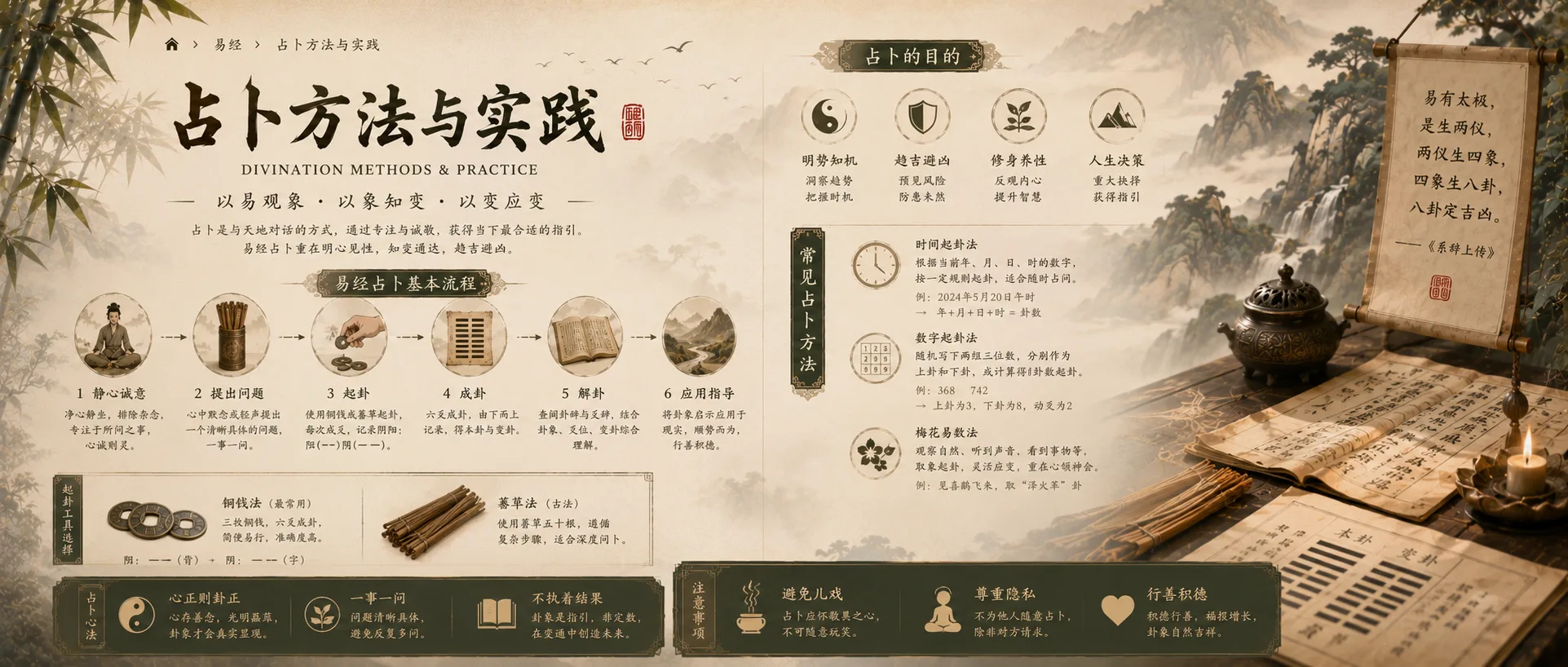
A statement of position first, since it affects how the rest should be read. Explaining a procedure is not endorsing it. Nothing here claims that casting a hexagram yields information about future events, and nothing here claims that it does not. What is set out is what practitioners do, what the texts say about it, and what can be said with confidence about the mechanics — including a fact about the mechanics that most popular accounts do not mention.
Formulating the question
Traditional accounts spend more time on this than modern ones, and the emphasis is informative.
The received advice is that the question should be single, specific, and about a situation rather than about a fact. Questions of the form “will this happen” are treated as poorly posed; questions of the form “what is the character of this situation and how should I conduct myself in it” are treated as well posed. Repeating a question because the first answer was unwelcome is discouraged in essentially every source, which tells you something about how common it must have been.
There is a practical reason behind the advice as well as a pious one. The line texts are overwhelmingly about conduct, timing and restraint. A question about conduct will find something in them to engage with. A question demanding a yes or no will not, and the reader will end up forcing the text.
The stalk method
The older of the two standard procedures uses fifty thin stalks, traditionally of yarrow. It is slow, and the slowness is part of it: a full casting takes a considerable time, and the tradition treats that interval as the point rather than an inconvenience.
The procedure runs roughly as follows. One stalk is set aside at the start and takes no further part. The remaining forty-nine are divided into two heaps by an arbitrary grab. One stalk is taken from one heap and held. Each heap is then counted off in fours, and the remainder from each is held with the first. The stalks held aside at the end of this round are counted, and the round is repeated twice more with the stalks that remain. Three rounds produce one line. Six lines require eighteen rounds.
What matters for understanding is the output. Each set of three rounds yields one of four values, conventionally written as six, seven, eight and nine. Seven and eight are a stable unbroken line and a stable broken line. Nine and six are an unbroken and a broken line at their extreme, marked as changing.
This is where the odd line names in the book come from. When a hexagram is read aloud, the lines are called by these numbers rather than as yin and yang, so a text refers to first-nine or six-in-the-fourth. The vocabulary of the book carries the casting numbers inside it.
The coin method
The later and now far more common procedure uses three coins. They are thrown together six times, once for each line, working from the bottom up. Each face is assigned a value, the three values are added, and the total is again six, seven, eight or nine, with the same meanings as before. A full casting takes a couple of minutes rather than most of an hour.
The coin method became widespread from roughly the Song period onward and is associated with a tradition of practical prognostication that developed its own extensive technical literature, much of it concerned with matters the base text never mentions.
A fact about the mechanics that is usually omitted
The two procedures do not produce the same distribution of results, and the difference is not small.
With three coins, the two changing values are equally likely and each is comparatively rare, while the two stable values are equally likely and common. With the stalks, the four values occur with markedly unequal frequencies: one of the changing values is several times more likely than the other, and the two stable values are also unequal, with the stable broken line the most frequent single outcome.
The practical consequence is that a reading obtained with coins and a reading obtained with stalks are drawn from different systems. Traditional practitioners were aware that the methods differ, and various compromise procedures were devised using coins or beads to reproduce the stalk frequencies. Anyone who tells you the two are equivalent is either simplifying or has not checked.
This is worth stating clearly for a general reason. The apparatus is a designed piece of machinery with properties that can be examined. Examining them is not disrespectful to the tradition; the tradition examined them too.
Other methods
Several other routes to a hexagram have been used. One well-known family of techniques derives a figure from numbers taken from the moment of asking — the date, the time, a count of characters in a written question — rather than from a random draw, on the reasoning that the moment itself is what is being read. Others use dice, drawn slips, or a single throw with a marked instrument.
The variety is itself informative. If the tradition had held that one particular randomising device channels something, the proliferation of devices would be hard to explain. What the methods have in common is that they produce a figure the enquirer did not choose.
Reading the result
A reading is assembled from several parts, and the order below is roughly standard.
Identify the hexagram and read its name and judgement. Note the two trigrams and read inner against outer. Then attend to the changing lines. If there is one changing line, its text is usually treated as the centre of the reading. If there are several, the traditional rules for which to prioritise vary between schools, and the disagreement is real rather than a matter of lost knowledge. If there are none, the judgement carries the reading. Finally, convert the changing lines to produce the second hexagram and read it as the direction of movement.
The result is not a verdict but a description with a tendency: this kind of situation, unstable at this point, moving towards that. Practitioners of the later prognosticatory tradition add much more apparatus, correlating lines with people, months, five-phase relations and much else, in order to extract specific answers. That apparatus is a later development and is not derived from the base text.
The argument inside the tradition
This is the part most worth knowing, and it is usually left out.
One position, held by respected figures over a very long period, is that a person who understands the book does not need to cast it. The reasoning is that the book describes the structure of situations, and someone who has absorbed that description reads situations directly. On this view frequent consultation indicates an unsettled mind and a failure to have learned anything. A related and blunter argument appears in early philosophical writing: the person who is good at the Changes does not divine.
A second position, associated with the interpretation that became orthodox in later dynasties, is that consultation is legitimate and that the book cannot be understood if its divinatory function is discarded. Serious scholars in this camp wrote detailed manuals of procedure and defended the practice against the view that it was beneath a gentleman.
A third position, visible in the earliest narrative sources, treats the result as one consideration among several and freely overrules it. In more than one recorded episode a hexagram is cast, an interpretation is offered, and an official argues that the conduct of the parties matters more than the omen, and prevails.
These three attitudes coexisted for most of Chinese history. A reader who assumes that traditional China simply believed in divination has flattened a live argument.
What can and cannot be said
On whether the procedure yields information about events, this site takes no position, and it is worth being precise about why rather than merely diplomatic.
The claim is not straightforwardly testable in the form practitioners make it, because the readings are descriptions of situations with recommendations about conduct rather than specific forecasts. The ambiguity is not an oversight that testing would expose; it is discussed openly in the commentaries, which are more interested in how a person deliberates than in whether a prediction lands.
What can be said is that the procedure reliably does several things. It produces a text the enquirer did not select, which interrupts a settled train of thought. It imposes a delay. It supplies a vocabulary of situation-types and stages. And it requires the enquirer to state a question precisely enough to be answered, which is frequently the most useful part of the exercise. None of that requires any claim about the future, and none of it establishes one.
Key points
- The tradition treats question-formulation as central, and favours questions about conduct over questions about outcomes.
- The stalk method is slow and deliberate; the coin method is quick and became standard from around the Song period.
- Both produce one of four values per line, two stable and two marked as changing, and these are the numbers the book uses to name its lines.
- The two methods have different probability distributions, which is rarely mentioned and is not a trivial difference.
- A reading is a present figure, its unstable points, and the figure it moves towards — not a single verdict.
- Chinese tradition contains three long-standing and incompatible attitudes to consultation, including the view that a competent reader should not cast at all.