The Eight Trigrams (Bagua)
八卦:八个符号各是什么
The eight trigrams are the smallest working part of the Book of Changes, and they are also the part of Chinese thought most likely to be met outside the book: on temple doorways, on the round mirrors sold at mountain shrines, on the compass a geomancer carries, on a national flag, and as the name of a martial art. Almost nobody who encounters them is told what they are, which is a pity, because the construction takes ten minutes to learn and turns a large amount of decoration into something readable.
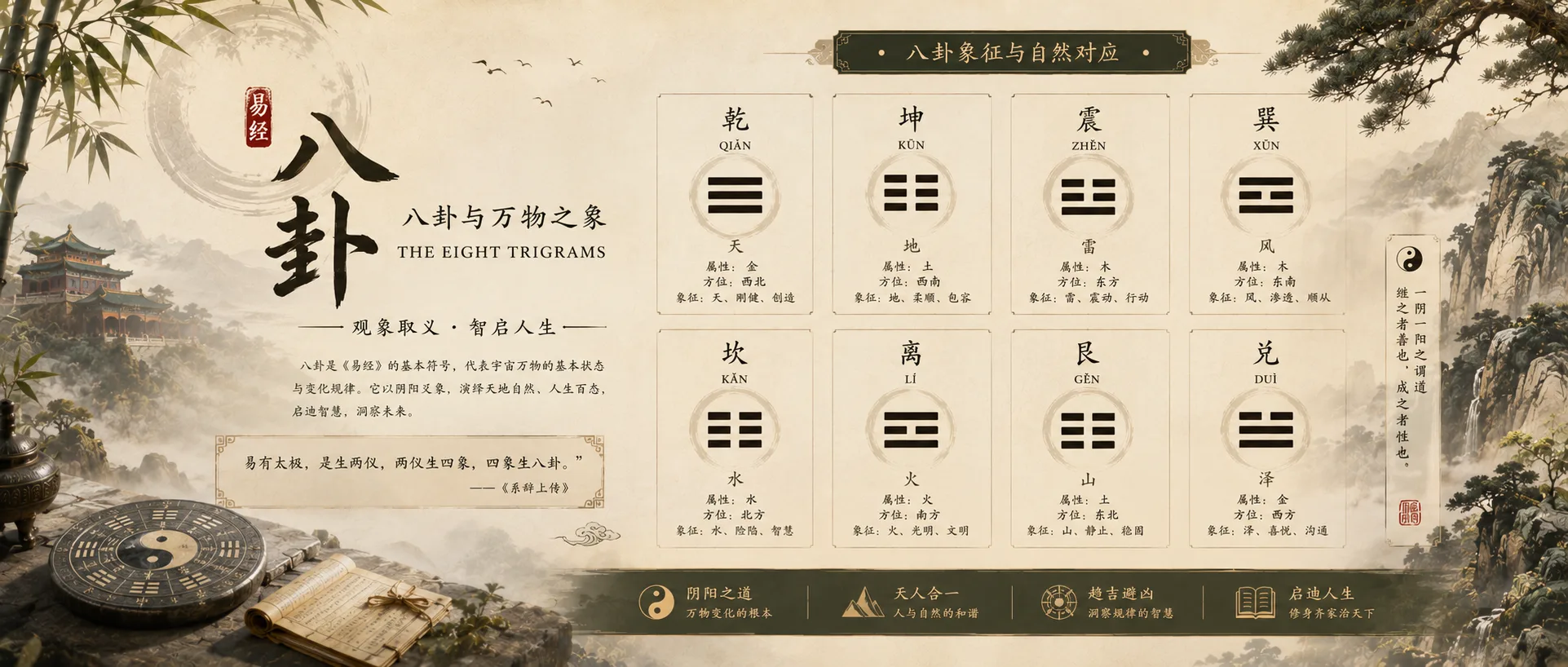
This page explains how the eight figures are generated, what the traditional correlations attached to them are and where those correlations came from, the two standard circular arrangements you will see printed, and the single structural rule that makes the whole set hang together. It also sets out the errors that are worth avoiding.
How the trigrams are built
There are two kinds of line. One is unbroken and is called yang; one is broken in the middle and is called yin. Nothing more is needed.
Stack three lines and you have a trigram. Since each of the three positions can hold either kind of line, there are two to the power of three, that is eight, possible figures. That is the entire derivation. The eight trigrams are not a selection from a larger set and they are not a revealed list. They are an exhaustive enumeration, and the fact that there are exactly eight is arithmetic rather than mystery.
One convention matters and is often not stated. Trigrams are read from the bottom up. The lowest line is the first line. This is not arbitrary decoration: the tradition treats the figure as something growing, with the bottom as the beginning and the top as the late stage, and the sequence of lines as a temporal order. Reading a figure from the top down inverts its meaning.
The rule that organises the set
Two of the eight are uniform: one has three unbroken lines, one has three broken lines. These are treated as the two extremes and are correlated with Heaven and Earth.
The remaining six each contain one line of one kind and two of the other, and here a simple rule does a surprising amount of work. The minority line rules the trigram. If a figure has one broken line among two unbroken, it counts as female; if one unbroken among two broken, it counts as male. And the position of that single line gives seniority: bottom is eldest, middle is middle, top is youngest.
Apply this and the family correlations that look arbitrary in tables become mechanical. The figure with a single unbroken line at the bottom is the eldest son; with it in the middle, the middle son; at the top, the youngest son. The figure with a single broken line at the bottom is the eldest daughter, in the middle the middle daughter, at the top the youngest daughter. Nothing has to be memorised, because it can be derived.
This is worth knowing for a general reason. Many of the correlative schemes in Chinese thought look like arbitrary lists in an introductory table and turn out to have a generating rule underneath. Where you can find the rule, learn the rule.
The eight, one by one
Each trigram has a name, a primary natural image, and a set of secondary correlations. The names below are given in the order used by most Chinese sources.
Qian, three unbroken lines. Image: Heaven. Attribute: initiating, unyielding, persistent. Family: father. Animal: horse. Body: head. It stands for what starts things and does not stop.
Kun, three broken lines. Image: Earth. Attribute: receiving, yielding, sustaining. Family: mother. Animal: ox. Body: belly. It stands for what carries and completes rather than what begins.
Zhen, one unbroken line at the bottom. Image: thunder. Attribute: sudden arousal, shock, the beginning of movement. Family: eldest son. Animal: dragon. Body: foot. A single active line pushing up under two yielding ones.
Xun, one broken line at the bottom. Image: wind, and also wood. Attribute: penetration by persistence rather than force, gradual influence. Family: eldest daughter. Animal: fowl. Body: thighs.
Kan, one unbroken line in the middle. Image: water, specifically flowing water, ravines and pits. Attribute: danger and also depth; something firm hidden inside something soft. Family: middle son. Animal: pig. Body: ears.
Li, one broken line in the middle. Image: fire, and by extension brightness, the sun, clinging. Attribute: illumination, dependence on fuel; something empty inside something firm. Family: middle daughter. Animal: pheasant. Body: eyes.
Gen, one unbroken line at the top. Image: mountain. Attribute: stopping, stillness, a limit. Family: youngest son. Animal: dog. Body: hands.
Dui, one broken line at the top. Image: marsh, standing water, a lake. Attribute: pleasure, expression, the mouth open. Family: youngest daughter. Animal: sheep. Body: mouth.
Two observations about this list. First, the pairs are structural opposites: Heaven and Earth, thunder and mountain, wind and marsh, water and fire, in each case one figure being the other with every line reversed. Second, the correlations beyond the primary image are not consistent across texts. Different sources give different animals, different colours, different organs. The lists are traditions of association, not measurements, and treating them as fixed data is a mistake.
Water and fire, and why they matter
Two of the eight deserve a note, because they carry more weight in Taoist writing than the rest.
The water figure has a firm line at its core surrounded by yielding lines. The fire figure has a yielding line at its core surrounded by firm lines. The tradition finds this pair of internal structures extremely suggestive: something hard concealed within softness, and something empty concealed within hardness.
In internal alchemy these two become the central technical pair. The images of extracting the firm line from within water, and of filling the hollow at the centre of fire, are used constantly to describe a process of internal rearrangement. If you read Taoist cultivation texts and find repeated talk of water and fire, dragon and tiger, lead and mercury, it is generally these two figures and their internal structure that are being invoked.
The two standard arrangements
The eight are almost always shown around a circle, and there are two standard circles. They are not versions of the same thing and they are not used for the same purposes.
The first arrangement, conventionally called the Earlier Heaven or Former Heaven sequence, places Heaven and Earth opposite each other on the vertical axis and arranges the rest so that every figure faces its exact structural opposite across the circle. It is a diagram of symmetry. It is the arrangement usually printed around the black-and-white circle of yin and yang, and it is the one used when the point being made is about balance and mutual generation.
The second, conventionally called the Later Heaven sequence, distributes the eight around the compass differently, with fire in the south and water in the north, and the four remaining figures placed at the intermediate points. It is not symmetrical in the same way. It is a working arrangement, correlated with directions, seasons and the eight divisions of the year, and it is the one used in geomancy, in the layout of buildings, and in the nine-square grid.
Confusing the two is one of the commonest errors in popular writing. If you see a source using compass directions, it is almost certainly using the second arrangement; if you see a source talking about symmetry and pairing, it is using the first. A source that mixes them without noticing is not reliable.
Where else you will see them
The trigrams escaped the book early and are now visible in a number of places.
They appear on octagonal mirrors and plaques hung above doorways, where the arrangement is the symmetrical one and the object is protective. They appear on the geomancer's compass, where the outer rings are subdivisions of the second arrangement. Four of the eight appear on the flag of South Korea. They give their name to a Chinese internal martial art whose circular footwork is organised around eight directions and eight changes of technique, discussed elsewhere on this site. They structure the nine-square grid used in ritual, in city planning and in classical mathematics. And they are carved and painted throughout Taoist temple architecture, including on Wudang Mountain, where they mark orientation and cosmological claim rather than serving as ornament.
How this helps when reading a hexagram
The practical reason to learn the eight is that a hexagram is two of them stacked, and the fastest way into an unfamiliar hexagram is to read its two halves.
The lower three lines are conventionally treated as the inner, the near, the earlier and the self; the upper three as the outer, the far, the later and the other. So a hexagram made of the mountain figure below and the water figure above can be read immediately as stopping within and danger without, before you have looked at a single word of the text. That reading will be crude, and it will usually be recognisably related to what the judgement says.
This is also how the hexagram names often make sense. A large number of them are transparent once you see which two figures are involved and in which order, since reversing the order gives a different hexagram with a different name.
Errors worth avoiding
The trigrams are not elements in the sense of substances. Heaven, thunder and marsh are not materials. They are situation-types given natural images as labels, and the images are chosen for behaviour rather than composition.
They are not the same as the five phases, which is a separate scheme with a different number of terms and a different logic. Correlations between the two systems exist, but they were built later and they do not fit neatly.
They are not a personality typology, and assignments of people to trigrams by birth date belong to a much later divinatory apparatus, not to the Book of Changes.
And the correlation tables are not a database. When two sources disagree about which animal or organ goes with which figure, the correct conclusion is that the association was never fixed, not that one source is corrupt.
Key points
- Two kinds of line stacked three deep give exactly eight figures; the number is arithmetic, not revelation.
- Trigrams are read from the bottom upward, and the bottom is the beginning.
- In the six mixed figures the minority line rules, and its position gives seniority; the family correlations can be derived rather than memorised.
- The pairs are structural inversions of each other, and the water and fire figures carry particular weight in Taoist internal cultivation.
- There are two standard circular arrangements, one symmetrical and one directional, and they are used for different purposes.
- Reading a hexagram as two stacked trigrams, inner below and outer above, is the quickest way into an unfamiliar figure.