Core Themes: Wandering, Wu Wei & Spontaneity
逍遥、无待、技进乎道
The Zhuangzi has a small number of recurring concerns and a large number of ways of approaching them. This page takes the main ones in turn: the language of unconstrained movement, the distinction between depending on something and not depending, the version of acting-without-forcing that this book holds, the accounts of skill, the vocabulary of forgetting, the use of what is useless, and the treatment of death.
Each is explained with attention to what the text actually says rather than to what the phrases have come to mean. In two cases — the opening story about the great bird and the passages about fasting the mind — the popular reading is close to the reverse of the text's.
Unconstrained wandering
The title of the first chapter joins a word for unhurried, unimpeded movement with a word meaning to roam, to travel for no purpose, and also to play. The compound is the book's central image for the condition it recommends.
Three things it does not mean. It is not travel; nobody in the book goes anywhere in particular, and the wandering is often done sitting still. It is not escapism; the characters who exemplify it are frequently in difficult situations, including serving under dangerous rulers. And it is not a mood of detachment; it is described as a way of moving through circumstances, with the emphasis on movement.
What it does mean is closer to freedom of manoeuvre. A person who is not committed to a single standpoint can move between them, and a person who is not attached to a particular outcome has more available responses. The image is spatial because the claim is about room to move.
Depending, and not depending
The first chapter's opening story is the most misread passage in the book, and getting it right changes the reading of everything after.
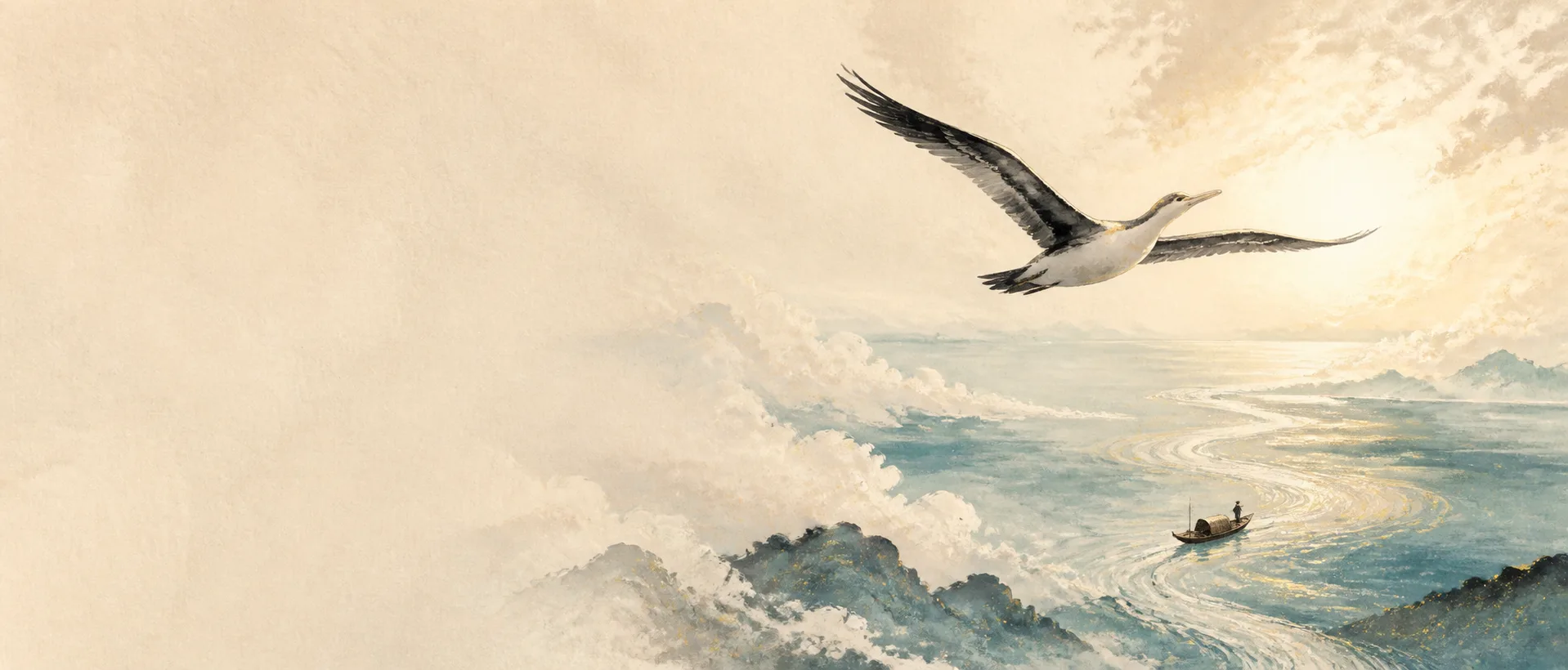
A vast fish becomes a vast bird and flies from the northern ocean to the southern, rising to an enormous height and travelling for months. A cicada and a dove laugh at it, saying they are perfectly happy fluttering between bushes and cannot see why anyone would go so far. The obvious moral, and the one almost universally drawn, is that small creatures cannot appreciate greatness.
The text then does something else. It points out that the great bird requires an accumulated depth of wind beneath it, and that without the wind it cannot fly at all. It goes on through a series of increasingly impressive figures — including a man who rides the wind — and observes that each of them still depends on something. The chapter's own conclusion names as the goal a condition of not depending, and asks what such a person would have to wait for.
So the great bird is not the ideal. It is one more example of dependence, more spectacular than the cicada and no freer in principle. The passage is not about the superiority of large perspectives; it is about the difference between having a bigger scope and not being conditional at all. Almost every popular retelling stops before the sentence that makes this clear.
Acting without forcing, in this book
The Zhuangzi shares the vocabulary of not forcing with the Tao Te Ching but uses it differently, and the difference is worth stating.
In the Tao Te Ching the term is mostly political: a recommendation to rulers about restraint in law, taxation and war. In the Zhuangzi it is mostly about the mode of an individual's action, and its content is given by the craftsman stories rather than by policy advice. Where the Tao Te Ching says what a ruler should not do, the Zhuangzi shows what competent action looks like from inside.
Two related words carry the weight. One means to follow or go along with, and the other to rely on what is already there. Competent action is described as following the given contours of a situation and relying on what the situation offers, rather than imposing a plan on it. The recurring formulation in the skill stories is that the practitioner does not encounter resistance, because nothing is being opposed.
The skill stories
These are the most accessible material in the book and they make a serious epistemological claim.
A butcher has used the same blade for nineteen years without sharpening it, because he cuts along the natural divisions of the carcass rather than through them. He says that at first he saw a whole ox, then he stopped seeing the whole animal, and now he works without looking, his senses stopping while something else proceeds. A hunchbacked man catches cicadas as if picking them up, and explains that he has practised until nothing in the world exists for him but the cicada's wing. A man swims in a dangerous torrent and says he has no technique, only long familiarity, having grown up with the water. A woodworker denies having any special art and describes instead a process of clearing his mind until he can see the right form in the timber. A wheelwright tells a duke that the knack of his trade cannot be conveyed in words, which is why the duke is reading the useless leftovers of dead men.
The claim these stories make together is specific. There is a kind of competence that cannot be reduced to rules, cannot be transmitted verbally, is acquired only through long engagement with particulars, and operates without deliberation at the point of action. This is not mysticism. It is a position about the nature of expertise which has serious modern defenders, and the Zhuangzi is one of its earliest and best statements.
One caution. The stories are about skills, and the book extends the model to living in general. That extension is an argument by analogy, and whether it holds is a real question rather than a settled one.
The given, and the humanly contrived
A pair of terms runs through the book: one word conventionally translated as heaven but meaning here something closer to what is simply the case, the given, the spontaneous; and one word meaning the human, the deliberately arranged.
The clearest statement contrasts an ox having four legs, which is given, with a rope through its nose, which is human. The distinction is not a preference for wilderness. It marks the difference between the way something already is and an arrangement imposed on it for a purpose.
The book's interest is in how much of what we take for granted belongs to the second category — including our categories themselves, our standards of value, and our confidence about right and wrong. This connects directly to the argument about the equality of things treated on its own page.
Forgetting
A cluster of passages uses the language of forgetting, emptying and losing, and this is the second place where the popular reading goes wrong.
One dialogue describes a progressive attention that moves from hearing with the ears, to hearing with the mind, to something described as emptiness that waits on things. Another describes letting go of the body, dismissing cleverness, and merging with what is unobstructed. Read through later traditions these look like meditation instructions, and they have been used that way for two thousand years.
Read in place, they are not instructions. They occur inside dialogues, they are attributed to characters, no method is given, no posture or breath or duration is specified, and in one case the speaker is Confucius. The passages describe a condition; they do not tell you how to produce it. Later Taoist practice supplied techniques and attached them to these lines, which is legitimate as religious development and misleading as interpretation.
What the passages do argue is that a great deal of what obstructs competent response is accumulated: habits, categories, self-regard, the desire to be seen doing well. Forgetting names the removal of accumulation, which is why the skilled craftsmen cannot say what they know.
The use of the useless
A recurring joke with a serious point. A tree is so gnarled and knotty that no carpenter wants it, and for that reason it is still standing while straight trees have been cut. A man is so deformed that he is exempt from conscription and taxation, and outlives the able-bodied. A large gourd is too big to be a container and is turned into a boat.
The argument is that usefulness is always usefulness for some purpose, and being useful to a purpose means being consumed by it. In an age when the purposes on offer were the purposes of states at war, this is not a whimsical observation. The praise of uselessness is a refusal of a particular set of demands, and it connects directly to the story of the refused ministership.
There is also a general point about value. To call something useless is to make an assessment from a standpoint, and the book delights in showing the standpoint shifting so that the assessment reverses.
Death
The Zhuangzi discusses death more than any other early Chinese text, and its treatment is the least consoling thing in it.
Its recurring move is transformation. What we are is a temporary configuration of the same stuff that everything else is a configuration of, and dying is a further transformation rather than an ending of something that was ever separate. When his wife dies, Zhuangzi is found drumming and singing, and explains that he wept at first and then reflected on the process. He does not deny grief; he describes changing his mind about what has happened.
Elsewhere a skull declines an offer to be restored to life. Elsewhere the text observes that we call one state life and the other death from where we stand, and asks how we could know which is preferable.
This is genuinely unsettling rather than comforting, because it does not reassure you that you continue. It proposes that the entity you are worried about was always a temporary arrangement. Readers who come for consolation often find this colder than they expected, and it is more honest to say so than to soften it.
What none of this amounts to
A closing caution, since these themes are frequently packaged as a programme.
There is no method here. No exercises, no stages, no sequence, nothing to do this evening. The skill stories describe what mastery looks like from outside and explicitly deny that it can be conveyed in words, which rules out the book being a manual. The passages about forgetting describe a condition without a route to it.
What the book offers instead is a set of arguments and a very large number of examples, aimed at changing how a reader holds their own judgements. Whether that changes anything else is left to the reader, and the book is notably unwilling to promise that it will.
Key points
- Unconstrained wandering is a claim about freedom of manoeuvre between standpoints, not about travel or detachment.
- The great bird of the opening story is an example of dependence, not the ideal; the chapter's goal is not depending on anything.
- Not forcing, in this book, is about the mode of individual action and is filled out by the craftsman stories rather than by political advice.
- The skill stories argue that real competence cannot be reduced to rules or transmitted verbally, which is a serious epistemological position.
- The passages about forgetting describe a condition and give no method; later traditions supplied the techniques.
- The treatment of death rests on transformation and is unsettling rather than consoling, since it dissolves the entity being worried about.