Zhuangzi in Taoist Practice & Later Influence
从魏晋玄学到禅宗与诗画,庄子影响了什么
The Zhuangzi's influence is out of all proportion to its length, and it runs through channels the Tao Te Ching never reached. It became the central text of a philosophical movement, was canonised as a scripture, supplied Chan Buddhism with much of its vocabulary and its literary manner, shaped the tradition of poetry about retirement, and became the standard philosophical reference for painting.
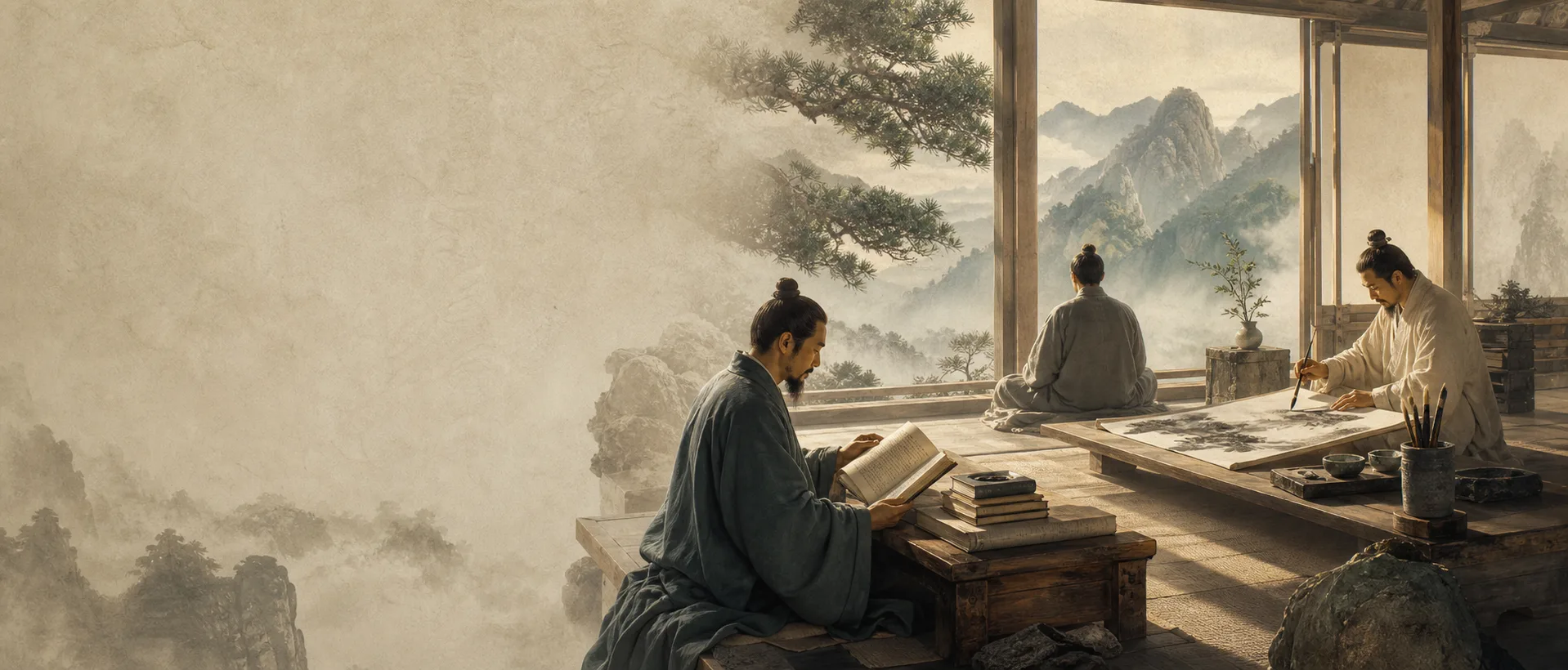
This page follows those lines of influence, and it also does something the usual accounts do not: it says what each tradition could not use, and what has largely been dropped.
The third and fourth centuries
The book's first great period was the era following the collapse of the Han, when a philosophical movement usually called dark learning or abstruse learning took the Zhuangzi, the Tao Te Ching and the Book of Changes as its three central texts.
The commentary produced in this period is the one we still read, and it did more than explain the book — it substantially reinterpreted it. Its author developed a doctrine of things generating themselves without any external cause, which is a genuinely bold metaphysical position, and a doctrine that each thing has its own allotted portion of nature.
The second of these had a striking consequence. If each person has an allotted nature and fulfilling it is what freedom consists of, then unconstrained wandering becomes compatible with occupying one's social station and doing one's job. A book written by a man who refused a chief ministership was turned, by its most influential commentator, into a philosophy reconciling the reader to office. That is not a distortion imposed by outsiders; it is the standard Chinese reading, and it is worth knowing that the text you meet in traditional commentary has been through it.
The same period produced a well-known circle of writers and drinkers who took the book as licence for disregarding conventional propriety in favour of what was natural. Their reputation, and the anecdotes about them, did as much for the book's cultural position as any commentary.
Becoming a scripture
In the eighth century an emperor with strong Taoist commitments conferred honorific titles on several early texts and their putative authors. Zhuangzi was ennobled as a transcendent being with a formal title, and his book was retitled as a scripture accordingly. That title remains in use.
The elevation was administrative as well as devotional: canonising texts, granting titles and sponsoring commentaries were the ordinary means by which the state managed religion. Being made a scripture placed the book in a system of transmission and in the syllabus of clerical education.
What religious Taoism took
The religion drew on the book selectively, and the selection is revealing.
It took the vocabulary of forgetting, emptying and fasting the mind. A Tang treatise on sitting and forgetting builds an explicit meditative method on terms drawn from the Zhuangzi, supplying stages, cautions and a progression that the original does not contain. This is the clearest single case of the pattern described elsewhere on this site: later practice supplies techniques and attaches them to earlier language.
It took the figures of the transcendent — the people in the book who ride clouds, ignore heat and cold, and are indifferent to death — and read them as accounts of accomplished adepts rather than as thought experiments.
It took the craftsman model as an image of what mastery of a cultivation practice would be like.
And it took the book's authority. A scripture in the canon lends weight to whatever can be connected to it.
What religious Taoism could not use
This is the more interesting half, and it is usually left out.
The book has no gods, no ritual, no priesthood and no afterlife. It offers no salvation and no cosmological hierarchy to petition. None of the apparatus of the religion is in it.
More sharply, its treatment of death runs against the religion's central promise. The Zhuangzi is at ease with dissolution: what you are is a temporary configuration and its dispersal is another transformation. A religion offering extended life, and ultimately transcendence of death, needs the practitioner not to dissolve. These are not the same aim, and the tension was never fully resolved. Commentators managed it by reading the passages about transformation as descriptions of a lower attainment, but the plain sense of the text is not on their side.
The book's suspicion of technique is also awkward. A tradition of graded methods, transmissions and stages has to work around a text whose most famous claim about skill is that it cannot be conveyed in words.
Chan Buddhism
The influence here is real, large, and constantly misdescribed.
When Buddhist texts were first translated into Chinese, translators used the available philosophical vocabulary, much of it from the Zhuangzi. That created overlaps in terminology that later readers mistook for overlaps in doctrine.
Chan then took a good deal more: the language of no-mind and of forgetting, the emphasis on the ordinary and the spontaneous, a deep suspicion of doctrinal formulation, the model of mastery that cannot be verbalised, and above all a literary form. The Chan encounter dialogue — a short prose anecdote in which a question is met with an answer that dissolves the question, often comic, often at the expense of a self-important interlocutor — resembles the Zhuangzi's dialogues so closely that the debt is not seriously disputed.
The warning is about direction. Chan is many centuries later and Buddhist in its premises: emptiness, dependent origination, rebirth, and a soteriology of awakening. None of these is in the Zhuangzi. Reading the Zhuangzi as proto-Chan imports a framework of meditation, enlightenment and lineage that is not there, and it is the commonest single error in popular writing about the book. The influence runs forwards.
Poetry
The book is the philosophical background of a whole tradition of Chinese poetry.
The poetry of retirement and of the plain rural life takes its vocabulary of the natural and the self-so from this source. The great poet of the Tang who wrote about wandering, immortals and vast flight used the book's imagery constantly, including the enormous bird of the first chapter, which became a standard figure for ambition and for release. The most famous prose-poem of the Song, written on a river at night, is essentially a meditation on the book's account of transformation and of what changes and what does not.
What poetry took was the imagery and the stance, not the arguments. The chapter on standpoints has almost no poetic afterlife; the butterfly, the great bird and the wandering have a great deal.
Painting and aesthetics
Chinese writing about painting quotes the Zhuangzi more than any other philosophical text, and for a specific reason: the craftsman stories provide a theory of artistic competence.
The claim that mastery cannot be reduced to rules, that it operates without deliberation, and that it involves clearing away accumulated intention became the standard account of what the painter does. A passage in the book describing a painter who takes off his clothes and sprawls at his ease before working supplied a phrase that became shorthand for the artist's required unconstrained state.
From this came the characteristic emphases of literati painting: that spontaneity matters more than finish, that resemblance is not the point, that the work should look unforced, and that the artist's condition is prior to technique. A twentieth-century Chinese study argued at length that the Zhuangzi is the origin of the Chinese artistic spirit as such, and while that is a strong claim, the connection it describes is not in doubt.
Prose and fiction
The book's formal influence on Chinese writing is easy to underestimate.
It established the philosophical fable as a form, and later essayists writing short allegorical pieces are working in a genre it defined. Its dialogues shaped the anecdotal collections that became a major branch of Chinese prose. Its stories were reworked for centuries, and a leading modern writer retold the skull episode as a short satirical play.
Modern reception
Within China the book has been read in several new ways over the last century. One influential early twentieth-century commentary read the chapter on standpoints through Buddhist logic. Twentieth-century historians of philosophy treated it as the high point of early Chinese thought. It has been read as a critique of authority, as a resource for aesthetics, and at times as politically suspect.
Abroad, it has been the more admired of the two classics among philosophers, precisely because it argues. It was translated into German in part by a well-known thinker early in the twentieth century, attracted the interest of European philosophers concerned with technology and with the limits of representation, and was rendered into English by a Trappist monk in a widely read version of selections. In recent decades it has been taken up by analytic philosophers interested in scepticism, in relativism and especially in the nature of skill, where its account of expertise is treated as a serious contribution rather than as an antiquarian curiosity.
What has been dropped
Three things have travelled badly, and it is worth naming them.
The political refusal. The book's rejection of service to power was domesticated early, most effectively by the commentator who reconciled it with holding office. Very little of the later tradition preserves the sharpness of the man who told the envoys to leave him in the mud.
The self-implication. The stories in which the narrator turns out to be the one who has not understood are rarely quoted, and their absence makes the book look more serene than it is.
And the humour. Solemn commentarial and religious traditions strip the jokes, and so do most translations. Since the comedy is a method rather than a decoration, this is a loss of content, and it is the main reason the book's reputation is so much more pious than the book.
Key points
- The commentary that shaped all later reading reinterpreted the book so that unconstrained wandering became compatible with holding office.
- An eighth-century emperor made it a scripture and its author a transcendent, placing it inside the religion's system of transmission.
- Religious Taoism took the vocabulary of forgetting and built graded meditative methods on it that the original does not contain.
- The religion could not use the book's ease with dissolution, which runs against its promise of extended life and transcendence of death.
- Chan Buddhism's debt is real, especially in its dialogue form, but Chan is later and Buddhist; reading the book as proto-Chan is the commonest popular error.
- The craftsman stories became the standard Chinese theory of artistic competence, while the political refusal, the self-implication and the humour largely did not survive transmission.