Life & Historical Context of Zhuangzi
庄子这个人:一个漆园小吏和他的时代
We know more about Zhuangzi than about Laozi, which is not a high bar, but the difference is real. There was a man, he had a name, he held a minor job, he had a friend who argued with him, and he was poor. The earliest biography is brief and unglamorous, and unlike the account of Laozi it does not offer competing identifications or admit that nobody knows.
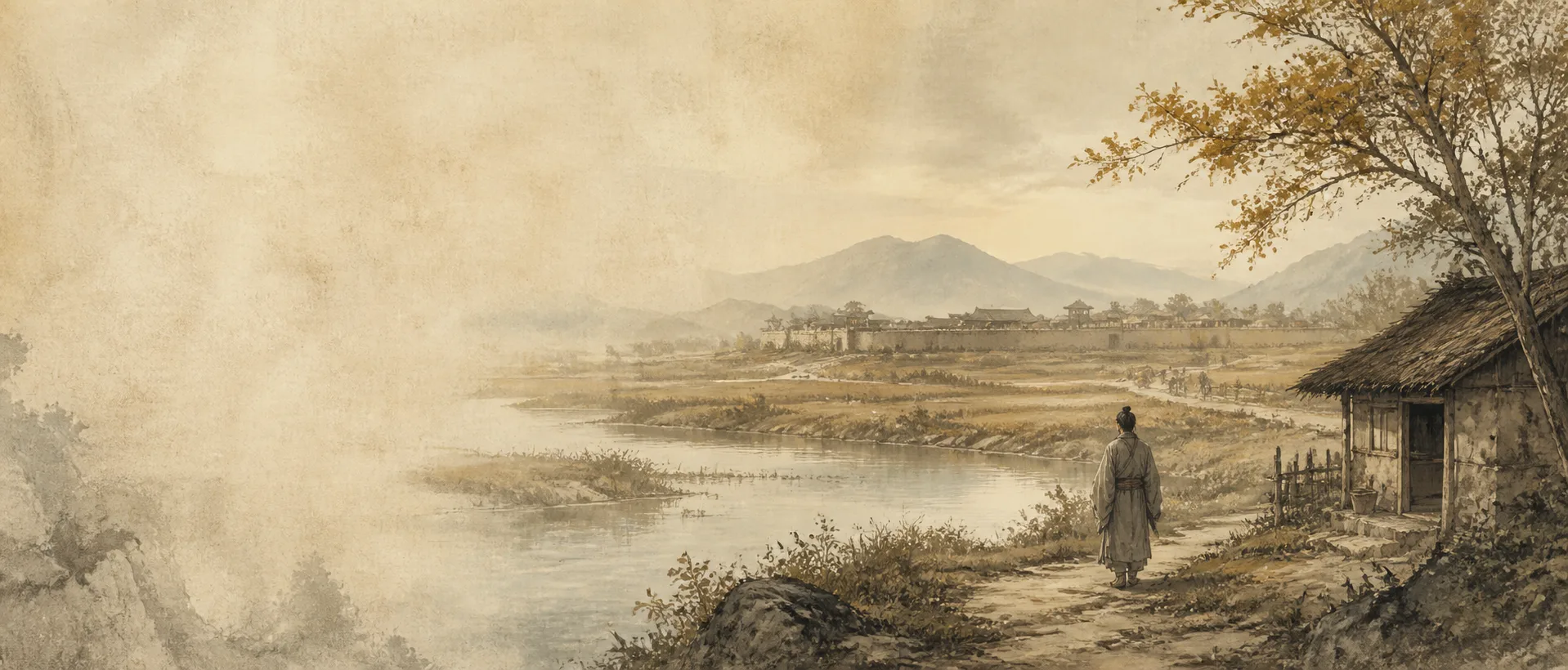
This page sets out what the sources say, what the text itself suggests, and — more usefully — what the period was like, because the Zhuangzi is a specific response to a specific situation and reads very differently once that situation is visible.
What the earliest biography says
The great history compiled at the end of the second century BC gives him a short entry. His personal name was Zhou. He came from a place called Meng, whose location is disputed but which lay in or near the small state of Song. He served as an official in a lacquer plantation there — a minor administrative post concerned with a useful industrial crop.
He is dated by reference to two rulers whose reigns are known, placing his activity in roughly the last third of the fourth century BC and the first years of the third. That makes him a contemporary of Mencius, and it is worth noting at once that neither man mentions the other, which is a caution against imagining the philosophers of the period as a single conversation.
The biography adds that his learning ranged over everything but that its foundation went back to the sayings of Laozi. That judgement is the historian's, made two centuries later, and it is one of the earliest pieces of evidence that the two books were being grouped together.
The lacquer garden
The detail of the job is worth dwelling on, because it places him socially.
He was not an aristocrat. He was not one of the itinerant advisers who travelled between courts selling doctrines, which was the standard career for an ambitious thinker of the period. He was a low-ranking functionary supervising the production of a commodity. Lacquer was economically important and the post was real work.
This matters for reading the book. The Zhuangzi is full of craftsmen and manual workers described with technical accuracy and evident respect — a butcher, a wheelwright, a cicada-catcher, a swimmer, a bell-stand carver, a ferryman. Philosophers of the period more usually took their examples from rulers, ministers and sages. Someone whose daily work involved supervising skilled production is a plausible source for that emphasis.
The refusal of office
The single most repeated story about him is the refusal of a high position, and it appears both in the biography and inside the text.
In the version the historian gives, a powerful southern state sends envoys with lavish gifts to invite him to serve as chief minister. He laughs, offers a comparison involving a sacrificial ox — pampered for years and then killed — and tells the envoys to leave him alone in the mud where he is happy.
Whether the episode happened is unknowable. What matters is that it was the story people told about him, and that it fits the book. In an age when philosophers competed for patronage and measured success by the rank of the ruler who employed them, a thinker famous for turning down the top job is making a point that the book makes repeatedly in other forms.
Poverty, and the domestic anecdotes
The text contains a handful of episodes involving the man himself, and they are consistent in tone.
He goes to borrow grain from a local official and receives a promise of help at some future date, which he answers with a story about a fish stranded in a rut being told to wait for the West River. He appears before a ruler in patched clothes with his shoes tied on with string and declines to be embarrassed. He is found making sandals to live.
Two episodes concern death and are the most discussed passages about him. When his wife dies, a friend finds him drumming and singing, and he explains his reasoning about transformation rather than denying grief. When he is dying, his disciples propose an elaborate burial and he tells them to leave his body in the open, since it will be eaten either way and he would rather not deprive the birds in favour of the ants.
These anecdotes are literature, not documentary evidence, and some are probably later additions. But they are early literature, and they show what the tradition thought was characteristic.
Hui Shi
The most substantial relationship in the book is with a named contemporary, a logician who served as chief minister of a major state and who appears throughout the text as friend, opponent and straight man.
Their exchanges are the closest thing in early Chinese literature to a philosophical friendship. They argue about whether a fish is enjoying itself and whether either of them could know. They argue about the uselessness of large things. Hui Shi is repeatedly given the position of the careful analyst who insists on distinctions, and Zhuangzi is repeatedly given the reply that dissolves the frame of the question rather than answering it.
The book does not present him as a fool. It presents him as formidable, and there is a passage in which Zhuangzi, standing at his friend's grave, says that since he died there is no one left to talk to. It is the least ironic thing in the book.
The period: states at war
The background is the two and a half centuries of competitive state-building that preceded the first unification.
The formal structure of the earlier order had collapsed and a handful of large states were absorbing the smaller ones by conquest. Armies had grown from aristocratic chariot forces into mass infantry levies of unprecedented size. Iron was in use for tools and weapons. States were building bureaucracies capable of registering populations, collecting grain and mobilising labour, and the most successful of them were doing so through explicit programmes of legal reform that abolished hereditary privilege in favour of centralised administration.
Song, the small state Zhuangzi came from, was one of the ones being absorbed. It was surrounded by larger powers and was extinguished within a few decades of his lifetime. Writing from a doomed minor state, at a distance from any centre of power, is a relevant fact about him.
The period: philosophers for hire
The intellectual situation is just as important, and it is the immediate target of much of the book.
The competing states needed administrators and advisers, and a market in doctrines had developed. Thinkers travelled between courts offering programmes: ritual and cultivation, universal benevolence and utility calculation, law and technique, military method, agricultural policy. Rulers maintained scholars. Academies existed. Debate was a professional skill with recognised techniques, and there were specialists in argument itself who worked on paradoxes about naming, similarity and difference.
A great deal of the Zhuangzi is aimed at this world. Its parodies of debate, its mockery of thinkers who cannot see beyond their own school, its suspicion of anyone with a programme, and its jokes at the expense of logicians all presuppose an audience that recognised the targets. The book is not a solitary meditation. It is a polemic conducted by other means.
Who he was arguing against
Four positions come up often enough to be worth identifying.
Confucians, who held that order comes from cultivated persons practising ritual within defined relationships. The Zhuangzi's response is usually to show a Confucian being corrected by someone with no status at all.
Mohists, who argued for impartial concern and judged practices by their measurable benefit. The Zhuangzi treats their earnestness and their taste for calculation as comic.
Logicians, whose paradoxes about names, similarity and difference the book knows intimately. It does not refute them; it accepts a good deal of what they say about the instability of distinctions and then declines to be impressed by the conclusion.
And the various advocates of technique and law, whose programmes for strengthening states the book regards as the machinery of the disaster it is describing.
Why the context changes the reading
Two things follow, and they are the reason this page comes first in the section.
The book's refusals are specific. Declining office, mocking debate, praising uselessness and admiring craftsmen are not general expressions of a serene temperament. They are positions taken against a particular set of career paths, a particular market in doctrines, and a particular kind of state-building, and each has a target that contemporaries would have recognised.
And the book's apparent detachment is not indifference to suffering. It was written during a period of large-scale warfare in a state that was about to be destroyed. Its treatment of death, its interest in what cannot be taken away, and its scepticism about the value of being useful to power all read differently in that light.
Key points
- The earliest biography is brief and plausible: a man named Zhou, from a place in or near the small state of Song, who held a minor post supervising a lacquer plantation.
- He is dated to roughly the last third of the fourth century BC, making him a contemporary of Mencius, who never mentions him.
- His social position was that of a low-ranking functionary, not an aristocrat or a travelling adviser, which fits the book's attention to skilled manual work.
- The story of refusing a chief ministership is the defining anecdote and matches the book's suspicion of service to power.
- His relationship with a named logician is the closest thing in early Chinese literature to a philosophical friendship, and he is not made ridiculous.
- The book is a polemic against a real market in doctrines, written from a small state that was destroyed shortly afterwards.