Famous Parables of the Zhuangzi
那些人人知道的寓言,和总被略掉的下一句
The Zhuangzi is the most quoted book in Chinese philosophy and the most reliably truncated. Its best-known stories have circulated for two thousand years in versions that stop one or two sentences early, and in several cases the omitted sentence reverses the moral that everyone draws.
This page goes through the famous parables and restores the endings. It is the most immediately useful page in this section, because these stories are the form in which most people meet the book, and the popular versions are frequently the opposite of the text.
Why the stories get truncated
Three reasons, and they compound.
The memorable line usually comes before the qualifying one. A story that ends on a striking image is more quotable than one that ends on a distinction, so the image travels and the distinction does not.
The qualifications are often the harder part. Where the image is vivid and immediate, the following sentence is frequently technical, and anthologists cut it.
And the truncated versions serve purposes the full ones do not. A Zhuangzi who dissolves all distinctions is more useful to certain later traditions than a Zhuangzi who insists on one at the crucial moment.
The butterfly
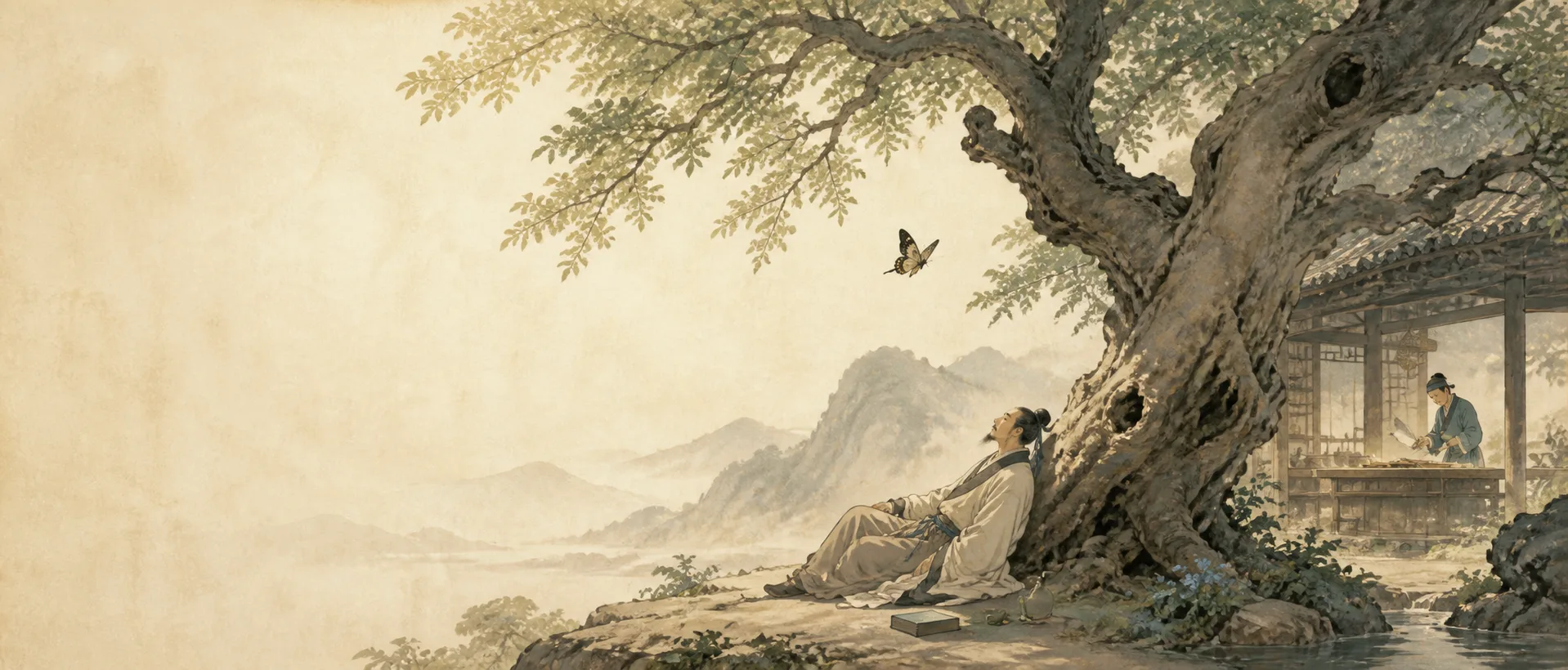
The story as everyone has it: Zhuang Zhou dreams he is a butterfly, entirely a butterfly, and on waking does not know whether he is Zhou who dreamt he was a butterfly or a butterfly now dreaming it is Zhou. The standard moral is that reality and dream are indistinguishable, or that identity is an illusion.
The text then adds a sentence, and it is one of the most surprising in the book. It says that between Zhou and the butterfly there must be some distinction, and that this is what is called the transformation of things.
So the passage does not conclude that there is no difference. It asserts that there is one, and names the topic: not the unreality of things but their changing from one into another. The uncertainty in the middle of the story is real, and it is not the conclusion. Read with the last line, the parable is about transformation and about the limits of the standpoint from which one asks the question — which is the same subject as the rest of the chapter it sits in.
Cook Ding
The story as usually told: a butcher has used one blade for nineteen years without sharpening it, because he cuts along the natural divisions rather than through bone. He works without looking, his senses at rest while something else proceeds. The standard moral is effortless flow.
Two things get left out.
First, he describes coming to difficult places where the joints are complicated, and says that at those points he becomes wary, slows down, watches closely, and moves the blade very slightly. Mastery in this account includes recognising difficulty and hesitating. It is not uninterrupted flow; it is graduated attention, and the difficult parts are handled with more care rather than less.
Second, the story has a frame. The duke who has been watching says that from the butcher's words he has learned about nurturing life. Whether the duke has understood or has just done what dukes do — extract a self-help lesson from a craftsman — is left entirely open, and the ambiguity is characteristic.
The useless tree
The story as usually told: a tree is so crooked and knotty that no carpenter will touch it, and because it is useless it survives while straight trees are cut down. The moral drawn is that uselessness is a virtue.
The book then contradicts itself, deliberately and in the open. In a later chapter a man is offered two geese, one that can cackle and one that cannot, and the one that cannot is killed for dinner. A disciple points out that the tree survived by being useless and the goose died by being useless, and asks what the rule is. The answer given is that one should occupy the position between usefulness and uselessness — and even that is immediately said to be not quite right.
This is not carelessness. It is the same move as the argument about standpoints: any general rule, including the rule that uselessness protects, is a standard being deemed, and circumstances will supply a case that defeats it. Anyone quoting the tree without the goose is presenting the book as offering a maxim, which is exactly what it declines to do.
The frog in the well
The story as usually told: a frog living in a caved-in well boasts about his domain to a turtle from the Eastern Sea, who describes the ocean, and the frog is dumbfounded. The moral drawn is that limited experience produces limited understanding, and it has become a standard Chinese idiom for parochialism.
The passage continues, and the continuation is the point. It goes on to ask what the four seas amount to within the space between heaven and earth — comparing them to a small hole in a great marsh. The ocean, having just humbled the frog, is itself put in its place. And in the surrounding dialogue the god of the Yellow River, who has been overwhelmed by the sea, is told by the sea that it too does not consider itself large.
Read whole, this is not a story about a foolish frog and a wise turtle. It is a regress: every scale is small from a larger one, including the scale from which you are currently feeling enlightened. The idiomatic use of the story to mean that other people are provincial is precisely the frog's mistake.
The happiness of the fish
This is the one that reads most like a philosophical exchange, and it is worth following carefully.
Standing on a bridge, Zhuangzi remarks that the fish are enjoying themselves. His friend the logician objects that since he is not a fish he cannot know. Zhuangzi replies that since his friend is not him, his friend cannot know whether he knows. The logician tightens the point: he concedes that not being Zhuangzi he does not know Zhuangzi, and argues that by the same token Zhuangzi, not being a fish, certainly does not know the fish. On the logic, this is a strong reply.
Zhuangzi's answer is to ask his friend to go back to the beginning. In asking how he knows, the friend already granted that he knows something — the question presupposes it. And then a final line: he knows it from up here on the bridge.
Two readings are available and both are worth having. On one, this is a debater's trick, catching an opponent on a presupposition rather than answering him; on this reading the logician wins the argument and Zhuangzi changes the subject. On the other, the last line is the serious answer: knowing is something done from somewhere, and the demand to know a fish from no standpoint at all is the confused demand. The chapter about standpoints supports the second reading. That the first is available is part of the joke.
The skull
Travelling, Zhuangzi finds a skull and addresses it, listing the ways its owner might have come to this. That night the skull answers in a dream and describes being dead as freedom from the obligations of rulers, from the seasons, from the whole apparatus of being alive. Zhuangzi asks whether it would like to be restored to life. It refuses.
This is usually cited as evidence of equanimity about death. Read in place it is sharper than that. The skull's account of what it has escaped is a list of specific social burdens, and the passage sits alongside other material in the same chapter about the misery of ordinary striving. It is not a serene meditation on mortality; it is partly a complaint about being alive under the conditions then prevailing.
The mantis, and the man with the crossbow
A story almost never told in full, and the most self-implicating in the book.
Walking in an orchard, Zhuangzi sees a cicada absorbed in its perch, unaware of a mantis stalking it, which is in turn unaware of a magpie about to take it. He raises his crossbow to shoot the magpie. At that moment the orchard keeper shouts at him for trespassing, and he flees.
The chain of predators, which is where popular versions stop, is a nice observation about absorption and danger. The point of the story is that the observer was in the chain. He was so taken up with noticing that others had failed to notice that he failed to notice. The text adds that he was depressed for three months afterwards.
Any account of this book as detached serenity has to deal with that ending.
The empty boat
A short passage with an unusually clear application. If a boat crossing a river collides with yours and there is a man in it, you shout at him; if the boat is empty and drifting, you do not, even though the collision is identical. The conclusion drawn is that if a person could empty themselves in the way that boat is empty, nothing in the world would come into conflict with them.
The observation is precise: the anger is not caused by the collision but by the presence of someone to hold responsible. The recommendation is not to become passive but to remove the target — and the passage is candid that this is difficult, which is more than most later uses of it manage.
Drumming after his wife's death
A friend arrives to offer condolences and finds Zhuangzi sitting with his legs sprawled, drumming on a basin and singing. Asked whether this is decent, he answers that of course he grieved at first, and then describes the sequence: something without form became breath, breath became a body, the body became a life, and now it has changed again, as the seasons change. To wail beside her, he says, would be to fail to understand what has happened.
The crucial detail, almost always omitted, is that he wept first. The passage is not a claim that a wise man feels nothing. It describes arriving at a different account of an event, over time, having first responded as anyone does. That is a substantially more modest and more credible position than the one usually attributed to it.
How to read a parable in this book
Four habits, which follow from the above.
Read to the end of the section, not to the end of the image. The qualification is usually one or two sentences past the memorable part.
Look for the frame. Many stories are told to someone, by someone, and the listener's reaction is often part of the point.
Check whether the book contradicts the moral elsewhere. It frequently does, on purpose.
And notice when the narrator implicates himself. The stories in which Zhuangzi appears as a character are usually the ones where he is not the one who has understood.
Key points
- The butterfly passage ends by asserting that there must be a distinction between Zhou and the butterfly, and names its subject as transformation.
- Cook Ding slows down and becomes wary at difficult joints; the story describes graduated attention, not uninterrupted flow.
- The useless tree is contradicted by the useless goose, and the book offers no rule to settle the two.
- The frog in the well is followed by a passage that reduces the ocean in turn, making the story a regress rather than a lesson about other people.
- In the fish debate the logician has the better of the logic, and Zhuangzi's reply relocates the ground to knowing from where one stands.
- In the crossbow story the observer is himself in the chain of predators, and he is depressed for three months afterwards.