Xingyiquan Principles: Six Harmonies, Intention and Power
形意拳原理:六合、意与劲力训练
A Xingyiquan principle is most useful when it turns a slogan into a question that can be tested in practice: did the step and hand support the same task, did the body remain organized through the transition, and could the movement stop or change without collapse? Principles guide attention; they do not make every branch look identical.
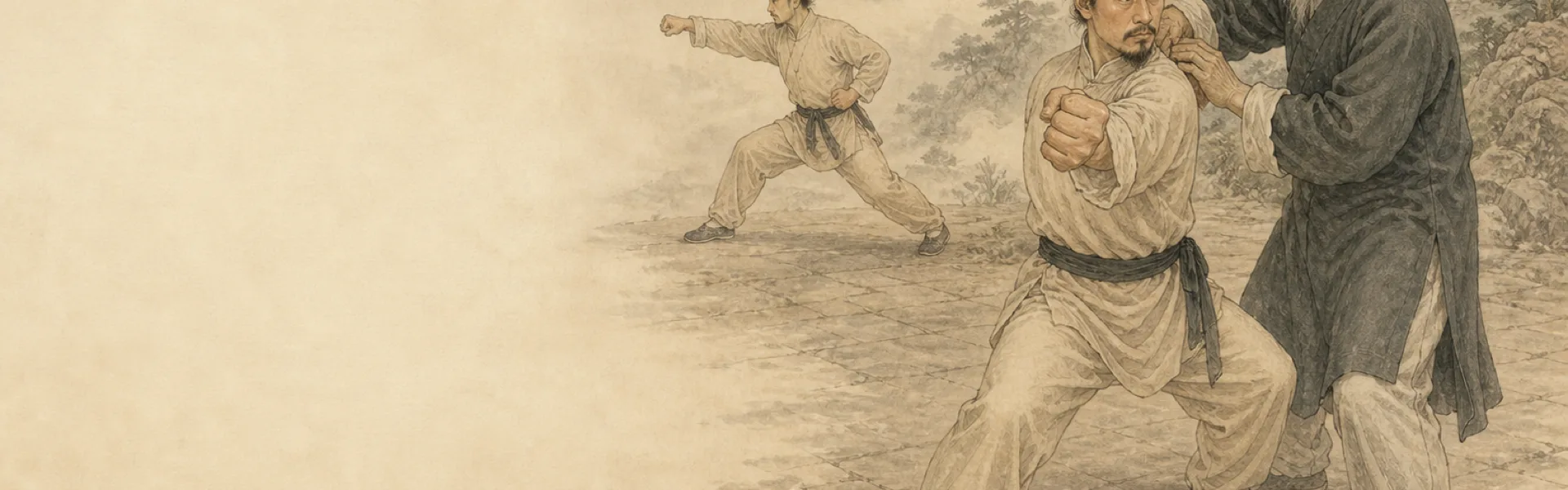
This guide separates the wording of dated manuals from present-day coaching language. Terms such as liuhe (六合, six unions), yi (意, intention) and jin (劲/勁, trained power or force expression) carry histories and multiple translations. They should not be presented as modern anatomy, neuroscience or a promise of extraordinary ability.
Begin with dated witnesses
Sun Fuquan’s Study of Xingyi Boxing, published in 1915, describes three “external unions”: elbows with knees, hands with feet, and shoulders with hips. It then asks upper and lower, inside and outside, to coordinate as one. This records Sun’s formulation at a particular date; it is not a certificate for every lineage.
Liu Dianchen’s Subtleties of the Xingyi Boxing Art, published in 1921, gives a dedicated chapter to six unions. Its external three match Sun’s pairs, while its internal three connect heart or mind with intention, intention with energy, and energy with power. Reading both witnesses makes shared vocabulary visible without erasing differences in explanation.
The external three unions are relationships
Hand–foot, elbow–knee and shoulder–hip do not require the paired points to touch, line up vertically or arrive at one mechanically identical instant. A more useful reading is relational: the step, trunk and hands should contribute to the chosen action instead of pulling against one another.
Test that relationship at a manageable speed. Can the supporting foot accept the shift? Does the knee follow a controllable line? Can the hand finish without the shoulder lifting or the torso pitching? The exact answer changes with posture, body proportions, direction and branch method.
The internal three unions are historical training language
Liu’s 1921 sequence—heart or mind with intention, intention with energy, energy with power—describes how his text organizes inward purpose and outward action. Sun’s 1915 discussion similarly asks the inside and outside to become one. These phrases are valuable evidence for how the authors explained practice.
They are not a modern physiological pathway. A teacher may use them to ask whether attention, breathing, timing and effort support the same task, but that is a coaching interpretation. Name the source when quoting the old formulation and name the teacher or exercise when giving a contemporary one.
Intention gives the drill a clear task
In practice, yi can be approached as a chosen task: where to step, what line to occupy, when to change, and where the action should finish. This makes attention observable without claiming that intention alone moves another person or that one exercise has a proven effect on cognition.
Start with one instruction. For example: arrive with the lead hand as the front foot settles, keep an exit available, or change direction without holding the breath. If several corrections compete at once, reduce the speed or simplify the drill until the main task is readable again.
Whole-body organization is not one rigid shape
Coordinated movement need not freeze the body into a single alignment. The feet manage contact with the ground; the legs and trunk transfer and redirect effort; the arms shape the task. Their timing overlaps, and the proportions change as the practitioner advances, turns, rises or lowers.
Use plain checks: balance before and after the action, continuous pressure rather than a sudden joint lock, and enough freedom to stop or redirect. Describing these observations is more accurate than asserting one invisible “force path” that every body and every Xingyiquan method must reproduce.
Directness can include angle and recovery
Many Xingyiquan drills cultivate committed advancing actions, but “direct” does not have to mean straight ahead at all times. An angled step, a turn or a withdrawal can still serve the task efficiently. The Twelve Animal Forms make this range of directions especially clear.
Practise the entry together with its recovery. After the hand arrives, can you keep your base, see the partner and choose the next step? A movement that reaches forward but leaves the practitioner unable to stop, turn or protect a joint is not improved merely by adding speed.
A 1924 presentation of three kinds of power
Sun’s Authentic Transmission of Boxing Concepts, published in 1924, presents teachings attributed in its contents to Guo Yunshen. It describes ming jin (明劲/明勁) as hard power, an jin (暗劲/暗勁) as soft power that is not weakness, and hua jin (化劲/化勁) as a highly refined flexibility. The text says the forms may remain similar while their use changes.
The same presentation relates the three to changing the bones, changing the sinews and washing the marrow, and to an alchemical sequence of essence, energy and spirit. Those correspondences belong to the book’s explanatory system. They should not be converted into literal anatomy, medical treatment or guaranteed biological stages.
Do not turn the three kinds into fixed ranks
A dated model can organize study without becoming a universal lifetime timetable. Teachers and branches may translate the terms differently, combine their qualities in one exercise or place emphasis elsewhere. A student should not be judged by a mystical label that has no agreed test.
Ask what changes in the drill: amount of visible effort, softness during contact, continuity through a transition, ability to redirect, and control at the finish. These observations cannot prove that one historical category has been “mastered,” but they can support a clear conversation between teacher and student.
Checks for solo practice
- Define the task: choose one direction, rhythm or finishing condition.
- Use a controllable range: shorten the stance or action before alignment deteriorates.
- Watch the transition: do not sacrifice balance between named postures.
- Leave joints available: avoid forcing knees, elbows or shoulders to their end range.
- Repeat on both sides: compare organization without demanding perfect symmetry.
Breathing should remain comfortable rather than forcibly synchronized to a count. Pain, dizziness, numbness or loss of control is a reason to stop and reassess, not evidence that the exercise is “working.”
Progress partner work by consent and variables
Begin with a known line and light contact. Agree on the role of each partner, the target area, permitted steps, intensity and stop signal. Test one question—such as maintaining the hand–foot relationship during a slow entry—before adding choice or resistance.
Increase only one variable at a time: speed, pressure, direction or uncertainty. Avoid strikes to the head, forceful joint locking and competitive escalation unless the participants, supervision and protective conditions are appropriate for that separate activity. Consent can be withdrawn at any moment.
Compare vocabulary without ranking branches
When a teacher explains a principle, record the Chinese term, the translation, the exercise and the observable correction. Then compare it with the dated formulations above. A difference may reflect branch vocabulary, teaching purpose, translation or the level of the drill; it does not automatically make one version older or more authentic.
Use the Five Fists to test coordination in a compact curriculum, and the Xingyiquan gateway for the wider training map. Good principle language makes practice clearer, preserves the source of inherited terms and remains open to revision when the movement or evidence says otherwise.