The Five Fists of Xingyiquan
形意拳五行拳:劈、崩、钻、炮、横
The Five Fists are a compact way to study Xingyiquan’s basic actions: Pi (劈), Beng (崩), Zuan (钻), Pao (炮) and Heng (横). They are often paired with metal, wood, water, fire and earth, but they are more than five isolated hand techniques. Practised carefully, they organize stepping, balance, direction, timing and the exchange between opening and closing.
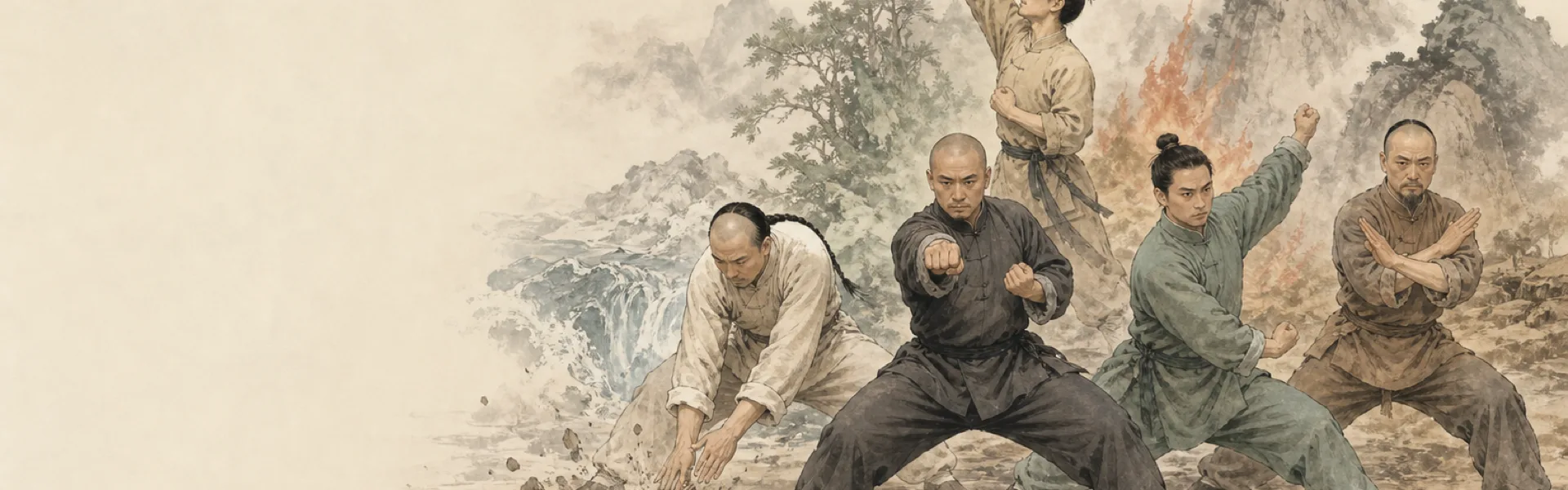
There is no single version that represents every branch. Names are widely shared, while fist shape, height, rhythm, footwork and teaching order can differ. This guide therefore describes recognizable training ideas rather than prescribing a universal choreography. Learn your branch’s method from a qualified teacher, then use dated manuals to compare rather than to overrule living instruction.
One family of methods, several curricula
Sun Fuquan’s Study of Xingyi Boxing, published in 1915, presents San Ti Shi, the five individual fists, a linked sequence and a two-person generating-and-overcoming set. Zhu Guofu’s illustrated Essentials of Xingyi Liuhe Quan, published in 1929, likewise separates preparatory practice, the five fists, their generating and overcoming relations, and a linked form.
These books are valuable dated witnesses, not universal rulebooks. Even their chapter order—Pi, Beng, Zuan, Pao, Heng—differs from the generating sequence often used as a memory aid: Pi, Zuan, Beng, Pao, Heng. A teacher may begin elsewhere for a student’s needs. What matters is whether the practice develops clear structure and adaptable movement.
San Ti Shi and line practice
Many Xingyiquan curricula begin from San Ti Shi and return to a related alignment after each repetition. The stance gives a quiet place to check the relationship of head, trunk, hips, knees, feet and hands. It should not require forcing the chest, locking the rear knee or sinking lower than you can control.
Line practice makes change visible. Choose a moderate stance and a step length that lets you arrive without pitching forward. Begin slowly enough to notice whether the hand and foot finish together, whether you can stop without wobbling, and whether the next repetition starts without an extra reset. Speed and impact belong later.
Pi Quan: splitting as rise and fall
Pi Quan is commonly translated as splitting or chopping and associated with metal. In Sun’s 1915 presentation, its defining motion includes both lifting and dropping. In practice, one hand often rises or drills before turning over as the body advances and the other hand withdraws.
Do not reduce Pi to an arm swinging down. A useful solo check is whether the descending hand, advancing step and settling of the body support one another without collapsing the shoulder. Branches differ in palm shape, trajectory and finishing height, so the name identifies a family of actions rather than one exact target.
Beng Quan: direct issuing with recovery
Beng Quan is commonly translated as crushing and associated with wood. It usually trains a direct forward issue while the two sides of the body exchange roles: one fist goes out as the other returns. The straight appearance can hide the work of stepping, turning and maintaining width through the base.
Practise a clean arrival before chasing power. The wrist should remain organized, the elbow should not be driven into a hard lock, and the rear side should stay available for the next action. The well-known “half-step Beng Quan” saying belongs to transmitted teaching culture; it is not proof that one footwork pattern or one practitioner’s achievement defines the whole art.
Zuan Quan: drilling through an upward path
Zuan Quan is commonly translated as drilling and associated with water. Representative versions use a rising, threading or spiralling path, often changing from a covered position into a fist. The action can teach how to move through a narrow line while the body continues to advance.
Avoid lifting the shoulder or tipping backward to make the fist rise. Adjust height and range so the movement remains connected to the step. Some branches emphasize a more pronounced turn of the forearm; others show a smaller change. Neither variation should be declared the only authentic meaning of “drilling” without naming the branch and source.
Pao Quan: covering and issuing together
Pao Quan is commonly translated as cannon or blasting and associated with fire. A familiar version pairs a rising or covering arm with an issuing fist while the body changes angle. Its lesson is not simply “a powerful punch”; it is the coordination of two hands, a step and a directional change.
Keep the covering arm clear of the face and do not wrench the shoulder to imitate a large shape. Start with a compact path and a stable landing. When a partner is added, the covering hand should first learn to receive a known line with light contact rather than crash into the partner’s limb.
Heng Quan: crossing, wrapping and changing direction
Heng Quan is commonly translated as crossing or transverse and associated with earth. Across branches it may appear as a horizontal fist, a wrapping change, or a way of crossing the centre while the body turns. That range of presentations is precisely why a one-sentence “correct technique” is misleading.
Use Heng to study redirection without losing your base. Let the waist and step carry the change instead of twisting the knee under a fixed foot. The finishing line should leave you ready to continue, not stretched across yourself. Compare your teacher’s terminology with a named manual or lineage before assuming that different wording indicates a different principle.
What the five-phase map does
In Sun’s book, Pi–metal is paired with the lungs, Beng–wood with the liver, Zuan–water with the kidneys, Pao–fire with the heart and Heng–earth with the spleen. These are traditional correspondences within a historical correlative framework. They show how one early-Republican author explained and remembered the curriculum.
They are not modern anatomy, a diagnosis or evidence that a fist treats an organ. Practitioners may value the imagery while keeping medical questions separate. If training causes persistent pain, dizziness or loss of function, stop and seek appropriate professional care rather than interpreting the symptom through the five-phase chart.
Generating, overcoming and linking
The generating cycle gives a sequence—metal to water, water to wood, wood to fire, fire to earth, earth to metal—which can organize transitions. The overcoming cycle supplies paired relationships. Sun’s 1915 manual records a two-person set in which assigned attacks and answers cycle through the five fists; Zhu’s 1929 contents preserve both generating/overcoming practice and a linked form.
Treat these as designed drills, not automatic laws of fighting. A cooperative pattern can teach recognition, distance and continuity because both partners know what comes next. Later, timing and choice can be varied within agreed limits. The phase label does not guarantee that one technique will defeat another under every angle, speed or rule set.
The spear comparison: a useful lens, not an origin proof
Practitioners often compare the five fists with long-weapon actions because both can coordinate the hands, torso and advancing step along clear lines. That comparison can sharpen direction and whole-body connection. It can also suggest why withdrawing one side matters while the other issues.
Technical resemblance does not prove that each fist was copied from a specific spear method, or that spear practice alone explains the art’s origin. Use the analogy where it clarifies movement and leave it aside where it forces a match. The history guide explains why lineage association, technical comparison and documentary evidence must remain distinct.
A safe progression from solo work to a partner
- Solo shape: choose a manageable stance, learn the path and finish in balance.
- Continuous lines: repeat at an even pace without adding impact.
- Known contact: agree on the attacking line, target area and stopping point; use light touch.
- Scripted generating or overcoming drill: keep fixed roles until both partners can maintain distance and control.
- Limited choice: vary one element—timing, side or entry—without turning the exercise into unrestricted sparring.
Check consent before increasing speed, contact or unpredictability. Protective equipment does not replace control. Reduce stance depth and range for restricted mobility, and keep the head out of early contact drills. Stop when either partner calls stop.
How to study across versions
Keep a simple practice record: branch or teacher, starting posture, step, hand path, finish and intended lesson. Then compare that record with the 1915 and 1929 books. Differences can reveal teaching choices; they do not by themselves prove corruption or superiority.
For historical context, read Origins and History of Xingyiquan. For the larger curriculum, return to the Xingyiquan gateway. The best question is not “Which five fists are the only real ones?” but “What does this version train, what evidence identifies it, and can I perform it with balance, control and continuity?”