Xingyiquan’s Twelve Animal Forms
形意拳十二形:动物意象与训练方法
“Animal form” in Xingyiquan does not have to mean a literal imitation of an animal. Depending on the branch and exercise, the image may point to a direction, rhythm, tactic, stepping pattern, way of opening and closing, or a relationship between two actions. The name is a prompt for practice, not a zoological definition.
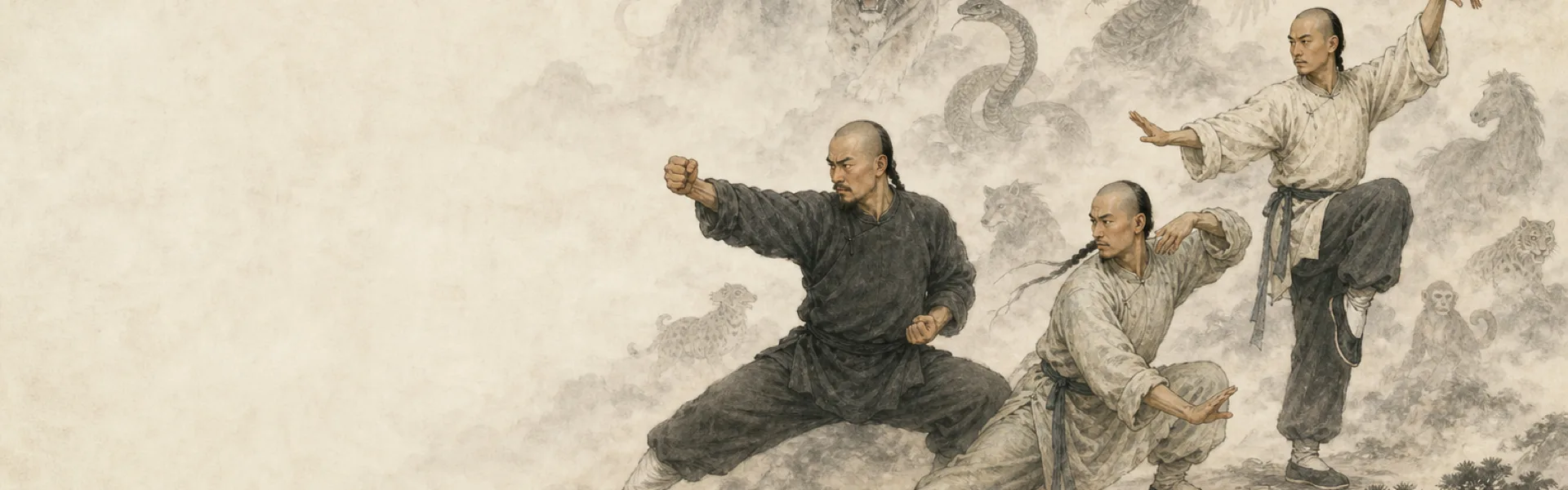
There is no single twelve-animal syllabus that represents every Xingyiquan lineage. Dated manuals preserve related but non-identical lists, characters, orders and methods. This guide begins with named documentary witnesses, then shows how to compare them without turning one book—or one modern curriculum—into a universal rule.
A named witness: Sun Fuquan’s 1915 chapters
Sun Fuquan’s Study of Xingyi Boxing, published in 1915, organizes its second part as twelve animal chapters. Its contents give: dragon (龍), tiger (虎), monkey (猴), horse (馬), tuo (鼉), rooster (鷄), yao (鷂), swallow (燕), snake (蛇), the rare graph 𩿡, eagle (鷹) and bear (熊). The book then combines material in a Mixed Postures set and a Settled-Body Cannon partner set.
This is firm evidence for what Sun’s book presented in 1915. It is not proof that every teacher used the same twelve, named them identically or taught them in this order. Even the introductory prose in the same book places swallow before yao, whereas the contents reverse them—a small reminder that sequence on a page is not necessarily the essence of practice.
Why the animal names require care
Dragon, tiger, monkey, horse, rooster, swallow, snake, eagle and bear translate readily. Three labels need more restraint. 鼉 often refers to the Chinese alligator but is also rendered more broadly as a water creature; 鷂 can be hawk or sparrowhawk; and the uncommon 𩿡 has been translated as kestrel, although its exact identification is not transparent to every reader.
Keeping the Chinese graph beside a cautious gloss is more accurate than forcing false certainty. It also helps readers recognize textual variants. An animal label can remain useful as a mnemonic even when modern translators disagree about the species.
A second list: Liu Dianchen’s 1921 manual
Liu Dianchen’s Subtleties of the Xingyi Boxing Art, published in 1921 after prefaces dated 1920–21, also includes Twelve Animal Boxing as well as twelve-animal sword and spear sections. Its boxing list reads dragon, tiger, monkey, horse, 鮀, rooster, swallow, 鷂, snake, 台, eagle and bear.
The close correspondence with Sun’s list is important, but so are the differences: 鮀 appears where Sun prints 鼉, 台 where Sun prints 𩿡, and swallow precedes 鷂. These observations support careful comparison. They do not, by themselves, establish which spelling or order was earliest, nor do they settle how every lineage practised the forms.
What an omitted section can—and cannot—show
Zhu Guofu’s illustrated Essentials of Xingyi Liuhe Quan, published in 1929, foregrounds preparatory practice, the Five Fists, generating and overcoming relations, a linked sequence and Liuhe Long Boxing. Its contents do not document a twelve-animal section.
That absence describes the selection in this particular book. It does not prove that Zhu, his associates or an entire branch rejected all animal practice. A manual may be introductory, selective or shaped by space and teaching purpose. Documentary silence should be reported as silence, not expanded into a lineage history that the source never states.
How the animals relate to the Five Fists
Sun’s 1915 book places the Five Fists before the animal chapters, and Liu’s 1921 table likewise lists Five Element Boxing before Twelve Animal Boxing. This arrangement makes a useful study path: first stabilize a compact group of actions, then explore more varied directions, levels and combinations.
It is still one documented arrangement, not a mandatory ladder. The animals do not merely add “techniques” to five supposedly incomplete fists, and learning all twelve does not certify skill. Use the Five Fists guide to compare how a branch connects Pi, Beng, Zuan, Pao and Heng with its animal material.
Read movement from the method, not only the mascot
An animal name alone cannot tell you the exact stance, hand shape, target or application. A dragon exercise may train rising and descending; a tiger method may coordinate a forward pounce; a swallow image may cue a change of level. But those summaries must be checked against the actual sequence and the teacher’s explanation.
When learning, record observable features: starting posture, direction of the step, height change, hand path, finishing balance and how the next action begins. This turns a vivid name into a testable practice note. It also makes branch differences easier to discuss without declaring one visual shape authentic and another false.
Paired qualities: opening, closing and changing direction
Many animal exercises become clearer when read as paired qualities: rise and fall, advance and withdraw, open and close, seize and release, straight and angled. The useful question is not “Which animal wins?” but “What change does this drill make available?”
Train the transition as carefully as the final posture. Keep the supporting foot able to turn without wrenching the knee, choose a level you can control, and arrive without pitching the torso beyond the base. A larger or faster version is not automatically a better expression of the animal.
Eagle and bear: a source-specific case study
Sun presents eagle and bear as separate chapters and also as a combined “eagle and bear fighting” practice. Liu’s manual describes bear as defensive and eagle as offensive in one summary of the twelve methods. These texts make the pairing historically visible in their own curricula.
That does not make a single eagle–bear interpretation universal. One teacher may use the pair to discuss opening and closing, another to connect receiving and issuing, and another may preserve different choreography. Name the book, branch or teacher when explaining the pair, then describe what the exercise actually does.
From solo sequence to controlled partner study
- Solo path: learn the direction, level and finish at a pace that preserves balance.
- Repeatable transition: connect both sides without rushing or forcing range.
- Known contact: agree on the line, target and stopping point; begin with light touch.
- Cooperative response: let the partner provide a predictable cue while you test one movement quality.
- Limited choice: vary one factor—side, timing or entry—only after both partners can maintain control.
Consent must be renewed before adding speed, contact or uncertainty. Do not use animal imagery as permission for uncontrolled pouncing, joint pressure or head contact. Protective equipment helps but does not replace a defined task, an agreed intensity and an immediate stop signal.
How to read verses and traditional explanations
Old manuals often connect an animal with a short verse, a striking image, traditional physiology or cosmology. Read these passages first as evidence of how an author taught and explained movement in a particular period. They may offer memorable practice cues without becoming modern medical claims or secret historical proof.
Separate three questions: What does the text literally say? What movement does the pictured or taught sequence show? What interpretation does a living teacher add? Keeping those layers distinct allows respectful study without pretending that every metaphor has only one technical answer.
How to compare a teacher’s version
Write down the animal names and characters used in your branch, their order, whether they are single methods or longer sets, and how they connect with the Five Fists. Then compare those details with the 1915, 1921 and 1929 publications above. A difference may reflect curriculum, terminology, copying or editorial selection; it is a question to investigate, not an automatic ranking.
For the wider setting, return to the Xingyiquan gateway and read Origins and History of Xingyiquan. A responsible comparison identifies its witness, preserves uncertain characters, describes observable movement and leaves room for more than one living branch.