Origins and History of Xingyiquan
形意拳的起源与历史
Xingyiquan has a rich origin tradition, but its surviving evidence was not created all at once. A transmitted preface links the art to Yue Fei, names Ji Jike, Cao Jiwu, Dai Longbang and Ma Xueli, and gives an internal date of 1750. Family memory, nineteenth-century teaching lines and early-Republican manuals add further layers. None of these sources should be made to say more than it can support.
This guide therefore separates an account’s date from the date of the copy we can inspect, a lineage claim from an independent record, and technical resemblance from proof of descent. The result is less tidy than a single founder story, but more useful: it shows how Xingyiquan became a family of related practices and how its history was written.
Begin with layers of evidence
Four kinds of material matter here. Official histories can establish people and events outside martial lineages. Transmitted prefaces and boxing manuscripts show what a community said about its art, although copies may be late or altered. Genealogies and memorials preserve local memory, but require an identifiable edition or image before a quotation can be treated as securely checked. Printed manuals show what authors were prepared to put before the public at a known time.
These categories answer different questions. A 1915 book can document a 1915 curriculum and the history its author received; it cannot by itself prove an event in the twelfth or seventeenth century. A spear-like action can illuminate how practitioners understand power and alignment; it cannot establish who first converted spear work into boxing.
Yue Fei: historical general, later boxing attribution
Yue Fei was a Southern Song general, not a fictional figure. His biography in the History of Song, chapter 365, records military service, archery learned from Zhou Tong and the use of weapons in battle. It does not identify a boxing art called Xingyi or Xinyi Liuhe Quan.
The martial attribution appears in later transmitted texts. It should be presented respectfully as an important lineage tradition, not converted into a contemporary Song record. Nor does the documentary gap tell us why every later writer repeated the attribution. Political symbolism, reverence for Yue Fei and technical associations with weapons are possible contexts, but they are interpretations unless a particular source states them.
The transmitted “Xinyi Liuhe Quan Preface”
An accessible transcription headed “Xinyi Liuhe Quan Preface” and attributed to Dai Longbang tells a compact genealogy. It credits Yue Fei, says Ji Jike—styled Longfeng—obtained a manual at Zhongnan, names Cao Jiwu as his student and says the narrator studied with Cao before meeting Ma Xueli in Luoyang. Its closing line bears the fifteenth year of the Qianlong reign, corresponding to 1750.
That internal date is important, but the accessible Chinese Text Project presentation also states that its source is a hand-copied manual and warns of wrong or missing characters. Without an authenticated autograph or a critical comparison of witnesses, the careful description is “a transmitted text bearing a 1750 date,” not “a document proven to have been written in 1750.” Its value lies both in what it says and in showing which links later transmitters wanted to preserve.
Ji Jike and the problem of a secure anchor
Ji Jike, also called Ji Longfeng in martial literature, is the earliest named human teacher around whom the later Xingyi/Xinyi origin narrative consistently gathers. Later publications quote a Ji clan genealogy describing exceptional spear skill, but a quotation repeated in print is not the same as an inspected genealogy page. Until the exact witness, edition and context are available, precise birth and death years and claims of a fully authenticated “physical document” should remain out of the article.
This caution does not erase Ji. It places him accurately: a central ancestral figure supported by converging later lineage records, with parts of the genealogical case still needing source-level verification. It also avoids turning uncertainty into dismissal. Historical method can respect inherited memory while distinguishing it from a contemporary record.
From spear association to boxing: analogy is not proof
Xingyiquan frequently coordinates advancing footwork, whole-body force and direct lines in ways that practitioners compare with long-weapon work. Some drills and postures make that comparison especially persuasive as a teaching model. Yet the body can organize similar actions for more than one reason, and later boxing can also reshape its weapon practice.
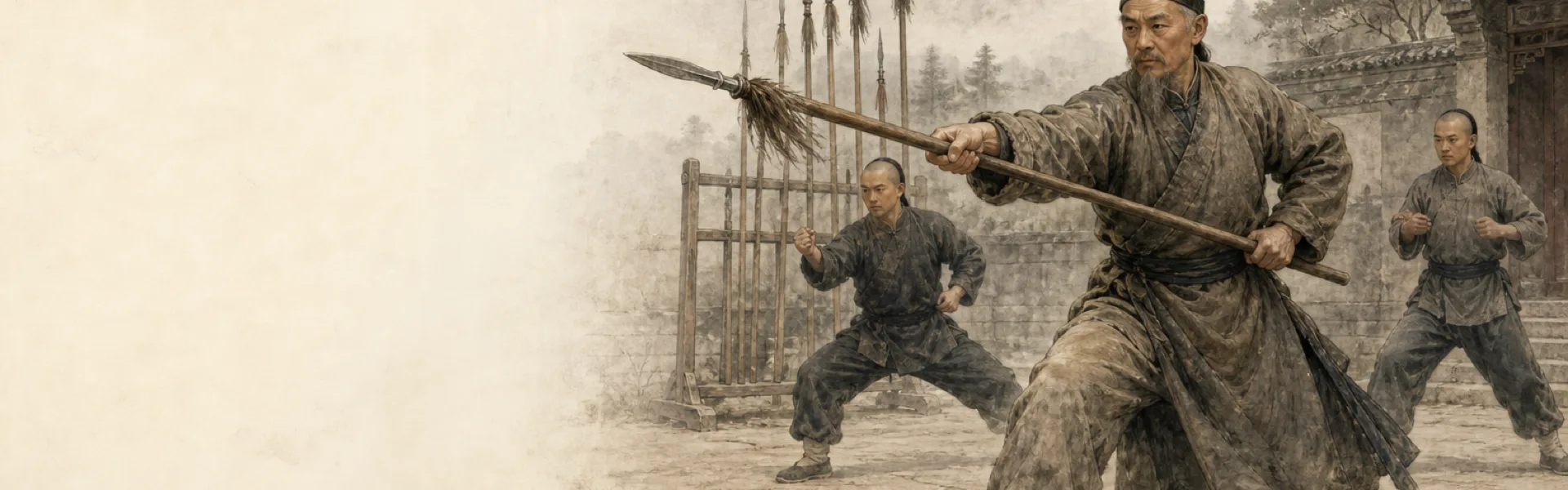
It is therefore reasonable to study spear and fist together, but not to say that resemblance proves a single act of invention. The retained hero painting should be read in the same way: it evokes the transmitted spear association without pretending to portray an identified founder or a documented lesson.
Cao Jiwu, Dai Longbang and Ma Xueli: a transmitted junction
The preface connects Ji Jike to Cao Jiwu and places both Dai Longbang and Ma Xueli downstream of Cao. That is a meaningful textual claim. It is not yet an independently verified chain for every generation, and identifying Cao with similarly named examination or official records requires evidence beyond a matching name.
Later communities developed distinct bodies of practice associated with Shanxi, Hebei and Henan. “Distinct” does not mean sealed from contact, and modern branch names should not be projected unchanged into the eighteenth century. Dai-family Xinyi, Henan Xinyi Liuhe Quan and the Xingyiquan lines associated with Li Luoneng preserve overlapping terms alongside different emphases, sequences and teaching memories.
Li Luoneng and nineteenth-century expansion
Lineage histories give Li Luoneng—also called Li Nengran—a decisive place in the spread of Xingyiquan during the nineteenth century. Through students and later generations, lines associated with Hebei and Shanxi became widely taught. Exact dates, occupations, nicknames and “nearly all current practice descends from him” are stronger claims than the sources assembled here can carry, so they should not be used as shortcuts.
The historically useful point is the widening network: teaching moved among families, villages, security work, urban associations and eventually published instruction. Different branches organized shared material in different ways. This explains variation better than a story in which one complete, fixed curriculum simply passed unchanged from person to person.
Print makes the received history visible
Sun Fuquan’s Study of Xingyi Boxing, published in 1915, gives a traceable early-Republican witness. Sun reports the history taught to him, openly says that a Yue Fei manual he saw was a later handwritten copy, and presents a structured curriculum of standing, five fists, linked practice and animal methods. The book securely documents Sun’s presentation in 1915, not the antiquity of every claim inside it.
Zhu Guofu’s Essentials of Xingyi Liuhe Quan followed in 1929 with text and photographs for a public readership. Such books did more than preserve practice. By selecting names, sequences and explanations, they helped stabilize what readers would recognize as a curriculum while leaving room for living branch differences.
Living branches are not fossils
China’s current heritage records list Xingyiquan and Xinyiquan as living transmission projects. These records are useful for present-day communities, locations and heritage recognition. They are not substitutes for early manuscripts, nor should one branch be used as an unchanged fossil from which every earlier stage can be reconstructed.
For readers, the safest sequence is to learn the broad structure on the Xingyiquan gateway, then compare claims against dated texts and the annotated sources and reading guide. Keep three labels in view: documented at the time, stated in a later transmission, and interpreted from practice. That discipline protects both history and tradition.
A responsible working timeline
- Southern Song: Yue Fei’s historical life is well documented; the inspected official biography does not name Xingyiquan.
- Ming–Qing transition: later martial sources place Ji Jike/Ji Longfeng at the center of the art’s emergence; exact genealogical claims still require the precise witness.
- Text bearing 1750: the transmitted preface joins Yue Fei, Ji, Cao, Dai and Ma in one account, but the accessible copy is later and textually imperfect.
- Nineteenth century: lineages associated with Li Luoneng expand and diversify across Shanxi and Hebei, alongside distinct Henan Xinyi transmissions.
- 1915 and 1929: Sun Fuquan and Zhu Guofu make received histories and selected curricula inspectable in print.
- Today: multiple communities continue Xingyi and Xinyi as living arts; their differences are historical evidence, not defects to be flattened.