Tianzhu Peak at Wudang Mountain: Summit, Golden Hall and Sacred Landscape
武当山天柱峰:山顶、金殿与神圣景观
Tianzhu Peak is the principal summit of Wudang Mountain and the point around which much of the range’s visual and cultural geography is understood. An official Hubei government introduction records its elevation as 1,612 metres. From lower ridges it appears as the mountain’s high centre; from the summit, nearby peaks, ravines and temple routes become parts of a much larger composition.
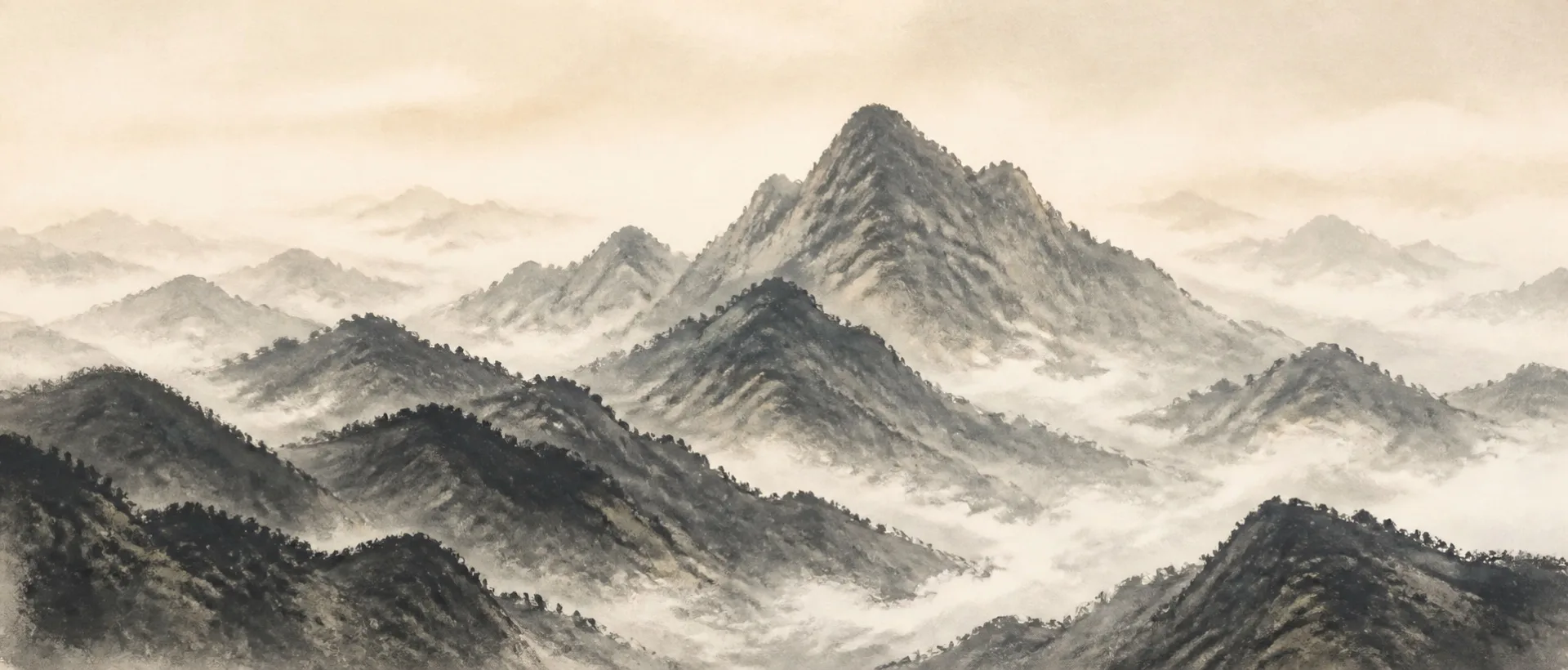
The peak is also one of the easiest places at Wudang to describe imprecisely. Tianzhu Peak is the natural mountain. The Golden Summit is the summit precinct. Taihe Palace is the working temple complex on and below the high point, and the Golden Hall is the small bronze building at the top. They belong together, but they are not interchangeable names.
What Tianzhu Peak is—and what it is not
Tianzhu Peak is first a landform: the principal peak in the Wudang mountain landscape. Its height, steep approaches and commanding position existed before the palaces, walls and stairways that now shape a visitor’s experience.
It is not a single temple, and it is not simply another name for the Golden Hall. A photograph of the gilded bronze hall shows the monument placed on the summit; it does not show the whole peak. Keeping that distinction clear helps readers understand why the site matters both as a natural landmark and as the final architectural destination of the central route.
The name Tianzhu and the peak’s documented height
Tianzhu means “Heavenly Pillar”. The name describes how the peak was seen: a high, upright centre rising above the surrounding folds of the mountain. Hubei’s official introduction to Wudang Mountain identifies Tianzhu as the main peak and gives an elevation of 1,612 metres.
Older guidebooks, local descriptions and modern websites sometimes vary in precision, but the differences are usually small. For a general visitor’s guide, 1,612 metres is the clearest responsible figure. Elevation explains part of the summit’s climate and visibility, but not its cultural importance by itself. The peak became central because topography, route design, religious meaning and Ming imperial building all reinforced one another.
How the landform organizes the surrounding mountain
Wudang is not a single cone rising from a plain. It is a broken landscape of ridges, rock faces, gullies and streams. Tianzhu Peak stands within that network as a high reference point rather than as an isolated mountain.
Approaching the upper mountain, sight lines repeatedly disappear behind nearer ridges and reopen at gateways, terraces and turns in the path. This alternation between concealment and revelation makes the summit feel farther away than a map suggests. The landscape does not present everything at once. It makes distance, effort and sequence part of how the place is read.
The natural summit, Taihe Palace and the Golden Hall
The top of Tianzhu Peak carries a compact architectural ensemble fitted onto very limited ground. Taihe Palace occupies terraces around the high point and remains the functioning religious complex of the summit. A stone-walled enclosure follows the mountain’s irregular form. Above it stands the Golden Hall, a small cast-bronze building whose visual authority is much greater than its physical size.
An earlier bronze hall from the Yuan period survives lower on the summit precinct. The better-known Golden Hall belongs to the great Ming transformation of Wudang in the early fifteenth century. Readers looking for architectural history should treat these as separate buildings, not two dates for the same monument.
Why the summit became the architectural climax of Wudang
The position of the summit made it suitable for a building programme concerned with hierarchy, pilgrimage and sacred authority. In the Ming period, routes and monuments were arranged so that ascent became a progression: lower gateways and temples prepared the visitor for the more compressed, exposed and symbolically elevated summit.
The result is not architecture placed against scenery as decoration. The peak supplies height, difficulty, wind, cloud and distant views; the buildings give those physical conditions ritual and political meaning. Each depends on the other. Without Tianzhu Peak, the Golden Hall would lose its commanding position. Without the summit complex, many visitors would read the peak mainly as a viewpoint.
How Tianzhu Peak fits the central Wudang route
The central route links major places such as Taizipo, Zixiao Palace and Nanyan Palace before reaching the upper mountain. These sites should not be reduced to stops on the way to Tianzhu Peak: each has its own history, architecture and religious life. Yet the route’s upward movement gives the summit a clear role as its climax.
That relationship is easier to understand by reading a route map before travelling. Road transport and cable access may reduce some sections of the ascent, but the upper precinct still involves steep stone steps, confined passages and changing weather. Access arrangements can change, so current operating details should always be checked close to the visit.
How to understand “the seventy-two peaks paying court”
A widely repeated Wudang expression describes the surrounding peaks as “paying court” to the Great Summit. The image draws on the way many ridgelines appear to incline toward Tianzhu Peak, especially when viewed from certain upper positions. It also uses the language of hierarchy: lesser peaks are imagined as officials facing a central ruler.
This is a powerful cultural interpretation, not a claim that every summit physically points toward one exact coordinate. Nor should the traditional number seventy-two be mistaken for a modern survey inventory with universally agreed boundaries. The phrase tells us how generations learned to see the landscape—as an ordered assembly centred on Tianzhu Peak.
Weather changes the summit more than the map suggests
At 1,612 metres, the summit can be colder, windier and wetter than lower parts of the scenic area. Cloud may remove the long view completely, while wet or icy stone can change a short climb into a slow one. Conditions at the base are not a reliable guide to conditions at the top.
Cloud is not necessarily a failed visit. It can make the relationship between rock, wall and temple easier to notice by removing the distant panorama. Clear weather reveals the surrounding ridges; mist compresses attention onto the summit itself. Both are characteristic experiences, provided the route remains open and safe.
How to visit Tianzhu Peak with attention and restraint
Allow more time than the distance alone appears to require. Wear footwear suited to worn stone, carry a warm or windproof layer, and avoid treating barriers, walls or rock edges as viewing platforms. Follow closures immediately; weather and crowd controls on a confined summit are safety measures, not optional advice.
The precinct is also an active Taoist place. Keep voices low near halls, give space to worshippers, follow posted photography rules and do not handle architectural surfaces. The aim is not merely to reach the highest point. It is to understand how mountain, route, temple and continuing practice meet there.
Evidence, names and limits
The elevation and identification of Tianzhu as Wudang’s main peak follow the official introduction published by the Hubei provincial authorities. The broader heritage context follows the UNESCO description of the Ancient Building Complex in the Wudang Mountains. Architectural distinctions are consistent with this site’s separate guide to Taihe Palace and the Golden Hall.
This page does not fix current opening times, cable-car schedules, ticket rules or seasonal closures because those details change. It also avoids assigning every traditional peak name to a modern mapped coordinate where the evidence is uncertain. A useful landmark page should make what is known clearer without filling gaps with confidence.
Key points about Tianzhu Peak
Tianzhu Peak is Wudang Mountain’s principal peak, officially recorded at 1,612 metres.
The peak is a natural landmark; Taihe Palace, the summit enclosure and the Golden Hall are buildings placed upon it.
The Golden Hall and the earlier Yuan bronze hall are separate monuments.
Tianzhu Peak gives the central temple route a visible and symbolic climax.
“The seventy-two peaks paying court” is a traditional way of interpreting the surrounding ridges, not a modern survey statement.
Weather can change quickly, and cloud is a normal summit condition rather than evidence that the visit has failed.
Responsible visiting means respecting steep terrain, safety controls, historic fabric and an active Taoist precinct.
Continue exploring Tianzhu Peak
Tianzhu Peak is one part of a larger mountain route. Use these guides to continue from natural landscape to architecture, travel planning and the wider peak directory.