Wudang Mountain Summit: Taihe Palace and the Golden Hall
武当山金顶:太和宫与金殿
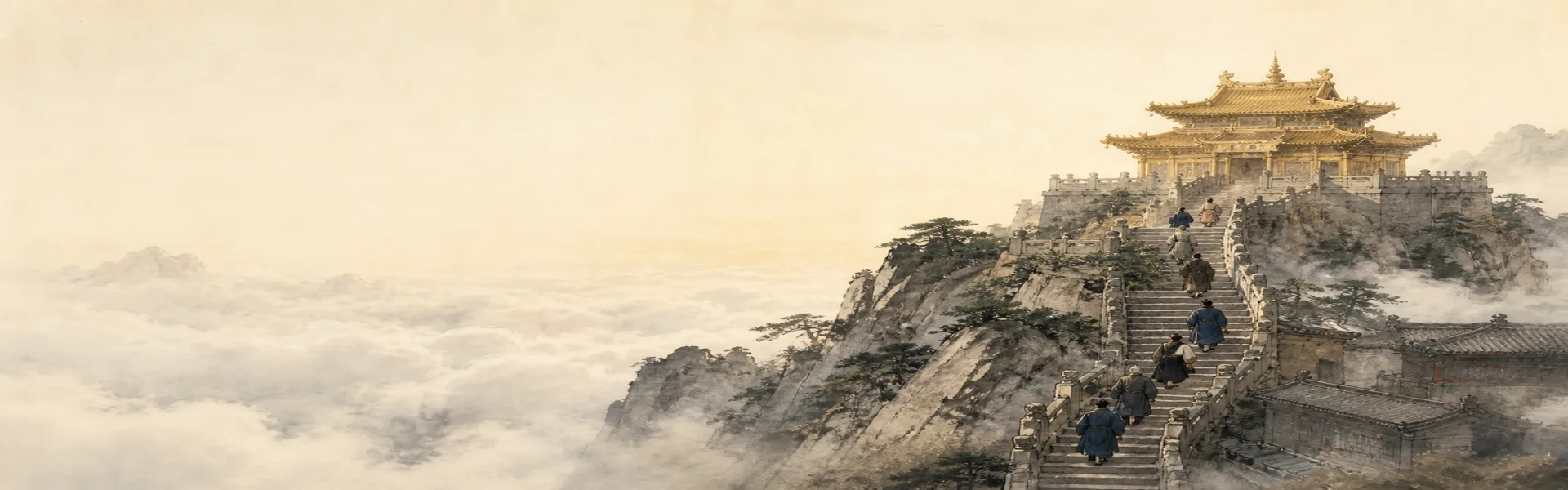
The summit is the destination of the whole composition, and it is the smallest of the major sites in area and the largest in effect. A bronze building stands on the highest peak inside a stone wall built around the mountaintop, and everything on the ascent below has been arranged so that you arrive here last.
Getting up
The final approach cannot be avoided by any means of transport. Vehicles reach a point on the upper mountain and a cable car covers part of the remaining height, but from wherever you are set down there are steep stone stairways to climb, in places narrow and exposed, and this is the part that most often defeats visitors who assumed machinery had solved the problem.
The historic ascent was made entirely on foot from far below, through a series of gateways that mark stages of the climb, and those gateways are still there. If you have the time and the legs, walking at least the upper section is worth it, because the design of the summit only makes sense as the end of an effort. Arriving without effort is a different experience, and a weaker one.
Note also that the summit is where crowding is worst. It is a small enclosed area receiving the full flow of the mountain, and there is no way to spread people out once they are inside the walls.
The walled summit
The mountaintop is enclosed by a stone wall of the early fifteenth century, built of large dressed blocks, following the contour of the peak and rising in places to a considerable height. It has gates at the cardinal points, though only one is used for access.
The name given to it deliberately echoes the imperial palace enclosure in the capital, and the parallel is the whole point. An emperor lives inside a walled city within a city; a god of this rank is given the same. The wall is not defensive in any military sense — there is nothing to defend against on a peak — it is a statement of status expressed in the only architectural vocabulary the Ming had for supreme authority.
Building it was extraordinarily difficult. Every block had to be brought up the mountain and set on a steep and irregular summit, and the wall carries stairways, gateways and terraces integrated into it. Masonry survives where timber does not, so this is among the most authentic Ming fabric on the mountain, and it is easy to walk past without noticing because it reads as landscape rather than as building.
Taihe Palace
Just below the highest point is Taihe Palace, the Palace of Supreme Harmony, which takes its name from the mountain's older name and which serves as the summit's functioning temple.
It is a compact group of halls on terraces, necessarily small because there is no room, containing a principal hall, subsidiary halls including one for scripture, and the practical rooms a working temple needs. Because space is so tight, the usual courtyard sequence is compressed almost to nothing, and buildings are fitted into whatever level ground the wall and the rock provide.
This is where most of the actual religious activity at the summit takes place, and it is worth more attention than it usually gets, because visitors tend to walk through it on the way to the bronze hall above.
The older bronze hall
Slightly below, on a subsidiary rise, stands a second and earlier bronze hall, cast in the early fourteenth century under the Yuan. It originally stood on the summit itself and was moved down when the Ming programme installed its own hall at the top.
It is a remarkable object in its own right and it is regularly overlooked. It also demonstrates something useful: the idea of a cast metal hall on this summit was not a Ming invention but a Yuan one, and the Ming did what Chinese dynasties usually did, which was to take an existing idea and execute it on a much larger scale.
Popularly it has acquired a name and a practice connected with turning one's fortune, and visitors circle it. This is a good example of how a displaced historical monument acquires a new devotional function; nobody planned it, and it now has more visitors performing a ritual than admiring the casting.
The Golden Hall
On the highest point stands the Golden Hall, a building of cast bronze, gilded, of the early fifteenth century, and it is the object the whole mountain exists to hold.
It is not large — a few metres in each dimension — and its power is not scale but material and precision. It was cast in sections and assembled on the peak with interlocking joints, and the components reproduce, in metal, the entire language of a timber hall: columns, beams, bracket sets, rafters, ridge, tiles, even the modelling of woodgrain in places. Inside is a gilded image of Zhenwu, with attendants and the tortoise and snake.
Consider what its construction required. The metal had to be founded and cast elsewhere, at a scale and precision that allowed parts made in a foundry to fit together on a mountaintop; then every piece had to be carried up a mountain by human and animal power; then it had to be assembled correctly on a peak, in wind, with no possibility of returning a mis-cast component. This is one of the most impressive metallurgical and logistical achievements in Chinese architectural history, and it is the reason the summit is worth the climb even when there is no view at all.
Lightning on the summit
A metal building on the highest point of an isolated massif is struck by lightning, frequently and violently.
Traditional accounts made this a wonder rather than a hazard. Strikes were described as fire from the thunder deities playing over the hall, refining rather than damaging it, and the hall was said to emerge from a storm brighter than before. There is a mechanism behind the description: a large, well-connected mass of bronze conducts a strike relatively harmlessly, and electrical discharge can burn deposits off a gilded surface. So the account was not simply pious invention, though it was interpreted in religious terms.
In the modern period lightning protection was installed, and the traditional phenomenon is reported to have ceased as a result. That fact is worth sitting with. A conservation measure that any engineer would recommend removed a religious wonder that had been attested for centuries. It is a small, clean example of the tension between preserving a site and preserving what a site meant, which runs through everything on this mountain.
Why the summit was built this way
Step back and ask what the design is saying, because the summit is the conclusion of an argument made over several kilometres of mountainside.
The ascent has taken you through the young prince's near-abandonment, his princely origins, the long middle years of cultivation and the place of his transformation. At the top he is not shown cultivating. He is enthroned, in metal, inside a walled enclosure that borrows the vocabulary of the imperial palace. The sequence therefore ends by changing category: what you have been following is a man, and what you arrive at is an office-holder in the celestial administration, housed accordingly.
The choice of bronze belongs to that argument. Timber decays, burns and needs constant replacement, and every other hall on the mountain has proved it. Metal was the material of permanence, of ritual vessels, of objects that outlast dynasties. Putting a bronze building at the end of a route lined with timber ones is a statement about the difference between what is mortal and what is not — and it was made by an emperor whose own legitimacy was the thing he most needed to make permanent.
What it feels like, honestly
Set expectations, because the summit is where they are most often mismanaged.
It is usually crowded, sometimes very. It is markedly colder and windier than the base, and a substantial proportion of the year it is inside cloud, so the famous view of surrounding peaks below you is a matter of luck. Space is tight, queuing is normal, and photography of the bronze hall without other people in the frame is difficult.
None of that spoils it if you know what you came for. The bronze hall is a masterpiece at close range and does not require weather. The wall is a Ming engineering achievement you can put your hand on. And if the cloud does clear, the reason every account describes surrounding peaks bowing towards this one becomes immediately obvious. If it does not clear, you have still seen the best things here.
Practical information
Treat the summit as weather-dependent and go for it early in the day, before the heaviest congestion and before afternoon cloud builds. Take warm and windproof layers regardless of conditions at the base. Footwear with grip matters on worn, often wet stone. Carry water, and be aware that provisioning at altitude is limited and concentrated.
The upper stairways are steep, and descent is harder on knees than ascent; allow for it, and consider descending by a different route if one is available. In winter, ice can close upper sections entirely, and that decision is not negotiable. Do not climb on walls, railings or the hall. This is an active place of worship as well as a monument, so keep your voice down inside the halls and give way to anyone making an offering. Photography rules vary and are sometimes restricted inside; look for notices.
Sources and limits. Dates and dimensions for the Golden Hall, the summit wall and the earlier bronze hall follow the mountain's gazetteers and published architectural studies; figures vary slightly between sources and are given approximately. The traditional accounts of lightning are reported as tradition, together with the physical explanation generally offered; the cessation of the phenomenon after lightning protection was installed is as commonly reported. Transport stages, access in bad weather and photography rules change and none are stated here.
Key points
The summit is the destination of the whole composition, smallest in area and largest in effect.
No transport removes the final steep stairways, and the design only makes sense as the end of an effort.
A fifteenth-century stone wall encloses the peak, echoing an imperial palace enclosure as a statement of the deity's rank.
Taihe Palace just below is the summit's working temple, compressed into whatever level ground exists.
An earlier Yuan bronze hall, displaced downhill by the Ming works, now attracts a fortune-turning practice.
The Golden Hall is cast and gilded bronze reproducing the full language of a timber hall, and its making was a metallurgical and logistical feat.
Lightning strikes were traditionally read as refining the hall; modern lightning protection reportedly ended the phenomenon.
Expect crowds, cold, wind and cloud; the bronze hall and the wall do not depend on a view.