Chinese Coin Divination and Temple Lots: Methods and Meaning
中国钱占与求签:方法、解读与文化意义
While the oracle bones and the Yijing represent the classical, scholarly side of Chinese divination, the arts that most people actually encountered were simpler, cheaper, and woven into the rhythm of everyday religious life. Two of these popular methods stand out for their reach and longevity: coin divination and the drawing of temple lots. Both made the act of consulting fate quick, affordable, and available to anyone who walked into a temple.
Why these two methods spread furthest
The milfoil procedure takes eighteen manipulations to produce one hexagram, requires time and patience, and requires the ability to count. Three coins thrown six times produce a hexagram in a few minutes. Shaking a stick out of a bamboo cylinder in a temple requires no calculation at all.
How widely a method spreads is determined almost entirely by how low its threshold is, and hardly at all by how much doctrine stands behind it. From the Ming onward, the divination that actually operated in ordinary Chinese life was these two: coin casting and lot drawing.
How coin divination is done
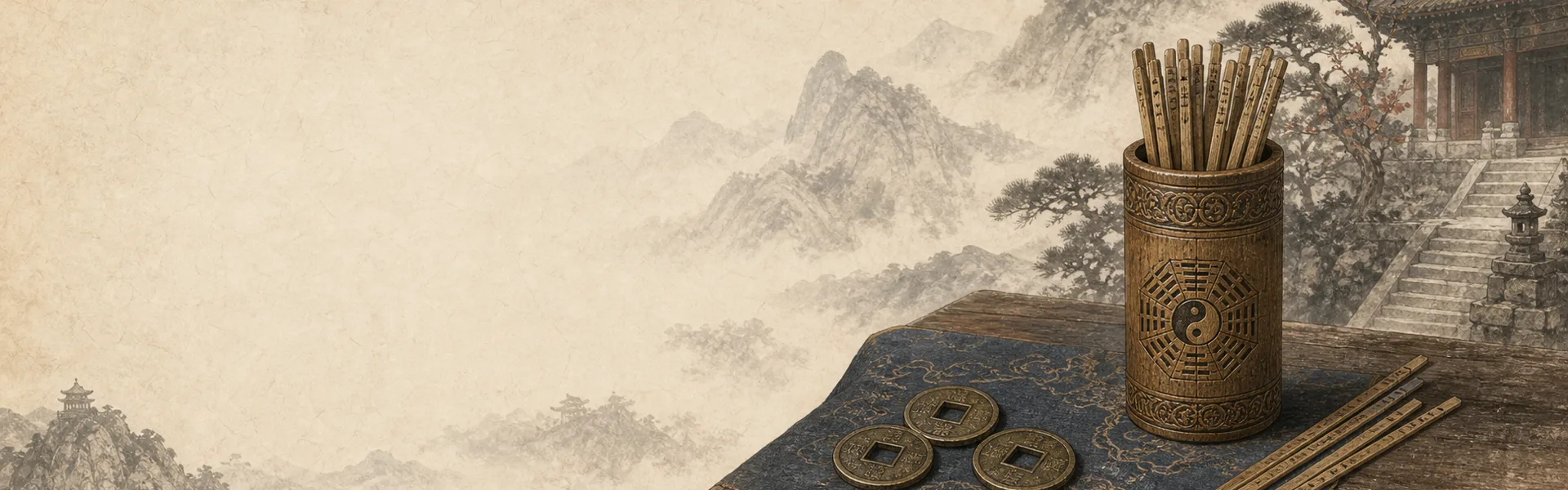
Coin divination is essentially a streamlined version of the Yijing method. Instead of the long and demanding ritual of sorting fifty yarrow stalks, the enquirer simply takes three coins, shakes them, and lets them fall. The pattern of heads and tails from each throw is converted into a single line of a hexagram, and six throws complete the figure. The results are then read against the same Book of Changes used in the classical method. Because it can be done in minutes with objects anyone owns, coin divination became the ordinary way of consulting the Yijing, and it remains the most common form today. It preserves the philosophy of the classical text while stripping away the elaborate ceremony.
Because copper coins were standard, this line is also called the money hexagram, and because it is pseudonymously credited to King Wen it is known as the King Wen method; since judgement proceeds line by line it is generally called six-line divination (六爻). Its difference from classical milfoil practice lies only in the randomising device. The symbol system produced is identical — sixty-four hexagrams, moving lines, a derived second hexagram — which is worth knowing, because popular books sometimes present the two as separate arts with separate authority.
Six-line judgement: a vocabulary of family roles
The genuinely complex part of coin divination is not casting but judging.
Each line is assigned a stem, a branch and a phase, and then, by its relationship to the hexagram's own phase, one of five family roles: parent, sibling, offspring, wife-and-wealth, or officer-and-ghost. The question determines which line is taken as the governing line — wealth questions look to the wife-and-wealth line, career and official matters to the officer line, questions about elders to the parent line, questions about children to the offspring line. In medical questions the officer line represents the illness and the offspring line the remedy.
The reader then examines whether the governing line is strong, whether it is supported or attacked by other lines, whether it falls in a "void" decade, and how the month and day of the consultation bear on it.
This vocabulary shares its origin with the Ten Gods of BaZi, and both translate the concerns of a life into the roles of a family, reflecting the same social structure. Technically it is far more refined than classical milfoil practice and offers many more conditions to weigh — which is precisely why different schools routinely reach opposite conclusions about the same hexagram.
How lot drawing works
The drawing of lots, known in Chinese as qiuqian, is a different kind of practice altogether, and it is the form of divination most visible in Chinese temples. A worshipper who wishes to put a question first prays before the deity, then takes up a cylindrical container holding a bundle of flat numbered bamboo sticks. Kneeling, the enquirer shakes the container at an angle until one stick works its way loose and falls to the ground. The number on that stick corresponds to a printed slip, the oracle poem, which is collected from a rack of numbered drawers nearby. Before the answer is accepted, the worshipper usually confirms it with a pair of crescent-shaped wooden blocks called jiaobei. These are thrown to the ground, and the way they land, one flat side up and one down, is taken as the deity's assent that the correct stick has been drawn. If the blocks fall in an unfavorable pattern, the enquirer may draw again. Once confirmed, the oracle poem is interpreted, sometimes by the worshipper and sometimes with the help of a temple attendant who explains its often cryptic verses in relation to the question asked.
Why an oracle poem always fits
The language of temple oracle poems is open by design. They speak of a boat meeting wind, a withered tree meeting spring, the moon waxing and waning, a benefactor appearing, of holding one's position rather than advancing. None of these images specifies a situation, which is exactly why the same poem reads sensibly for money, illness, marriage or examinations.
The interpretation is where the work really happens. Whoever explains the poem must first establish what you are asking about and how matters currently stand, and only then connects the verse to your circumstances.
This is the identical mechanism described on the physiognomy pages. The content is supplied by the conversation; the poem supplies an opening for it. That is not an accusation of dishonesty — a temple attendant explaining a verse is usually sincere and often kind — but it explains why the fit is so consistently good, and why it would be equally good if the sticks were shuffled.
What "sincerity makes it work" actually does
Popular practice imposes rules on lot drawing: one question, one lot, no repeating; the heart must be sincere or it will not work; the gods must not be tested.
As etiquette these are perfectly coherent. It is worth seeing what they do structurally as well.
"Sincerity makes it work" transfers responsibility for failure to the person asking. If the lot proves wrong, the explanation is that you were not sincere enough — and no one can demonstrate that they were.
"Do not repeat" blocks the simplest possible test. If a person asked the same question three times and drew three incompatible answers, the problem would be exposed immediately; the rule forbids precisely that experiment.
These belong to the same family as the physiognomic principle that appearance changes with the heart. Such rules protect the system, and the price they pay is the possibility of ever being checked. Noticing this does not require assuming anyone designed them cynically; rules that shield a practice from disconfirmation tend to survive, and rules that expose it tend not to.
What it actually provides
Set efficacy aside, and several real functions remain.
Entering a temple, becoming quiet, and stating the matter aloud before an image forces a person to formulate the question. A great many hesitations dissolve halfway once they have been put into words, and this alone accounts for a good deal of the relief people report.
Drawing the lot, reading the verse and hearing it explained supplies an external warrant, which allows someone to commit to a course they were already inclined towards. The advice in the verses is overwhelmingly to keep to one's station, endure, wait for the right time and act well — counsel that carries very little risk whatever the situation.
It is also nearly free, requires no appointment, and can be done anonymously. For someone unwilling to confide in another person, it is the lowest-threshold outlet available, and there is no reason to be contemptuous about that. What it cannot do is any of the things it appears to promise.
Some other popular methods
Beyond coins and lots, several simpler practices circulate widely.
Character analysis (测字) asks the client to write any character; the diviner then takes it apart by radical, stroke and structure, adding or removing strokes as required, and produces a judgement fitted to the question. Its flexibility is effectively unlimited: the character an (安) can be read as a woman under a roof, indicating that one should stay home, or as a woman left exposed once the roof is removed — the reading depends entirely on which way the diviner wishes to go. Character analysis is the method that takes interpretive freedom to its logical extreme, and for that reason it is the clearest demonstration of where the content in any of these practices comes from.
Dream interpretation works from tables of dream omens, of which the Duke of Zhou's Dream Interpretations is the best known; the correspondences are conventional and the manuals disagree.
Moon blocks (掷筊) give a simple yes, no or laughing-refusal answer from two curved wooden pieces, and are used constantly in temples for questions that need only a binary reply.
Things to watch for
These are the most accessible of the divinatory arts, and accessibility cuts both ways. A few practical cautions apply.
Free lots followed by a paid interpretation is a common arrangement, and there is nothing wrong with it in itself — but where the interpretation identifies a calamity and the remedy for that calamity is also for sale, the two halves have arrived from the same source and the sequence should stop there.
Be wary of escalation. An unfavourable lot leading to a suggestion of a ritual, then a more expensive ritual, then an object to be consecrated, follows the pattern described throughout this section.
Watch for the invitation to re-draw. The tradition's own rule forbids repeating a question. A practitioner encouraging you to draw again, at a further charge, is contradicting the practice they are selling.
Nothing here bears on medicine. An officer line is not a diagnosis and an oracle poem is not a prognosis. Where illness is involved, a doctor is the only appropriate source, and any suggestion to delay treatment until a more favourable answer appears should be refused outright.
Temples that print their verses openly, charge nothing or a fixed small sum, and make no attempt to follow up are conducting an ordinary devotional activity. The warning signs are all about money and pressure, not about belief.
Key points
Alongside the scholarly methods ran simpler popular ones that most people actually used.
Coin divination is a streamlined Yijing method using three coins instead of fifty yarrow stalks.
Drawing lots, qiuqian, is the form most visible in temples today.
A numbered stick is shaken from a container and exchanged for a printed oracle poem.
The poems use open, often cryptic imagery that can be read to fit almost any question.
Their openness is deliberate, since it lets the enquirer find their own situation in the verse.
These methods need no special learning and cost little, which is why they spread so widely.
Sources drawn on for this article include: Richard J. Smith's studies of Chinese divination and popular religion, general scholarship on Chinese temple practice and the drawing of lots, and reference works on the Yijing and coin divination.