Chinese Oracle Bones and Turtle-Shell Divination
中国甲骨与龟卜:商代占卜和早期文字
Oracle-bone divination is the oldest form of Chinese divination for which we have direct evidence, and it stands at the very origin of the written Chinese language. Practiced by the royal house of the Shang dynasty in the second millennium BCE, it was a solemn state ritual through which the king communicated with his ancestors and the spirit world. The physical remains of that practice, inscribed bones and shells unearthed in enormous numbers, have allowed scholars to reconstruct the religion and politics of an era that would otherwise be almost entirely lost.
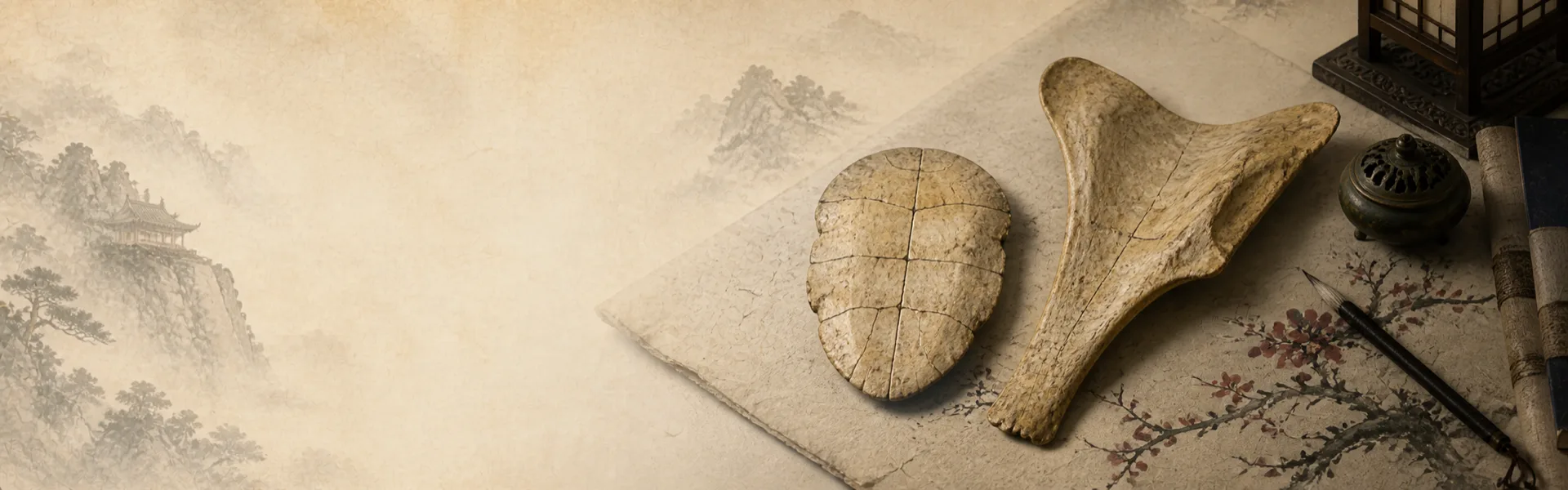
The materials
The materials used were the flat undershell of the turtle, known as the plastron, and the shoulder blades of oxen. These were carefully cleaned and prepared, and a series of small hollows was bored or chipped into the back. When a question was to be put, the diviner applied a heated point to one of these hollows. The intense, localized heat caused the bone to crack on the opposite surface, producing a distinctive T-shaped fracture. The Chinese word for this kind of divination echoes the very sound of that cracking, and the character for divination itself pictures the shape of a crack.
How a bone was prepared
A shell or bone went through considerable preparation before use. It was sawn and scraped flat, unwanted portions removed, the surface smoothed. Round hollows were then drilled into the reverse, and beside each hollow a longer chisel groove was cut, shaped rather like a date stone, so that the bone wall at that point became thin.
These drillings and grooves were laid out in neat rows and columns, and a single piece might carry dozens of them. At the moment of divination a heated brand or a charcoal point was applied to the thinned area, and a crack opened on the front face. The main stroke of the crack and its branch constitute the zhao (兆), the omen figure.
The character bu (卜) is a picture of that crack — an upright stroke with a shorter one branching off at an angle. Here the writing system can be seen growing directly out of the practice, which is about as literal a demonstration as one could ask for of how closely divination and Chinese writing are entwined.
How the cracks were read
Judgement rested on the direction of the crack, its angle, its length and the form of its branching. Some technical vocabulary survives in the inscriptions.
The complete rules, however, did not come down to us, and they cannot be reconstructed today into anything a person could actually follow.
This deserves attention. The single most important technical step in turtle divination is precisely the part for which no written rules survive. Unlike later six-line divination, which has explicit correspondence tables that anybody can consult, crack reading appears to have been an orally transmitted craft, dependent on the diviner's judgement in the moment and on his authority to make it stick. Whatever was happening, it was not the application of a public rule.
What the kings asked, and how it was recorded
The questions, or charges, were remarkably varied. The king inquired about the prospects for the harvest, the outcome of military campaigns, the meaning of dreams, the advisability of hunting expeditions, the health of the royal family, the childbirth of a consort, and the proper conduct of sacrifices. Many charges concerned the ancestors directly, asking whether a particular ancestor was responsible for a misfortune such as a toothache or a poor harvest, and whether an offering would set matters right. A very common form asked simply whether the coming ten-day period would pass without trouble.
Once the cracks had been read, the outcome was carved onto the piece, and a complete inscription usually has four elements. The preface gives the date in stem-and-branch form and the name of the presiding diviner. The charge states the matter asked about. The prognostication records the judgement — auspicious, greatly auspicious, inauspicious. The verification records what subsequently happened.
Some inscriptions were filled with red or black pigment to make the carved strokes legible and to preserve them. These were documents intended to be read again, which is consistent with everything else about how the Shang treated this material.
The verification inscriptions, and their limits
The fourth element is the most interesting thing on the whole subject, and it deserves separate treatment.
Verification inscriptions show that the Shang genuinely cared whether the divination had been right, and went back to record what happened. This is rare in the history of divination — most later Chinese arts keep no record of outcomes at all, which is one reason none of them ever accumulated evidence about itself.
But recording is a long way from testing, and three problems separate them. The record is selective: results matching expectation are more likely to be inscribed. There is no statistics of any kind, and individual successes, however many, do not add up to a reliability estimate. And the charge — the statement of the matter asked about — is frequently phrased loosely enough to accommodate more than one outcome, so that something corresponding can usually be found afterwards.
In short: the Shang achieved recording and did not achieve comparison. That distinction is exactly the line between divination and empirical method, and it is worth stating precisely because the Shang came closer to crossing it than anyone else in this story.
Paired charges: asking both ways at once
A practice appears constantly on the bones: the same question inscribed on the left and right sides of the piece in positive and negative form — one side asking that it will rain, the other that it will not. Scholars call these paired charges. Sometimes the same matter was divined repeatedly, or by different diviners in turn.
At the time this was presumably a matter of thoroughness. But it exposes the nature of the procedure rather clearly. If a single divination yielded a definite answer, there would be no need to ask both ways, and no need to repeat.
Leaving room to choose between outcomes means that the final decision stayed with a person. That is worth holding onto, because it recurs at every level of this subject: the apparatus narrows the options and a human being closes the gap.
The king interprets in person
In the later Shang inscriptions the formula "the king, prognosticating, said" becomes markedly more frequent — that is, the king himself is pronouncing on the meaning of the crack.
This is a significant shift. Interpretive authority moves from the diviners who possessed the craft to the ruler who possessed the power. The point of divination was to supply a judgement from beyond human intention; once the highest human authority is doing the interpreting, it has become an ornament of that authority instead.
The pattern recurs throughout the history of these arts, and it is worth naming plainly: a technique has very little capacity to resist the intentions of whoever is using it. Nothing internal to divination prevented this, and nothing internal to feng shui, physiognomy or date selection prevents the equivalent today.
Where the cracks actually come from
Physically, the shape of a crack is determined by the thickness of the bone, its moisture content, its internal structure, the depth and form of the drilled hollow and groove, and where the heat is applied and how fast the temperature rises. Some of these are controllable and some are not, so the crack is neither fully random nor capable of being set in advance.
There is no causal path between it and the matter being asked about. An ox's shoulder blade does not know what the harvest will be.
But one thing should be said carefully, because it is the most useful observation on the page. Unpredictability was not a defect of the method; it was the reason the method was adopted. What was wanted was a procedure for reaching a decision that no party could bend to their own preference, and a crack in heated bone supplies exactly that property — nobody can arrange it beforehand. Understanding why the procedure was attractive is considerably more illuminating than simply noting that it did not work.
What it finally gave us
The value of the oracle bones today has nothing to do with divination.
They preserve the language, the script, the calendar, place names, personal names, the sacrificial system, and records of warfare and agriculture — the most direct material we have for the study of early China. Wang Guowei used the royal ancestral names in the inscriptions to check the Shang genealogy in the Shiji, confirming that the transmitted account was broadly reliable and correcting errors of sequence within it.
These objects were made in order to know what was coming. They became a door into what had already been, which is the most elegant reversal in the history of Chinese divination and, in its way, the most complete answer to the question of what the practice was worth.
Key points
Oracle-bone divination is the oldest Chinese divination with direct surviving evidence.
It stands at the origin of the written Chinese language.
Turtle plastrons and ox shoulder blades were cleaned and hollowed, then heated until they cracked.
The cracks were read as answers, and question and outcome were inscribed on the bone.
The charges covered harvests, warfare, weather, illness, childbirth and ritual.
Inscribed bones and shells have been unearthed in enormous numbers, letting scholars reconstruct Shang religion and politics.
Wang Guowei used royal names in the inscriptions to confirm and correct the Shang genealogy in the Shiji.
What survives is an unusually direct record of what a Bronze Age court actually worried about.
Sources drawn on for this article include: David N. Keightley's foundational studies of Shang oracle-bone divination, and general scholarship on early Chinese history, religion, and the origins of Chinese writing.