The Yijing and Milfoil Divination: How Hexagrams Are Cast and Read
《易经》与筮占:卦象如何生成与解读
Of all the Chinese divination arts, none has been more influential than the method built around the Yijing, the Book of Changes. For more than two thousand years this text has been revered as one of the great classics of Chinese civilization, studied by philosophers and consulted by ordinary people alike. To understand it is to understand the intellectual heart of the whole divination tradition.
The Yi is three things in layers
Reading the Yijing requires separating three layers that are usually run together, and most confusion about the book comes from failing to do it.
The bottom layer is symbol: two kinds of line, broken and unbroken; three lines making a trigram; six making a hexagram. There is no text at this level at all.
The second layer is text: each hexagram has a name and a judgement, each line has a statement. The language is terse, largely divinatory, mixed with fragments of old songs and historical incidents. These two layers together constitute the jing, the classic proper.
The third layer is the Ten Wings — the Tuan, Xiang, Wenyan, Xici, Shuogua, Xugua and Zagua — which appeared very much later and philosophically reinterpret the first two.
This matters practically. What most readers today understand as "the philosophy of the Yi" — the waxing and waning of yin and yang, the correspondence of timing and position, the principle that exhaustion produces change — comes chiefly from the third layer. Reading the layers as one text means mistaking Han-dynasty thought for early Zhou thought, which is a gap of eight hundred years or more.
How a hexagram is generated
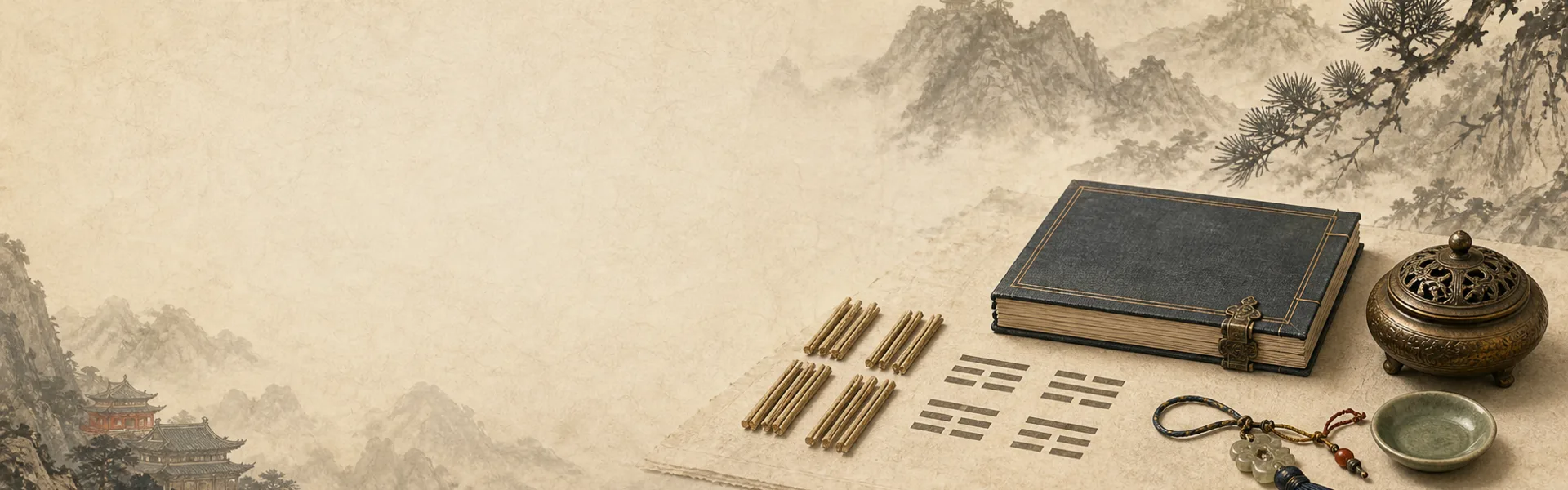
The classical way of arriving at a hexagram is the milfoil method, which uses fifty dried stalks of the yarrow plant. One stalk is set aside, and the remaining forty-nine are repeatedly divided, counted, and sorted through a fixed ritual procedure. Each round of counting yields a number, and after several rounds a single line is determined as yin or yang, and as stable or changing. Repeating the process six times builds the hexagram from the bottom up. The procedure is deliberately slow and exacting, and this very deliberateness was felt to focus the mind and lend the outcome its weight. A key feature of the system is the idea of changing lines. In the course of the count, certain lines emerge as unstable and on the point of turning into their opposite. These changing lines are read with special attention, and they transform the first hexagram into a second one. The enquirer is thus given not a single static answer but a picture of movement, a present situation and the direction in which it is shifting. This emphasis on change, rather than fixed prediction, is the deepest theme of the entire book.
How a hexagram is interpreted
A reader has several bodies of material to draw on at once: the hexagram's name and judgement; the statement attached to whichever line was moving; the overall image of the figure; the relationship between its upper and lower trigrams; the transformed hexagram; and, in later practice, techniques such as nuclear trigrams, hexagram transformation and the assignment of stems to lines.
Two consequences follow from that abundance, and they are inseparable. The more material available, the more that can be said — which is why the book has remained inexhaustibly useful to thoughtful readers for three thousand years. And the more material available, the less any reading can be shown to be wrong. The same hexagram with the same moving line can be given opposite judgements by different schools, each with textual support for its position.
These are not two separate observations. They are the same fact viewed from two sides, and any honest account of the Yi has to hold both at once.
A note on the coin method
Because the stalk procedure is slow, a shorter method using three coins became standard and is what almost everyone uses today. Three coins are thrown six times, once for each line from the bottom up, and the combination of heads and tails at each throw determines whether the line is yin or yang and whether it is moving. The result is a hexagram of the same kind. The probabilities are not identical to those of the stalk method — the older procedure makes moving lines rarer — but the difference is rarely mentioned in popular books, and most users are unaware that they are using a variant.
How people actually used it before the Qin
The Zuozhuan and Guoyu preserve several dozen accounts of actual consultations, and they are the most reliable evidence for early practice. What they show does not resemble later manuals.
Interpretation was remarkably free. A reader would break the hexagram into its component images and say that this is wind and that is mountain; would draw an analogy with a historical episode; would improvise according to the person and the situation. And — importantly — some participants said openly that divination was unnecessary, or declined to be bound by a result they thought mistaken. The outcome was advice, not a verdict.
The sharpest statement of this attitude comes from the Xunzi: those who are good at the Yi do not divine. A person who has genuinely understood the book has no need to cast with it. This is a pre-Qin judgement, not a later apology invented to make the tradition respectable, and it is worth setting against the modern assumption that the Yi and fortune-telling are the same enterprise.
From manual to Classic
The most consequential thing that ever happened to the Yi is that its nature was changed.
Between the Warring States and the Han, the composition of the Ten Wings reinterpreted a handbook of divinatory judgements as a philosophy of change. A hexagram ceased to be merely a marker of good or ill fortune and became a model for discussing position, timing, advance and retreat, growth and decline.
In the Han it was admitted to the canon and entered official learning. In the third century Wang Bi wrote a commentary arguing that the image-and-number apparatus should be swept away in favour of the meaning of the text. In the Song, Cheng Yi's commentary treats the book almost entirely as moral and political philosophy and scarcely discusses divination at all.
This is one of the more remarkable transformations in Chinese intellectual history: a book for casting lots became the foundational text of a philosophical tradition, largely by being read as though it had always been one.
Image-and-number against meaning-and-principle
Two approaches have coexisted throughout, and knowing which one an author belongs to prevents a great deal of misunderstanding.
The image-and-number school attends to the structure of hexagrams and lines and to their numerical correlations. In the Han, Meng Xi, Jing Fang and Jiao Yanshou wove the hexagrams together with the twenty-four solar terms, the twelve months, the stems and branches and the five notes, producing the hexagram-qi system, the assignment of stems to lines, and the theory of hidden and manifest lines. This line fed directly into six-line coin divination and into parts of calendrical calculation.
The meaning-and-principle school attends to what the text says. Wang Bi, Cheng Yi and Zhu Xi belong here, though Zhu Xi's position is distinctive: he expounds the philosophy and also takes the divinatory procedure seriously, arguing that the book cannot be understood if its original use is ignored.
Before deciding what a work on the Yi is claiming, establish which of these two it belongs to. Much apparent disagreement between commentators is simply the two schools talking past each other.
What the excavated manuscripts changed
Several twentieth-century discoveries have altered the picture substantially.
The silk manuscript Zhouyi from the Han tomb at Mawangdui has a hexagram sequence completely different from the received text, along with many textual variants. The Chu bamboo manuscript held by the Shanghai Museum is a Warring States copy. The Zhouyi among the Fuyang Han bamboo slips appends specific divinatory judgements after the line statements, showing that a genuinely practical divination-manual form of the book existed.
Taken together these establish one thing clearly. The "classic" familiar today took shape gradually: the text, the sequence of hexagrams and the manner of use all once existed in other forms. Treating the Yi as an unchanging scripture handed down intact from high antiquity is not consistent with the evidence, and this bears directly on claims that a particular reading of a particular line preserves an original meaning.
An honest statement
Two things need separating here, and both should be said plainly.
There is no testable connection between the symbol produced by dividing stalks or throwing coins and the matter asked about, and no evidence supports the correspondence between a line statement and an outcome. This judgement is the same one applied to every other art in this section, and the Yi receives no exemption for being a Classic.
But the value of the Yi does not rest on that. It supplies a language for discussing change. Any situation has a position — which line are you on; a stage — beginning or end; a direction — waning or waxing; and a set of relations — above and below, inner and outer, going and coming. That vocabulary trains a person to see a situation as a process rather than as a permanent state, which is a genuinely useful habit of mind and not a small gift.
Chinese philosophy, historiography, military thought, medicine and the theory of painting and calligraphy have all borrowed tools from it. A great many people have benefited from reading the Yi. There is no reliable record of anyone predicting accurately with it. Both sentences are true, and holding them together is the whole of a sensible attitude to the book.
Key points
The Yijing method is the most influential of all Chinese divination arts.
Its core is sixty-four hexagrams, each a stack of six solid or broken lines.
A solid line is yang and a broken line yin, so the whole system reduces to that one distinction.
The classical procedure uses fifty yarrow stalks and is slow and deliberate.
Tossing three coins became a widespread and much quicker substitute.
What raised the Yijing above other manuals is the commentary tradition built around it.
That tradition turned a divination handbook into a philosophical classic.
It is best understood as an interpretive system rather than a reliable predictive one.
Sources drawn on for this article include: Richard J. Smith's studies of the Yijing and Chinese divination, Richard Wilhelm's classic translation and its scholarship, and general histories of the Book of Changes.