Origins and History of Chinese Divination
中国占卜的起源与历史
The history of Chinese divination reaches back to the very beginnings of Chinese civilization, and its earliest chapters are also the earliest chapters of Chinese writing. To trace how the divination arts developed is therefore to follow one of the central threads of Chinese cultural history, from the royal courts of the Bronze Age to the crowded temples of later centuries.
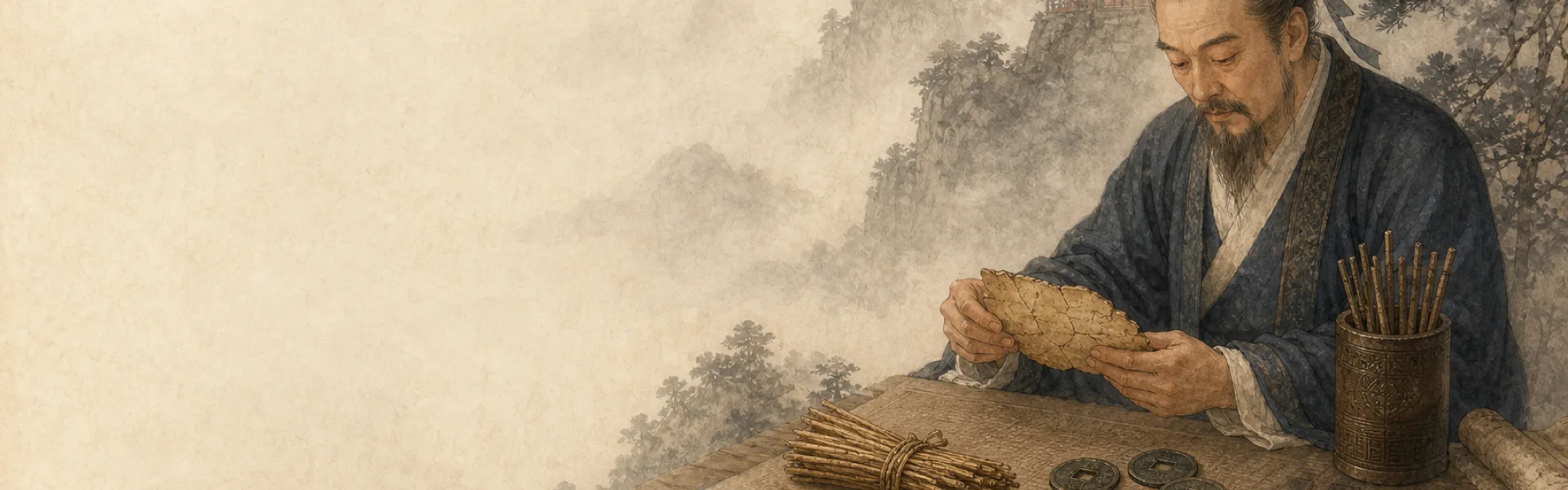
Older than writing
The practice of scorching animal bone with fire and judging the resulting cracks appears at late Neolithic sites in China, more than a thousand years before mature writing.
These early bones carry no inscriptions — only drilled hollows and burn marks. The procedure came first and the habit of recording came later, which is a small fact with large implications. Divination was not deduced from a theory of the cosmos and then put into practice. The practice existed, and the explanations were supplied afterwards to account for something people were already doing.
This order of events recurs throughout the subject, and it is worth carrying forward into every page that follows. Where a divinatory art appears to rest on an elegant cosmological principle, the principle is usually the later arrival.
The Shang: divination as government work
The oldest well-documented method is the oracle-bone divination of the Shang dynasty, practiced in the second millennium BCE. Shang kings sought guidance from their ancestors and from the high god Di on matters ranging from harvests and warfare to childbirth and the weather. A diviner would apply an intense heat source to a prepared turtle shell or ox scapula until it cracked, and the pattern of cracks was interpreted as a response. The question, and often the outcome, was then inscribed beside the crack in the characters we now call oracle-bone script. Tens of thousands of these inscribed bones have survived, and they are our single most important source for the language, religion, and royal affairs of the period.
The Zhou: milfoil rises and the Zhouyi takes shape
By the time of the Zhou dynasty, which followed the Shang, a second great method had come to the fore. This was milfoil divination, which used the dried stalks of the yarrow plant. Through a careful procedure of counting and dividing the stalks, the diviner generated a series of numbers that were translated into the broken and unbroken lines of a hexagram. The sixty-four hexagrams and their associated texts were gathered into the Zhou Yi, the Changes of Zhou, which later generations expanded and revered as the Yijing, the Book of Changes. Where oracle-bone divination had been the exclusive business of the royal house, the Yijing gradually became the shared inheritance of the educated class. The transformation of the Yijing from a divination manual into a philosophical classic was one of the most important developments in Chinese intellectual history. During the Warring States and Han periods, a body of commentary known as the Ten Wings was attached to the text, reading the hexagrams as a comprehensive account of change, balance, and the interplay of yin and yang. From that point on, the Yijing was studied not only as a way to consult the future but as a map of the cosmos and a guide to wise conduct, cited by philosophers, statesmen, and moralists for the next two thousand years.
The Zuozhuan and Guoyu preserve several dozen records of actual consultations, and they are the most reliable pre-Qin evidence we have for how divination was really conducted. What they show is unexpected. The interpretive method of the period was strikingly free. A reader would take the hexagram's images, draw an analogy with a historical episode, extend it as the situation suggested, and reach a judgement — none of it bound by the fixed rules of correspondence that later became standard. The rigid interpretive apparatus familiar from later manuals was not the original practice; it accumulated over centuries, and its imposition narrowed a genuinely literary art into a mechanical one.
The Warring States, Qin and Han: branching and canonisation
From the Warring States onward the divinatory arts subdivided rapidly, and divination proper became one branch among many. Sima Qian gave the Shiji separate chapters for turtle-and-milfoil specialists and for day-selection specialists, and his own posture is worth noting: he records the practices carefully while declining to vouch for their results.
The excavated Qin Daybooks from Shuihudi show what ordinary use looked like — prohibitions and permissions for travelling, marrying, building and childbirth, at a density far beyond what a modern reader would expect.
The decisive Han development was the admission of the Yi to the canon. Image-and-number scholarship followed, and Jing Fang, Meng Xi and Jiao Yanshou wove the hexagrams together with the calendar, the pitch pipes and the stem-and-branch cycle. At the same time apocryphal prognostication texts entered politics under divination's name, which is where the state's anxiety about the subject begins.
From the Wei-Jin to the Tang and Song: the techniques settle
The Wei, Jin and Southern Dynasties left biographies of celebrated diviners such as Guan Lu and Guo Pu — excellent stories, and impossible to verify. The Yilin, attributed to Jiao Yanshou, supplies a large body of verses for every hexagram and represents an early attempt to standardise divinatory answers.
The consequential change came under the Tang and Song. Coin casting combined with a full interpretive apparatus — the assignment of stems and branches to lines, the six relatives, the concept of a governing line — matured into the system still used today, and the Huozhulin, attributed to the Hemp-Robed Taoist, is the early representative of that line.
In the same period, printing made temple lots widely available, and sets of numbered oracle poems spread through temples across the country. Two things were happening at once: the specialist methods were becoming more technical, and the popular methods were becoming easier.
Ming and Qing: popularisation and specialisation together
The Ming and Qing pushed in both directions simultaneously.
On the popular side, works such as the Zengshan Buyi and the Bushi Zhengzong teach hexagram casting and judgement through large numbers of worked examples, addressed to ordinary readers rather than to scholars. This is when divination became something a literate person could learn from a book without a teacher.
On the specialist side, Taiyi, Qimen Dunjia and Liuren — collectively the "three systems" — developed into intricate self-contained disciplines that scholars regarded as advanced learning.
The Siku Quanshu collected a number of divination works, and its editorial abstracts take the same guarded line as with physiognomy and feng shui: preserve the textual lineage, decline to endorse the efficacy.
An elegant reversal: divination becomes historical evidence
Around 1899 inscribed bones came to the attention of Wang Yirong, and over the following decades Luo Zhenyu, Wang Guowei, Dong Zuobin, Guo Moruo and Chen Mengjia built oracle-bone studies into a discipline.
Its most striking achievement was Wang Guowei's use of the ancestral names in the inscriptions to check the Shang royal genealogy recorded in the Shiji. The inscriptions confirmed that the transmitted account was substantially reliable, and corrected it where it was wrong. A text written a thousand years after the events was verified against contemporary documents that had been buried the whole time.
This deserves a moment's reflection. These bones were made in order to know the future, and they did not achieve it. Three thousand years later they became one of the most reliable sources we have for knowing the past. Divination did not deliver what it promised, and gave us something else instead — which is, in miniature, the argument of this entire section.
The modern period
Divination was criticised repeatedly from the late Qing onward, suspended for a long period on the mainland after 1949, and continued without interruption in Hong Kong, Taiwan and Southeast Asia. It returned from the 1980s in substantially altered form: hexagrams are cast by software, consultations are conducted online, and six-line divination sits on the same web page as tarot.
At the same time, oracle-bone studies, Yijing scholarship and the history of the divinatory arts became serious academic fields. The participants in these two developments are, by and large, different people.
Any account of Chinese divination today has to keep both in view: a trade that is still operating, and a scholarship that treats it as an object of study. Conflating them — citing academic prestige on behalf of commercial practice — is one of the commonest moves in popular writing on the subject, and one of the least justified.
Two official attitudes at once
Governments through the imperial period both used divination and guarded against it, and the reason is not hard to see.
They used it because sacrifice, warfare, construction and the choosing of dates all required it, and because bureaus such as the Astronomical Bureau existed precisely to observe and to calculate.
They guarded against it because the moment someone claims to have calculated a change of dynasty or a transfer of the mandate, the matter has stopped being technical and become political. Imperial law accordingly maintained official divinatory institutions while prohibiting private study of astronomy and private possession of prognostication texts, with severe penalties for anyone using divination to spread sedition. Han apocrypha had intervened directly in imperial succession, and every subsequent dynasty was sensitive about it.
This double posture is exactly the one the court took towards feng shui. The technique was never really the issue; who had the authority to make pronouncements about the future was.
Key points
The earliest chapters of Chinese divination are also the earliest chapters of Chinese writing.
Shang oracle-bone divination, from the second millennium BCE, is the oldest well-documented method.
Shang kings put questions to their ancestors and to the high god Di, and the answers were inscribed.
Under the Zhou, milfoil stalk divination came to the fore and led toward the Yijing.
Around these classical methods grew simpler techniques such as coin divination.
Divination was never fixed doctrine but a tradition that absorbed new methods over time.
Sources drawn on for this article include: David N. Keightley's studies of Shang oracle-bone divination, Richard J. Smith's histories of Chinese divination and the Yijing, and general scholarship on early Chinese religion and the Book of Changes.