Correlative Cosmology: Body, Seasons & the Cosmos
天人相应:关联宇宙论
Behind every technique in Chinese metaphysics lies a single large idea: that the human being, the natural world and the political order are versions of one pattern, so that what happens in one register registers in the others. Scholars call this correlative cosmology. It is the assumption that makes the rest of the material hang together, and it is also the assumption most foreign to modern habits of explanation. This page sets out what the framework claims, how it reasons, what it made possible, and where it broke down.
What the framework claims
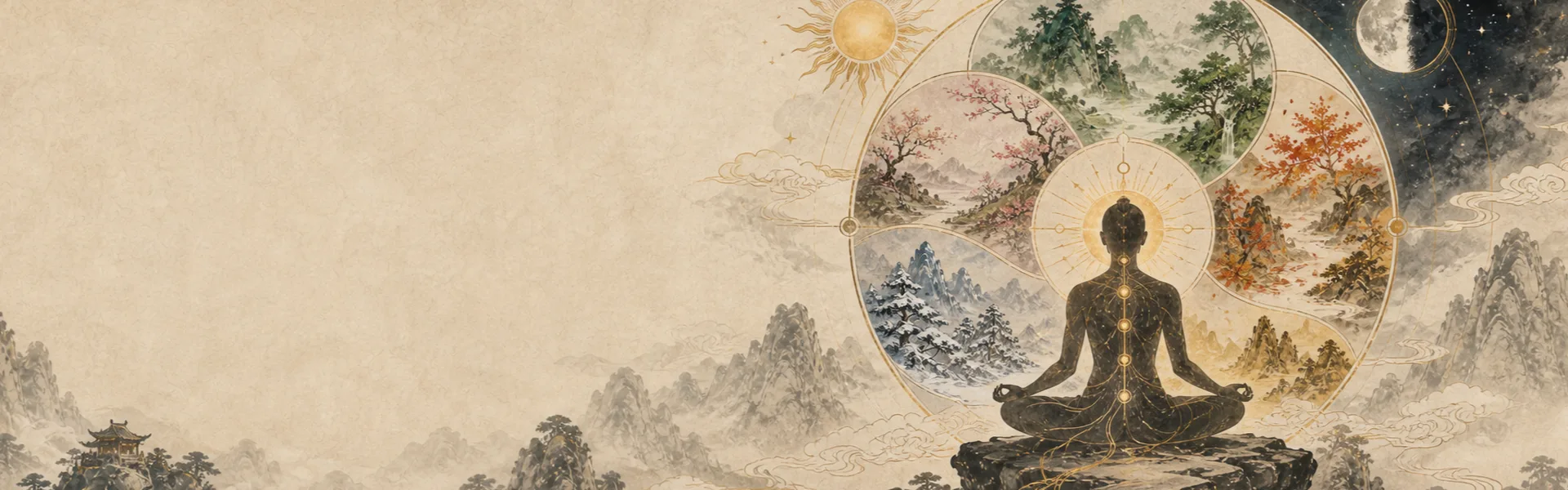
The claim is that Heaven, Earth and humanity form a single continuous system rather than three separate domains. There is no gap between the physical and the moral, or between the cosmic and the personal, that would need bridging. A season, an organ, a direction, a musical note, a colour, an emotion and a form of conduct can belong to the same category, and things in the same category are held to affect one another. The framework is usually summarised in the phrase about Heaven and humanity forming one body, and its practical consequence is that a well-ordered life is one aligned with a pattern already present in the world.
Resonance rather than cause
The mechanism, if it can be called that, is resonance rather than causation. In a causal account A produces B by acting on it, through contact or a chain of intermediaries. In a resonance account A and B move together because they share a category, with no push required and no intermediary needed. This is why the sources are so often silent on the question a modern reader most wants answered, which is how the influence gets from one place to another. In this framework the question does not arise, because nothing has to travel. Grasping that difference is the single most useful thing you can do to read these texts sympathetically.
The standard demonstration
Chinese writers had a favourite example: two stringed instruments tuned alike, where plucking a string on one sets the corresponding string on the other sounding without being touched. Sympathetic vibration is a real phenomenon and it looks exactly like action at a distance between things of the same kind. Han authors used it repeatedly as proof that resonance was an established fact of nature requiring only extension to other domains. The reasoning is understandable and the analogy was persuasive for a very long time, but the case is weaker than it appears, since sympathetic vibration works through air and depends on matching frequency, not on membership of a symbolic category.
The body as a small version of the whole
The human body was read as a miniature of the cosmos, and the parallels were worked out in detail. The body has a set number of joints answering to the divisions of the year, channels answering to rivers, and a hierarchy of organs answering to an administration. Some correspondences were adjusted to make the counts come out right, which tells you the parallel was being maintained rather than discovered. This reading has consequences that outlast the cosmology: it supports treating illness as a disturbance of order rather than an invading entity, and it underwrites the whole project of self-cultivation, since working on yourself becomes a way of working on your relation to a larger pattern.
The body and the state
The same analogy ran in the other direction, and political and medical language borrowed from each other constantly. The heart was described as the ruler and the other organs as officials with assigned duties, while a well-governed state was described as a healthy body in which each part performs its function and nothing usurps another's role. The vocabulary of blockage, circulation and depletion applied to both. This is not merely metaphor; the framework treats the two as genuinely the same kind of system at different scales, which is why a physician's advice and a counsellor's advice could take the same form.
The seasons and the calendar of conduct
If the year has a structure and you are part of the same pattern, then conduct should follow the season. Texts of this kind prescribe in considerable detail: what to eat, when to rise, what kind of activity to undertake, what colours to wear, even which government business to conduct in which month. Spring is for beginning and encouraging growth, so executions were to be postponed; autumn is for gathering and cutting back, so it was the season for judicial severity. Some of this advice is sensible on ordinary grounds about climate and daylight. Some of it is purely a deduction from the scheme.
Directions, winds and the ordering of space
Space was organised on the same principle. Each direction carried a phase, a season, a colour, a climate, a creature and a moral quality, and the arrangement of buildings, cities and graves was expected to respect it. Rulers faced south; the north was associated with cold, darkness and the storage of what is not in use. Winds from particular quarters were held to carry particular influences, and early medical writings treat certain winds as pathogenic in a fairly literal sense. Feng shui is the most developed application of this ordering of space, and its directional calculations are unintelligible without it.
Number, music and the pitch standard
Numerical and musical correspondences were taken very seriously, more so than modern readers usually expect. The five notes of the pentatonic scale were matched to the phases, the twelve pitch standards to the months, and the lengths of pipes producing those pitches were treated as cosmically significant measurements rather than arbitrary conventions. Because of this, the standardisation of pitch pipes was a state matter with ritual weight, and a dynasty getting the pitch standard wrong was a serious matter rather than a technical one. This is a good illustration of how far the framework extended into activities that look purely practical.
Portents and the ruler's responsibility
The most politically consequential application was the reading of unusual events as comment on government. Eclipses, floods, droughts, earthquakes and monstrous births were interpreted as the response of the larger pattern to disorder at the centre, and therefore as evidence about the conduct of the ruler. This cut both ways in practice. It gave officials a language for criticising a monarch that was very difficult to dismiss, since the evidence came from Heaven rather than from a subject. It also gave rulers reason to sponsor careful astronomical observation, which produced records of real scientific value.
How this differs from Greek explanation
The contrast with Greek natural philosophy is instructive without needing to rank the two. Greek thinkers characteristically asked what things are made of and what causes change, seeking explanation in substance and mechanism, and their arguments proceed by definition and refutation. Chinese correlative thinking asked how things are patterned and what corresponds to what, seeking explanation in position within a system, and its arguments proceed by demonstrating fit. One approach is well suited to isolating variables and eventually to experiment; the other is well suited to describing complex interdependent processes. Each did some things the other did badly.
What the framework made possible
It would be a mistake to treat this only as an error to be explained away. The framework produced an integrated body of medical practice that organised centuries of observation and remains in use. It motivated sustained astronomical and calendrical work of high quality, since getting the pattern right mattered. It supported a strong tradition of thinking about timing, cycles and the indirect consequences of intervention. It gave architecture and city planning a coherent set of principles. And it provided a language in which physical health, moral conduct and social order could be discussed together, which is something modern specialised vocabularies find difficult.
Where it broke down
The framework's weakness is that it cannot be wrong. Because correspondences are numerous and can be selected after the fact, any event can be fitted to the pattern, and a failed prediction can always be attributed to a correspondence not previously noticed. This makes it unfalsifiable in the strict sense, and it also made the system conservative, since a scheme endorsed as official cosmology and tied to dynastic legitimacy was politically costly to revise. The result was a framework that absorbed new observations by accommodation rather than being changed by them, which is a large part of why its shape altered so little over two thousand years.
What survives of it now
Rather more than you might expect, though usually detached from the cosmology. Chinese medicine retains the framework as its working language. Feng shui retains the spatial ordering. Fate calculation retains the calendrical correspondences. Seasonal dietary and lifestyle advice circulates widely, often without any awareness of its origin. And the general intuition it expresses, that a person is continuous with an environment and that health means an appropriate relationship with a larger pattern, has proved durable and is not obviously mistaken, even where the specific correspondences it was built from no longer persuade anyone.
Key points
- Correlative cosmology treats Heaven, Earth and humanity as one continuous patterned system rather than separate domains.
- Its mechanism is resonance between things of the same category, not causation, so nothing has to travel.
- Sympathetic vibration in tuned strings was the favourite demonstration, and the analogy is weaker than it looks.
- The body was read as a miniature cosmos and also as a state, with medical and political language borrowing freely.
- The framework produced real achievements in medicine, calendar science and astronomy alongside its errors.
- Its fatal weakness is that it can accommodate any observation, which made it both untestable and highly conservative.