The Five Phases: Wood, Fire, Earth, Metal & Water
五行:五种运行
Wood, Fire, Earth, Metal and Water are the five terms that organise an enormous amount of Chinese thought, from acupuncture to swordsmanship to the layout of a courtyard. This page explains what each of the five actually denotes, why the usual English name for them is misleading, how the correspondence tables work and where they came from, and what sort of reliability you should expect from the system. The relations between the phases are important enough to have their own page; here the concern is the five terms themselves.
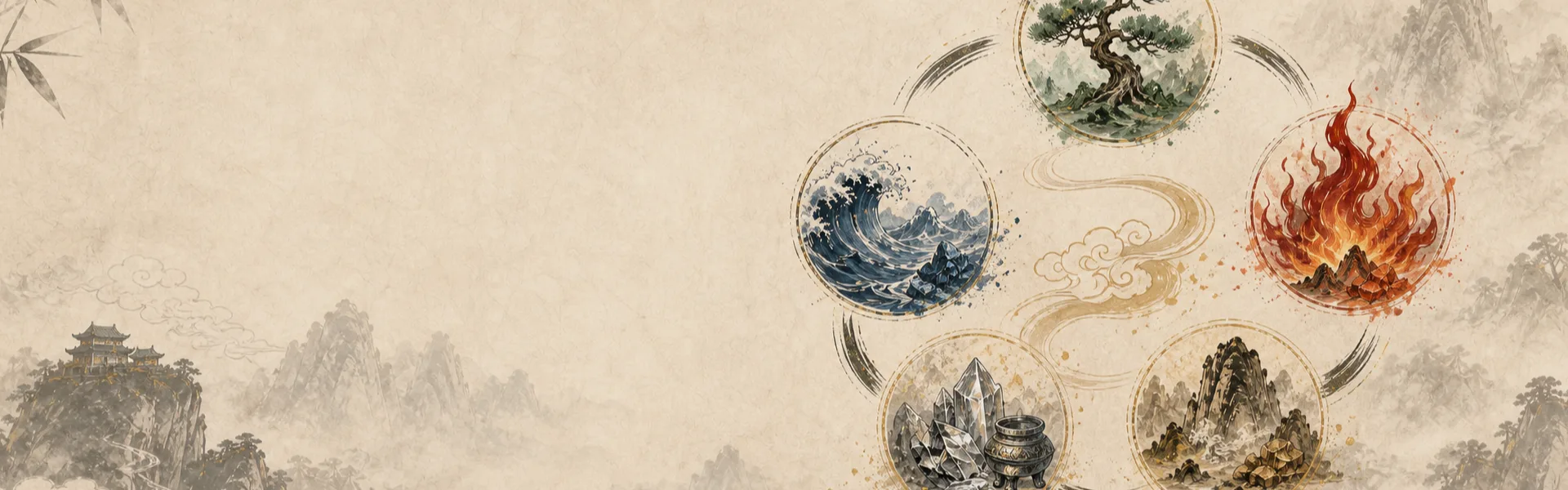
Why phases rather than elements
The standard English rendering, five elements, is unfortunate because it invites comparison with the Greek elements of earth, air, fire and water, which were proposed as the substances things are made of. The Chinese five are not substances. The word translated as element or phase means something closer to going, moving or conduct, so the whole term is better read as the five movements or five modes of process. Each is identified by a characteristic behaviour rather than by a material. Nothing in the system asserts that a tree is composed of Wood, and translations using phase or agent keep you pointed in the right direction.
Wood: expansion and upward growth
Wood names the mode of active outward growth, the movement of something pushing upward and outward against resistance. Its natural image is a shoot breaking through soil or a branch extending. Its season is spring, its direction east, its climate wind, and its colour green or blue-green, a single Chinese colour term covering both. In the body it is associated with the liver and gall bladder, with the sinews, with the eyes, and with the emotion of anger, which the tradition understands as the same expansive force turned obstructive. The characteristic Wood pathology is either stagnation, where the expansive movement is blocked, or excess, where it overruns what should restrain it.
Fire: maximum activity and dispersal
Fire names activity at its peak, movement that radiates upward and outward in all directions with nothing held back. Its season is summer, its direction south, its climate heat, its colour red. In the body it governs the heart and small intestine, the blood vessels, the tongue, and the emotion of joy, which at excess becomes agitation rather than contentment. Fire is also linked in medical theory to consciousness and the clarity of the mind, which is why disturbances of speech and awareness are classified here. Its typical disorders involve heat, restlessness, insomnia and inflammation, and its deficiency shows as cold and lack of animation.
Earth: stability, mediation and nourishment
Earth names the mode of stabilising, centring and transforming one thing into another. Its natural image is soil receiving and converting. It is assigned to late summer or to the transitions between seasons, its direction is the centre, its climate damp, its colour yellow. In the body it governs the spleen and stomach, the flesh, the mouth, and the emotion of worry or overthinking. Earth is the phase of digestion in the broadest sense, meaning the conversion of what is taken in into what can be used, and its disorders characteristically involve poor transformation: bloating, heaviness, loose stools, fatigue after eating.
Metal: contraction, refinement and separation
Metal names the mode of drawing inward, condensing, and separating what is to be kept from what is to be released. Its natural images are the blade that divides and the ore refined to purity. Its season is autumn, its direction west, its climate dryness, its colour white. In the body it governs the lungs and large intestine, the skin, the nose, and the emotion of grief. The connection between lungs, skin and letting go is a good illustration of how the system reasons: all three are boundaries that take in and release, so they are grouped by function rather than by anatomy. Metal disorders involve dryness, weak defences at the surface, and failure to let go.
Water: stillness, storage and descent
Water names the mode of sinking, stilling and storing, the movement that goes down and inward and conserves. Its season is winter, its direction north, its climate cold, its colour black or very dark. In the body it governs the kidneys and bladder, the bones and marrow, the ears, and the emotion of fear. Water is also the phase associated with deep reserves and with the constitutional basis a person is born with, which in medical thought is drawn on throughout life and only partly replenished. Its disorders involve depletion, cold, weakness of the lower back and knees, and problems of development and ageing.
The awkward position of Earth
Earth does not fit the scheme as neatly as the others, and it is worth knowing this rather than being puzzled by it later. Four phases match four seasons and four directions with no difficulty. Earth is the fifth, and the sources handle it in at least two incompatible ways. Sometimes it is placed at the centre, outside the cycle, mediating among the other four; sometimes it is given a season, either a short late-summer period or brief intervals between each pair of seasons. Both arrangements appear in respectable texts, and they cannot be reconciled. This is one of the visible seams left by the merging of originally separate schemes.
The two cycles, in brief
The five names alone do very little analytic work; the relations between them do almost all of it. In the generating sequence Wood feeds Fire, Fire produces the ash that is Earth, Earth bears Metal, Metal gathers Water, and Water nourishes Wood. In the controlling sequence Water quenches Fire, Fire melts Metal, Metal cuts Wood, Wood breaks up Earth, and Earth contains Water. A five-phase reading always considers both directions at once, asking what is supplying a situation and what is checking it. Because these relations matter so much, they are treated in detail on their own page.
The web of correspondences
Each phase gathers a long list of associated items: seasons, directions, colours, flavours, organs, tissues, sense organs, emotions, climates, planets, notes of the pentatonic scale, numbers, animals and much else. Tabulated, these form the correspondence tables you will find in most introductions. The tables are genuinely useful as a memory aid and as a way of seeing the system's shape at a glance, but they mislead if you read them as a list of facts. Their real function is to let a practitioner move between domains: noticing a pattern in a patient's complexion, taste preferences, sleep and temperament, and recognising these as a single configuration.
Where the correspondences came from
They came from several places, and being honest about this helps. Some are straightforward observation: spring really is when plants shoot, and autumn really is drier in much of northern China. Some are linguistic or visual associations, where the character or the appearance of a thing suggested the category. Some are structural, filling a slot because the system required five of something, which is how the pentatonic notes and the planets were fitted in. And some were adjusted over time to remove inconsistencies, which is why different sources occasionally disagree. Treating the whole table as if every entry rested on the same kind of evidence is a mistake.
The phases in medicine
Medicine is where the system was worked out in the most detail, and it repays study as the clearest example of the reasoning. A practitioner uses the phases to convert scattered signs into a pattern with a direction of treatment attached. Persistent irritability, tight sinews, headaches at the temples and a tendency to digestive upset under stress can be read as Wood constrained and overrunning Earth, which points toward easing the constraint rather than treating the stomach directly. Whether or not you accept the underlying theory, this is a coherent method for organising clinical observation, and it is why five-phase language survives in practice.
The phases beyond medicine
The same five terms appear across a striking range of activities. Xingyiquan names its five basic fists after the phases and uses the generating and controlling relations to explain how techniques answer one another. Feng shui assigns phases to directions, shapes and materials, so that a pointed roof is read as Fire and a low flat form as Earth. Fate calculation converts a birth moment into phase values and weighs which are strong and which absent. Dynastic historians used phase succession to argue about legitimacy. Cooking, music theory and the timing of ritual all draw on it. The scheme functioned as a general-purpose organising language rather than a specialist doctrine.
What kind of system this is
It is a classification scheme with rules for reasoning about relationships, and it should be judged as such. Its strengths are real: it is compact, it handles cycles and mutual influence well, it forces attention to context rather than isolated causes, and in medicine it organised centuries of careful observation into a transmissible form. Its weakness is equally real. With five categories and dozens of correspondences, some explanation can be constructed for any outcome after the event, which means the scheme cannot be tested against evidence. The useful attitude is to take it seriously as a language for thinking about process while declining to treat it as demonstrated fact.
Key points
- The five are modes of process identified by characteristic behaviour, not substances things are made of.
- Wood expands, Fire disperses at peak activity, Earth stabilises and transforms, Metal contracts and separates, Water sinks and stores.
- Earth fits the scheme badly, being placed either at the centre or in seasonal intervals, and the sources do not agree.
- The five names matter far less than the generating and controlling relations between them.
- The correspondence tables mix careful observation, loose association and slots filled to complete the pattern.
- The system is a strong organising language for process and a weak theory in the testable sense.